Nozzles for Agricultural Irrigation Sprinklers: Match Both Outlets Before Ordering
Identify the head and both outlet positions, recover the approved nozzle pair and confirm a service part before ordering a replacement or complete head.
Published by IrriNex Store

Buying nozzles for agricultural irrigation sprinklers starts with identifying the complete outlet arrangement on the installed head. On a double-nozzle impact sprinkler, a request for “the large nozzle” leaves the second outlet and the approved combination unresolved. Record the head model, both nozzle markings and their positions before asking for parts. A worn opening, a familiar color or a matching-looking thread cannot establish the original specification. A dual-nozzle sprinkler replacement pair should come from the exact head record, not from the size of only one visible outlet.
The practical aim is to restore a confirmed configuration without introducing a different water demand or spray pattern by accident. Keep the two outlets associated with the same head throughout inspection, quotation and receipt. Then compare an identified service part with a complete-head offer if a separate replacement cannot be confirmed.
Which two outlets are fitted to this agricultural sprinkler?
Assign the affected sprinkler a location such as block, lateral and station number. Photograph the whole assembly, its model label and each visible outlet from useful angles. Include the riser connection in a separate image so the supplier can distinguish the head inlet from a nozzle attachment. Copy every letter, number and suffix that remains legible; S30-1 and S30-2 are separate model identities even when part of their listed specification is shared.
On the sketch, label the main and secondary outlet positions using the manufacturer's terminology where available. If their roles are uncertain, label them A and B and show exactly where each is located. Record the marking on each outlet independently. Do not decide which service reference belongs in a position merely because one opening looks larger in a photograph.
Record an absent, unreadable or damaged marking explicitly. A blank field might be mistaken for a single-nozzle configuration, while “secondary outlet present, marking unreadable” asks a clear question. Keep the original pieces with the identified head if removal is permitted. Loose parts from several stations become difficult to match once they are mixed in one workshop tray.
Is the weak spray caused by a nozzle or another part?
Describe what changed: one stream is distorted, an outlet appears obstructed, rotation is irregular, the near area receives less water, or several heads have shorter throw. Note when the behavior began and whether the same irrigation group was operating. Observe running equipment from a safe position; do not reach into the impact mechanism or change a nozzle while the line is pressurized.
A restricted outlet, a damaged nozzle, changed supply pressure and an incorrect previous replacement can create overlapping symptoms. A distorted stream does not prove wear, and a clean-looking opening does not prove the right part is installed. If several nearby heads change together, record the common supply condition before ordering a batch of nozzles. The repair decision needs more evidence than the appearance of one wet patch.
An adjacent working head can provide useful comparison photographs, but first verify its model and documented configuration. Field edges, different sectors or earlier repairs may intentionally carry another arrangement. Copying whichever nozzle happens to work nearby can preserve an undocumented mismatch. Use the complete-head identification guide when the body, mounting or inlet identity is also unresolved.
Inspect safely without changing the evidence
Follow the installed system's procedure to stop the pump or supply, prevent automatic restarting, isolate the relevant section and release retained pressure through the designed provisions. Confirm depressurization before loosening a nozzle or head connection. Use the model's instructions to determine what the operator may remove and how to support the assembly. A controller set to off does not by itself establish that all trapped pressure has gone.
Before permitted removal, photograph the outlet, its seating position and any supplied seal or retaining feature. Keep the pieces together in a labeled container. Examine visible debris, cracks, chipped edges, distorted seating and damaged attachment features. Record observations before cleaning because removing deposits can erase evidence of where an obstruction occurred. A photograph beside a scale can document external dimensions without forcing an object through the outlet.
Use only the cleaning method approved for that nozzle. Do not drill, file, ream or push wire through an opening to make the stream look better. Do not remove the secondary outlet or substitute a plug to seek more distance unless that exact alternative is documented and approved for the installation. Such changes alter the assembly and can turn a service task into an unreviewed configuration change.
Wear can change the shape and size of the opening. Measuring today's worn bore therefore cannot reconstruct its original nominal diameter reliably. Retain any readable marking and the removed part for identification, but use the original equipment record or model-specific documentation to establish the intended size. A round-looking opening and a close ruler reading are not equivalent to a verified service specification.
Recover the approved pair from records
Look for the original quotation, order label, commissioning sheet, nozzle schedule or manual tied to that exact head. Distinguish what the farm intended to install from what is present now. A label on an old packet is useful only if its association with the affected head is known. Ask the supplier to resolve conflicting records instead of selecting whichever number is easiest to read.
Preserve the complete paired notation, including its unit. For example, a catalogue entry of 5.0 × 2.5 mm should not become an order for an unspecified “5 mm nozzle.” The pair identifies more than one outlet value, but the entry alone may not identify the separate service codes, attachment details or which loose component is offered. Request a drawing or explicit position reference where that mapping is unclear.
Keep the head-to-riser connection separate from the nozzle-to-head attachment. Even a confirmed inlet size says nothing by itself about the nozzle's thread, seat, retention method or seal. Two pieces can appear to engage and still be unsuitable. Color is useful as a recorded observation; it is not a universal sizing system across brands, production versions or product families.
When the original configuration cannot be established, pause the loose-part order and submit the evidence for identification. A guessed bore combined with a plausible thread is not a complete repair specification. If the supplier proposes a different pair, ask for its model-specific operating information and an assessment of the intended block before treating it as an acceptable substitute.
Read the three complete-head listings accurately
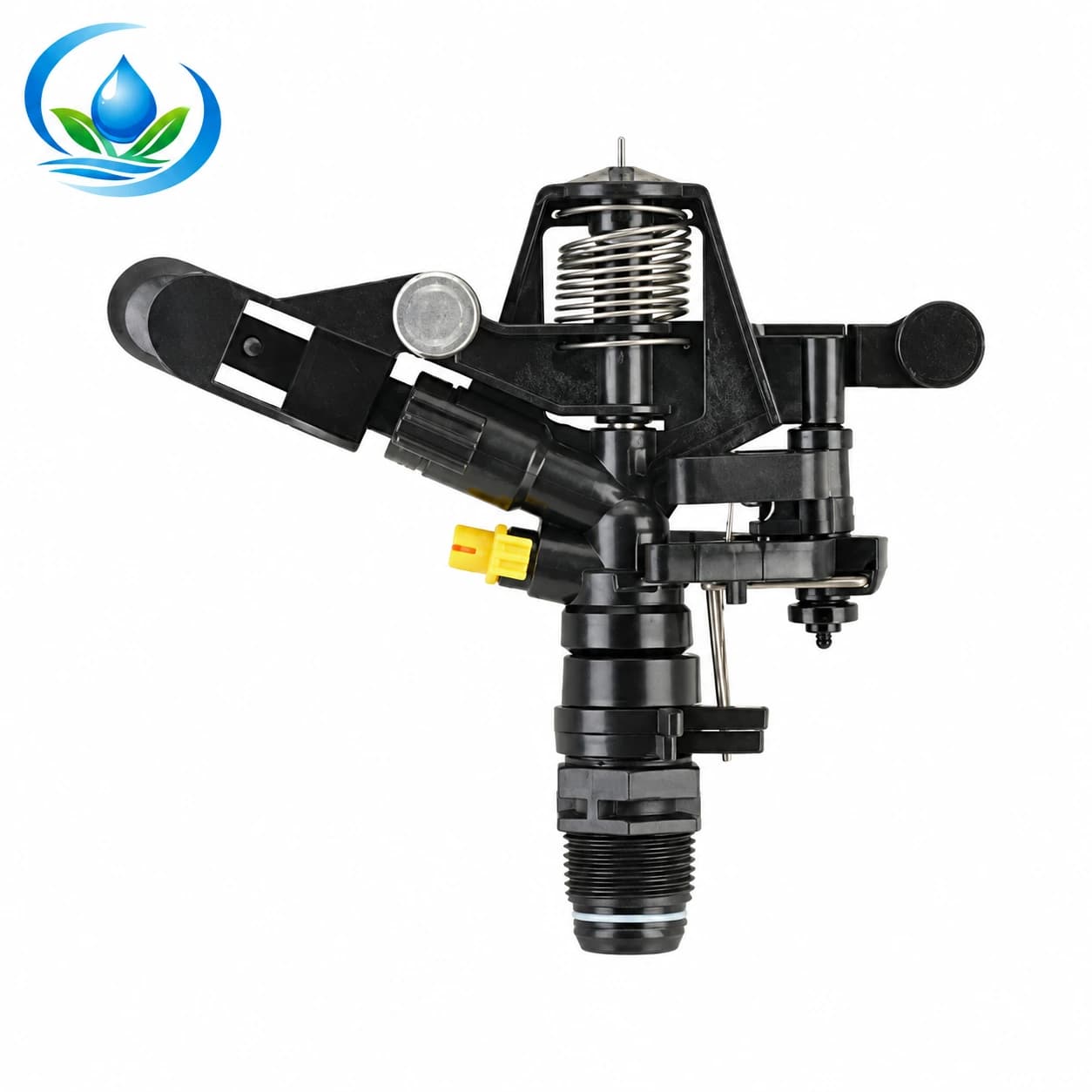
The S30-1 double-nozzle impact sprinkler is listed with the nozzle entry 5.0 × 2.5 mm. Its separate catalogue ranges are 2.0–5.0 bar pressure, 13–18 m radius and 11.6–41 L/min flow. Use the complete model reference IRRINEX-S30-1 when asking about serviceability. These values describe the listed head configuration, not a confirmed stock of individual replacement nozzles.
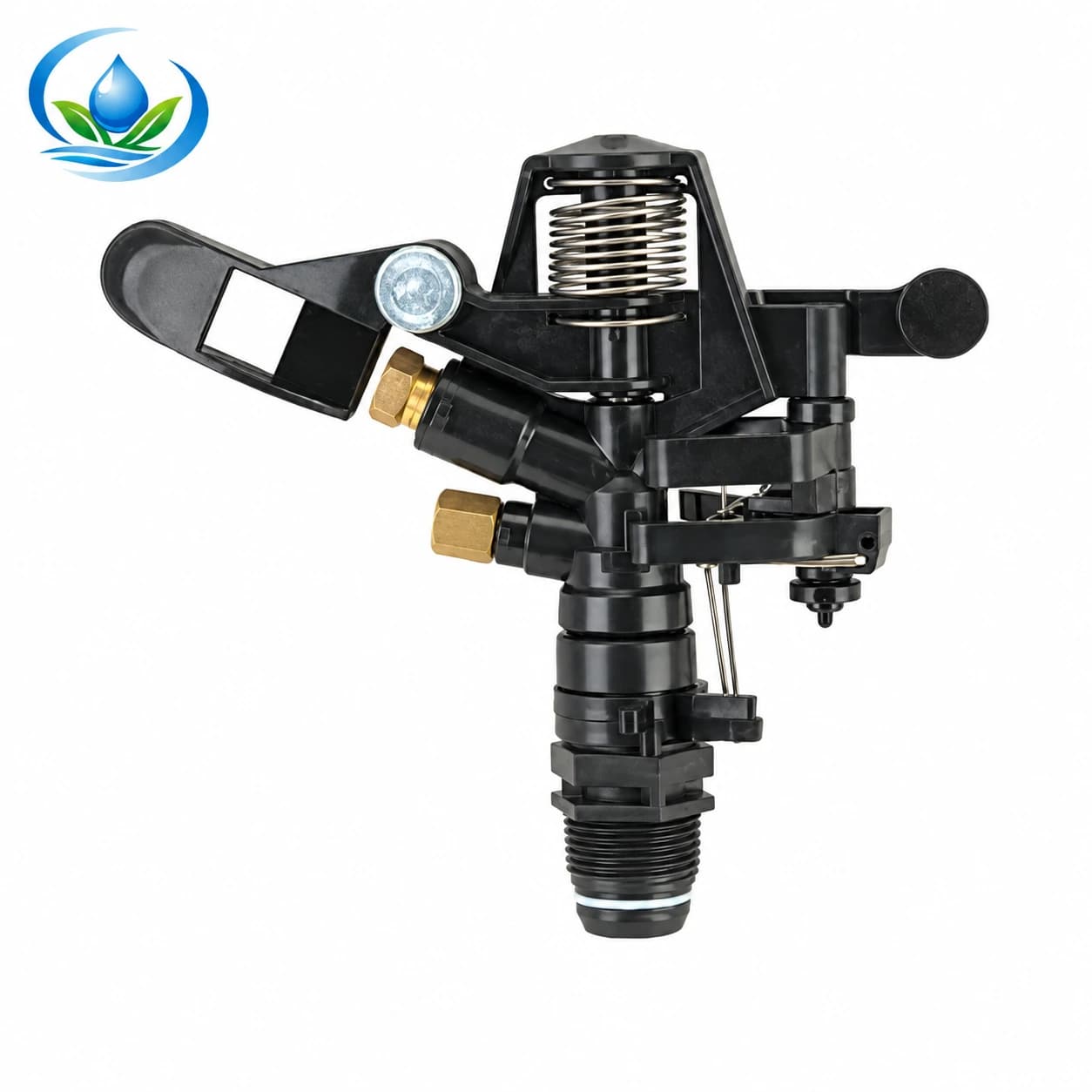
The S30-2 double-nozzle impact sprinkler also carries the 5.0 × 2.5 mm entry and those same stated pressure, radius and flow ranges. Its reference is IRRINEX-S30-2. Shared figures do not establish identical construction, interchangeable attachments or an approved nozzle swap between the two models. Keep the suffix in the enquiry and ask about the exact supplied version.
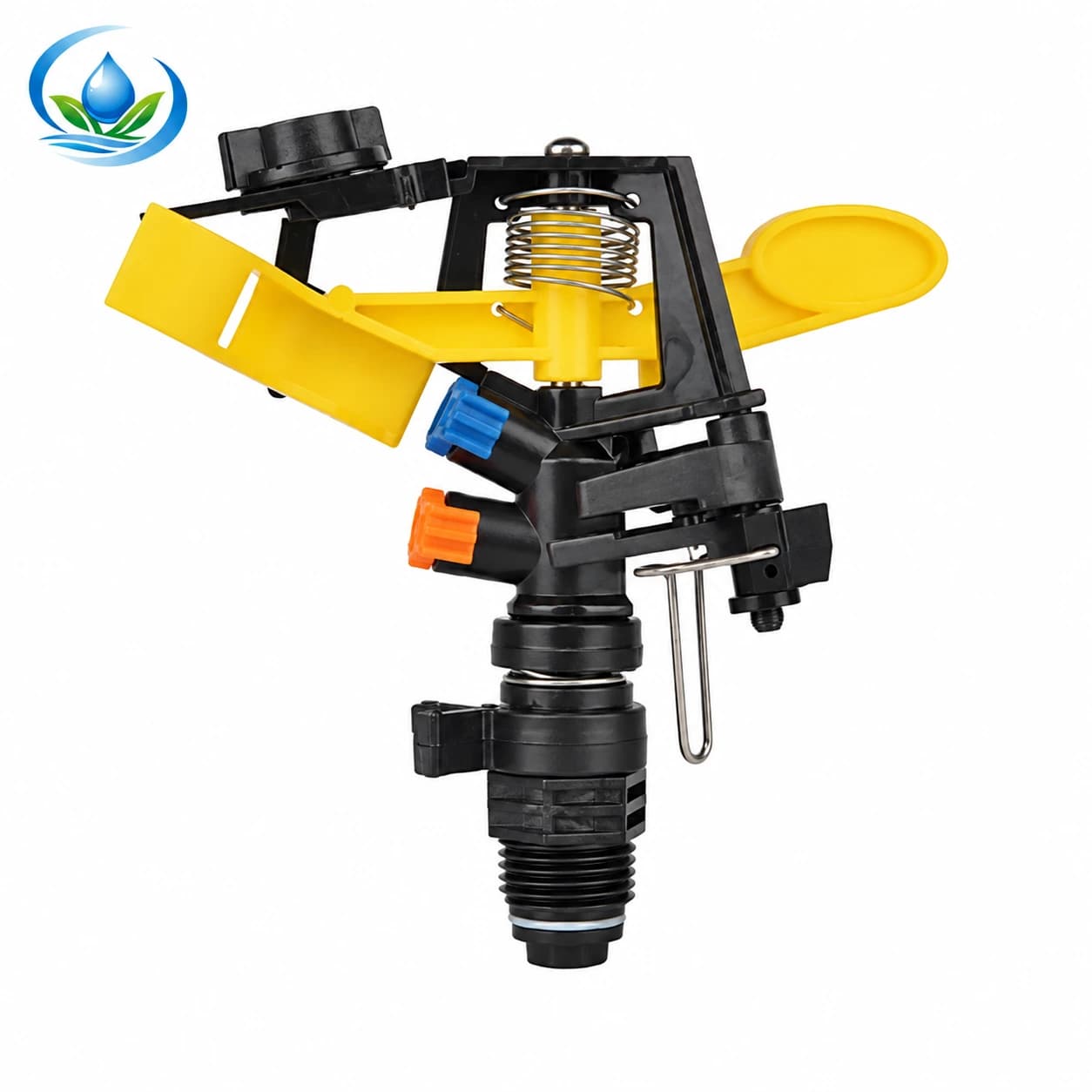
For the 9703K impact sprinkler, the recorded nozzle combination is 4.0 × 1.8 mm. Its independent entries give 1.5–3.0 bar, a 6–7 m radius and 1.1–1.3 m³/h flow. This is another complete head with its own identity, IRRINEX-9703K. Neither the smaller pair nor the lower flow range proves compatibility with an S30 body or the same field arrangement.
The catalogue ranges are not pressure-by-pressure performance tables. Do not pair their minimum or maximum endpoints to invent a tested operating point, divide total head flow between the two nozzles, or convert radius directly into a spacing recommendation. Request the relevant curve or table for the exact approved pair when a change is proposed. Current availability, price and supplied parts must be confirmed for the actual offer.
Write a parts request that keeps both outlets visible
Put the head model and location first, followed by two separate outlet records. For each, state the position, marking, documented nominal size if known, observed condition and the service reference being requested. Add the original approved pair and identify whether you want one confirmed component, both components, or a quotation for the complete head. Asking about both outlets does not mean both always require replacement.
Count affected heads and requested pieces separately. Three heads needing only a confirmed main-nozzle replacement are not automatically an order for three complete pairs. Conversely, three complete double-nozzle heads are not six loose nozzles. Have the supplier state the unit of sale and list exactly what is included: the identified nozzle, a required seal or retainer, an approved pair, or a complete assembly.
Attach close photographs and the available operating record, including pressure at a named measurement point while the intended group runs. The request should identify any proposed change from the original specification. If the complete head also has a damaged seat, attachment or mechanism, ask whether replacing only the nozzle would leave that fault unresolved. Compare repair and complete-head offers on the same documented basis.
Send the evidence to IrriNex Store support and request written confirmation of compatibility, present supply, included items and delivery terms. A product photograph showing a removable-looking nozzle does not establish that it is sold separately. Keep unanswered dimensions or service-code questions visible until they are resolved, rather than allowing the order to imply a match nobody has confirmed.
Check the received parts before fitting them
Compare the package label and the actual part markings with the accepted request. Confirm which outlet each component belongs to and keep pairs separated by head model. Check that the supplied sealing or retention pieces match the agreed contents. If an unmarked part arrives, request identification before installation instead of assigning it by color, apparent hole size or similarity to an old worn item.
Preserve the package and photograph a discrepancy before modifying or fitting anything. Follow the supplier's instructions for resolving it. Do not trim a shoulder, force a thread or enlarge an opening to make a questionable part fit. A modification can remove the very features needed to identify why the received item differs from the agreed component.
Install only the confirmed arrangement using the model's service instructions, with the section safely isolated and depressurized. Keep dirt away from open connections and use the specified sealing and tightening method. Complete any required flushing through the approved procedure before normal operation. No generic turn count or thread sealant suits every nozzle attachment.
Verify the repaired configuration and preserve a useful spare record
After correct reassembly, restart under the documented operating conditions and observe leakage, rotation and both outlet streams from a safe location. Record any remaining abnormal behavior. A new nozzle cannot compensate for inadequate supply, a damaged mechanism or an unreviewed field layout. If the change is uncertain, keep the original baseline and seek model-specific help before repeating it across the block.
Check water distribution separately when the repair changes or fails to restore the observed pattern. The field catch-test guide addresses where water arrives across the block. A larger total shown by a supply meter cannot establish that the near and far portions of the pattern are both correct. The whole-event water-use guide answers that separate volume question.
Save the confirmed head model, paired nozzle specification, outlet positions, service references and acceptance observations with the repair date. Store verified spares in labeled groups and retain the supplier's written match. Keep unidentified or worn pieces separate from usable stock. The next order can then restore a known pair instead of starting again from a damaged opening and an uncertain memory of what used to fit.
Before you order
Compare this guide with the specifications for your exact product, selected option, water supply and field conditions. Your equipment requirements take priority over a general example.
Compare irrigation products