How Much Water Does a Sprinkler System Use? Measure a Farm Block at the Meter
Use an existing suitable meter to record an irrigation event, confirm units and other users, and separate the complete volume from a steady operating rate.
Published by IrriNex Store
How much water does a sprinkler system use? For an existing farm block, a useful answer comes from the change in a suitable water meter’s cumulative reading over a defined irrigation event. Record the beginning and ending totals, confirm their unit and multiplier, and identify every outlet supplied through that meter during the interval. The difference describes water that crossed the measurement point. It can support a decision about additional sprinkler heads when the operating conditions are recorded alongside it. A sprinkler block meter reading is useful only when the start and end totals cover the same named irrigation event.
A meter total answers a different question from watching the spray or measuring catch depth. It does not show where water landed or how much remained around crop roots. Keep the volume record together with the active head count, timing and working-pressure observations, so a larger total is not mistaken automatically for better irrigation or a smaller total for a successful saving.
Which sprinkler block does this water meter reading include?
Start with the existing meter’s location on a simple supply sketch. Mark the sprinkler block, other branches, storage tanks and any bypass that affects the route. A meter on the dedicated block supply can describe that branch’s draw. A meter before several farm users measures their combined draw unless their contributions are excluded or independently accounted for. Name the result according to the boundary you actually observe.
Coordinate with the people responsible for other users before the test. A livestock trough refilling, a wash hose or another irrigation sector can add volume without any change to the sprinkler block. Use the normal authorized operating controls and choose a period when the boundary can be kept clear. If another user cannot be excluded and its volume is unknown, retain the result as a combined supply measurement rather than assigning all of it to the sprinklers.
Storage deserves particular attention. If the meter is upstream of a tank feeding irrigation, water entering the tank during the event may differ from water leaving for the field because the stored volume changes. A meter downstream of that tank describes a different boundary. Note this arrangement before calculating anything; an accurate reading at the wrong boundary can still answer the wrong purchasing question.
Is the display cumulative volume or instantaneous flow?
Use an existing meter that is suitable for the water, expected flow and installed arrangement, with permission to read it. Check its identification and available instructions. A readable dial alone does not establish that the installation meets its requirements or that it is measuring reliably. If suitability, service condition or calibration is uncertain, ask the responsible operator or qualified technician before treating the result as a precise comparison.
Find the cumulative volume register, often called the totalizer. Do not confuse it with an instantaneous rate screen showing liters per minute or cubic meters per hour. Photograph the display with its unit, decimal marks and any multiplier visible. Some meters change screens; use the same cumulative register for both readings. Record all meaningful digits in the same way, without adding decimals that the display cannot resolve.
Determine whether the displayed number already includes the scale or whether an indicated multiplier must be applied. As an independent example, a register whose instructions say each count represents 0.1 m³ advances from 8,125 to 8,167 counts. The increase is 42 counts, representing 4.2 m³. Applying that multiplier twice would give the wrong volume. Confirm the actual meter’s convention instead of inferring it from digit color or a nearby symbol.
Choose one reporting unit and preserve the original readings beside any conversion. One cubic meter equals 1,000 liters. If a record uses gallons, establish whether they are US or imperial gallons before converting. A rounded bill reading or a photograph that cuts off the last dial may lack the detail needed for a short event. Record the smallest readable increment so later comparisons do not claim a difference smaller than the instrument can show.
Define the event before taking the first reading
Write down what the measurement includes: the active sector, the number of heads, the normal startup, the intended watering interval and any flushing or other planned water use. A whole-event record can include filling empty pipe and an associated flush, provided those are identified. A record that starts only after the heads settle into normal operation excludes earlier draw. Either can be useful, but label them differently.
Take the initial cumulative reading immediately before the defined sequence begins and note the time. After the sequence is completed, take the final reading and time at the agreed endpoint, accounting for any continuing flow through the meter. Include interruptions and valve changes in the notes. If a controller pauses and restarts, retain that information instead of assuming that the programmed duration was the actual elapsed or flowing time.
Keep both readings from the same meter and register, with matching units and scale. Do not reset a cumulative register just to simplify subtraction. If a reset, meter replacement, rollover or reverse-count behavior occurs between observations, stop the simple calculation and resolve the sequence using the meter documentation and operator’s records. Taking the absolute value of an unexplained negative difference does not repair the evidence.
Subtract the totals before calculating a rate
For an unchanged cumulative register, event volume is the ending reading minus the beginning reading, with the confirmed scale applied once. Consider a hypothetical register displaying cubic meters directly: it begins at 412.68 m³ and ends at 426.18 m³. The difference is 13.50 m³, equivalent to 13,500 liters. These are arithmetic examples, not measurements from an IrriNex sprinkler installation.
| Example record | Value |
|---|---|
| Beginning cumulative volume | 412.68 m³ |
| Ending cumulative volume | 426.18 m³ |
| Water crossing the meter | 426.18 − 412.68 = 13.50 m³ |
| Equivalent volume | 13.50 × 1,000 = 13,500 L |
Mississippi State University Extension’s totalizer guidance explains using cumulative readings and the matching units to calculate irrigation volume. Preserve your original readings so someone else can check the subtraction and conversion.
If the example interval lasted 45 minutes, its average rate over that interval would be 13.50 divided by 0.75 hours, or 18 m³/h. That average includes whatever occurred within the recorded boundary and time window. It does not prove that the heads drew 18 m³/h at every moment, and it does not identify an individual head’s discharge. Keep the measured volume as the primary result for the complete event.
Measure steady operation separately when needed
A supplier may also need the block’s rate while the same heads run steadily. Take a separate pair of cumulative readings over a timed segment after the intended operating arrangement has settled, following the meter’s requirements. Record the active outlets, pressure observations and any changes during that segment. If the rate screen fluctuates, a volume difference over a suitable interval can describe the segment average more clearly than one isolated display value.
In a second, independent illustration, 2.0 m³ passes during ten minutes of unchanged operation. The segment average is 2.0 × 60 ÷ 10 = 12 m³/h. This example is separate from the 13.50 m³ event above. Multiplying 12 m³/h by a planned duration gives an estimate only if that rate remains representative for the time being estimated. A known startup, flush, interruption or change in active outlets should not disappear inside that assumption.
Likewise, timing a bucket under a fully opened tap describes flow from that tap in that arrangement. Connecting sprinklers introduces their nozzles, pipe losses and working pressure. The open-tap result cannot simply be multiplied by sprinkler runtime and called measured sprinkler use. The guide to separating source capacity from outlet demand develops that distinction for component planning.
Compare repeat events under named conditions
Give each run a record containing date, block, meter identity, start and end readings, scale, elapsed time, active head count and relevant valve settings. Include pressure readings with their measurement locations when available. Note source or tank conditions, visible leaks, wind and any maintenance since the previous run. This lets you compare two actual operating cases rather than two unexplained totals.
A larger event volume may come from a longer interval, more outlets or additional flushing, even if steady flow is unchanged. If comparable events differ unexpectedly, check the reading method and boundary before replacing equipment. An unrecorded user, changed nozzle, damaged line, altered valve position or source condition may explain the difference. The total alone cannot distinguish among them.
When changing one relevant factor, retain a baseline and repeat the measurement under comparable conditions. Compare event volumes with their durations, and compare stable segment rates separately. A lower total after shortening runtime does not demonstrate improved application. If the purpose is to investigate where the water lands, use the field catch-depth and distribution test as a separate observation, with its own locations and timing.
Use model data carefully before adding heads
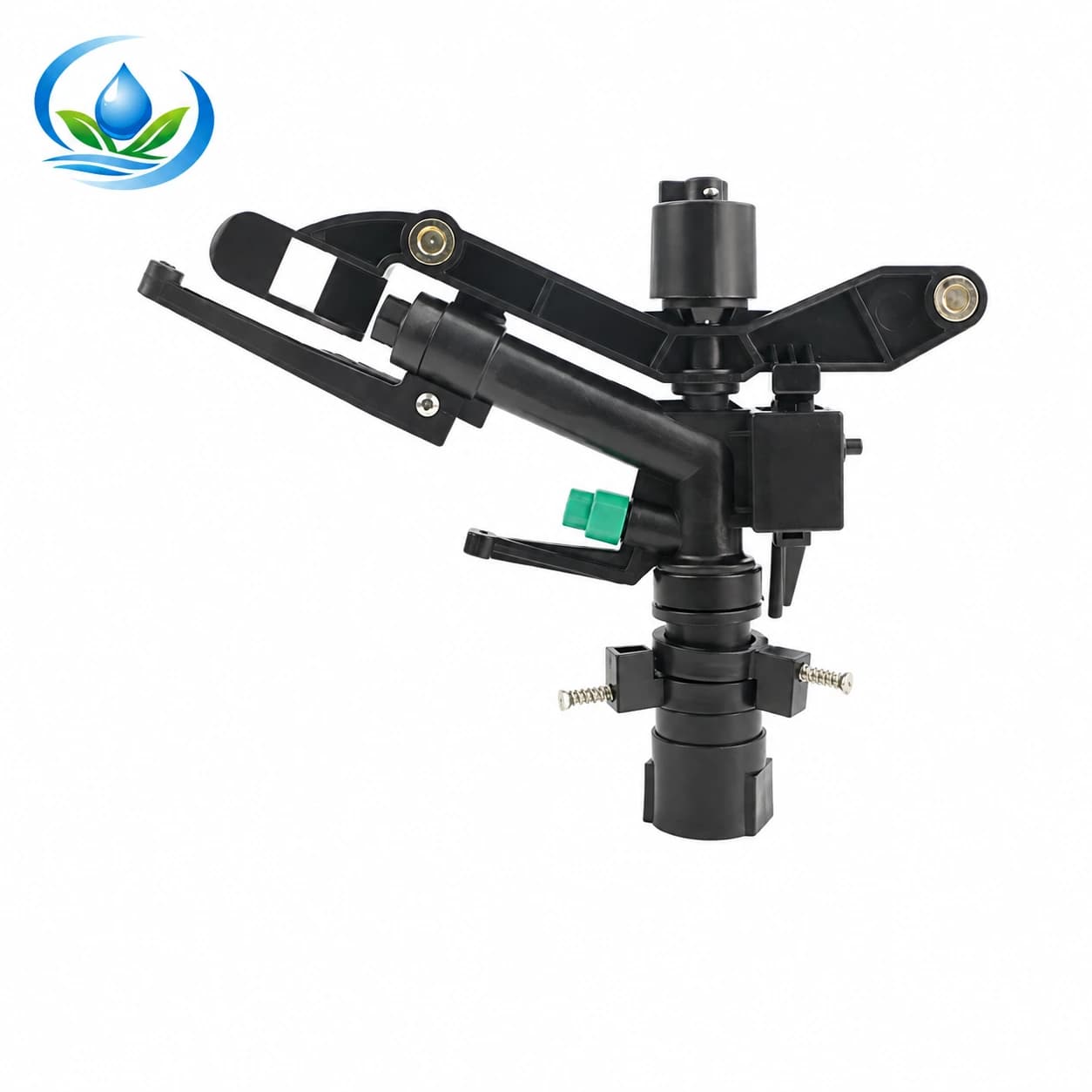
The S50 agricultural impact sprinkler has a catalogue flow range of 3.7–5.0 m³/h. That range is product information, not the measured flow of every installed S50. Its pressure and radius ranges are separate entries rather than a curve pairing all endpoints. Obtain the operating data for the nozzle and conditions being considered before estimating what an additional head would demand.
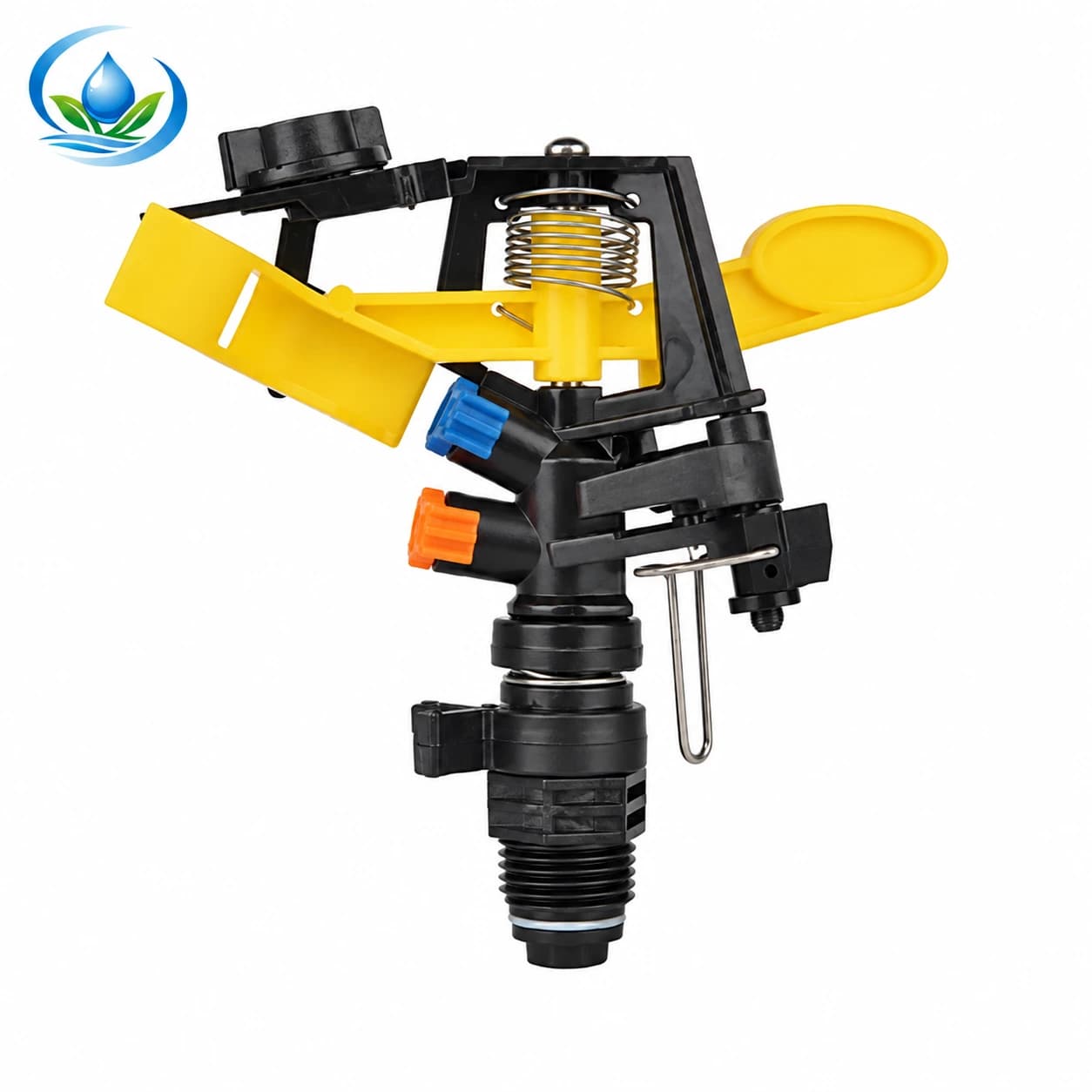
For the 9703K plastic impact sprinkler, the catalogue identifies 4.0 × 1.8 mm nozzles and gives 1.1–1.3 m³/h as the flow range. The lower range does not establish that it can replace an S50 in the same layout. Keep head identity, nozzle, pressure and distribution requirements together. The sprinkler replacement identification guide helps with the separate connection and model checks.
Do not multiply the largest catalogue flow by head count and label the result actual consumption. Conversely, dividing a block’s metered total by its number of heads does not prove that each head used an equal share: leaks, other users or different nozzles can be hidden in that average. If a supplier supplies a supported per-head working rate, use it to build a proposed demand, then compare that proposal with the measured baseline and available operating conditions.
Additional outlets can change the pressure available to existing heads, so current volume does not by itself prove spare capacity. Discuss which heads should operate together and whether the supply can support the proposed arrangement. The guide to dividing irrigation into operating blocks helps organize that question. Keep the confirmed sprinkler requirements in the calculation when applying the general planning approach.
Turn the record into a useful purchasing conversation
Water crossing the meter is not the same as water stored in the root zone. Spray outside the crop, evaporation, runoff, drainage and changes in pipe or tank storage can separate those quantities. Record visible field problems and use appropriate soil and crop information for scheduling. A volume reduction is useful only in the context of whether the intended irrigation task is still being achieved.
Send the supplier the boundary sketch, meter unit and multiplier, complete-event readings, steady segment results if taken, active head identities and pressure observations. Explain the proposed change and ask what additional model data is needed to evaluate it. Request the current offer for the exact sprinkler configuration, including availability and supplied mounting or connection parts. Retain the baseline so the effect of the eventual change can be checked with the same method.
Before you order
Compare this guide with the specifications for your exact product, selected option, water supply and field conditions. Your equipment requirements take priority over a general example.
Compare irrigation products