Sprinkler Application: Measure Water Depth Before Ordering More Field Heads
Measure a fixed field block with equal-opening collectors, a common exposure time and mapped depths before deciding whether to buy more sprinkler heads.
Published by IrriNex Store
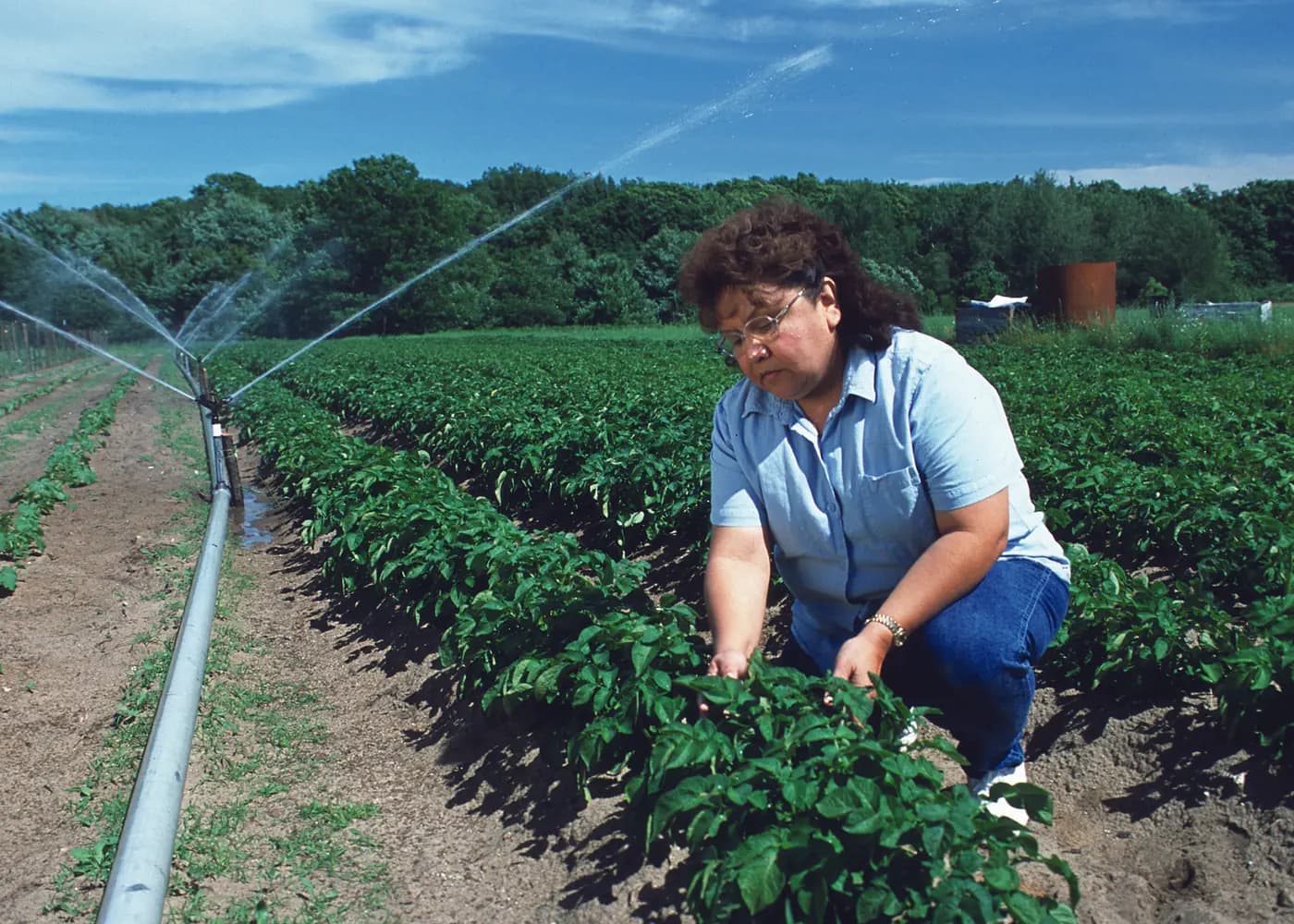
Sprinkler application should be checked where the water lands before a fixed field block receives more heads. A dry strip can result from an obstructed nozzle, changed operating pressure, wind, uneven overlap or a layout that does not suit the block. Adding outlets without identifying the cause can increase demand while leaving the original strip short of water. A timed catch test gives the purchase decision a useful starting point: water depth at named locations, the application rate during that run and the variation across the sampled area.
This guide concerns an existing block whose sprinklers stay in their working positions. It does not determine crop water requirements or certify an irrigation design. The objective is to compare a documented baseline with a controlled follow-up, then ask a supplier for the heads, nozzles or other changes supported by those observations. Keep the collected measurements even when they do not support the first explanation for a dry patch.
Define the block and the question before placing containers
Sketch the operating block, its supply entry, sprinkler positions, row directions and boundaries. Mark the outlets that run together and give the test a simple identifier. Include slopes, trees or structures that can interfere with spray. The useful question is specific: for example, whether a low-depth strip occurs between two sprinkler rows, or whether catches decrease toward the far end of the supply. A general impression that the field looks dry is harder to test and harder to turn into an accurate order.
Separate the interior pattern from boundary effects. An edge may receive a different contribution from neighboring heads, so mixing its readings silently into an interior average changes what the result represents. Use a regular arrangement of collection points covering the area you want to describe, with each point representing a comparable area. Record the spacing and the position of every point. The right number of containers depends on the layout and the detail required; four illustrative numbers in a calculation are not a recommended field sample.
If the block is large, agree which representative interior areas and which separate edge areas will be tested. Include the suspected problem rather than selecting only places that already look evenly watered. Once the positions are fixed, do not move an inconvenient container into a better spray pattern during the run. A map with missing readings clearly marked is more useful than a neat table whose locations changed without a note.
Identify the heads and the operating arrangement
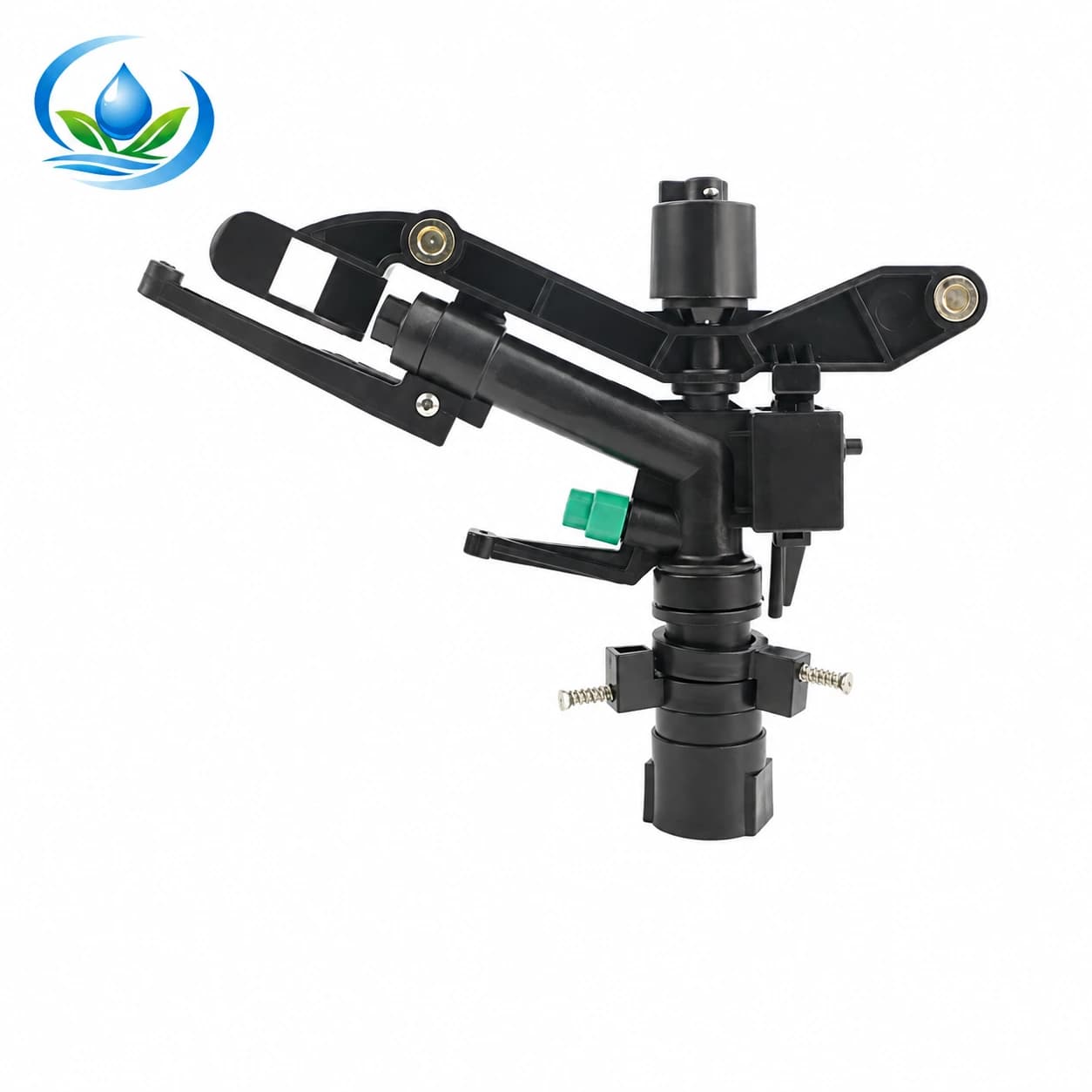
Record the model and visible nozzle markings at each relevant sprinkler, along with mounting height and condition. The IrriNex S50 impact sprinkler has a listed flow range of 3.7–5 m³/h and a listed radius of 15–17 m. Those separate catalogue ranges do not identify one tested combination of flow, radius and pressure. They also do not specify field spacing or prove that an installed head with an unidentified nozzle produces the same pattern.
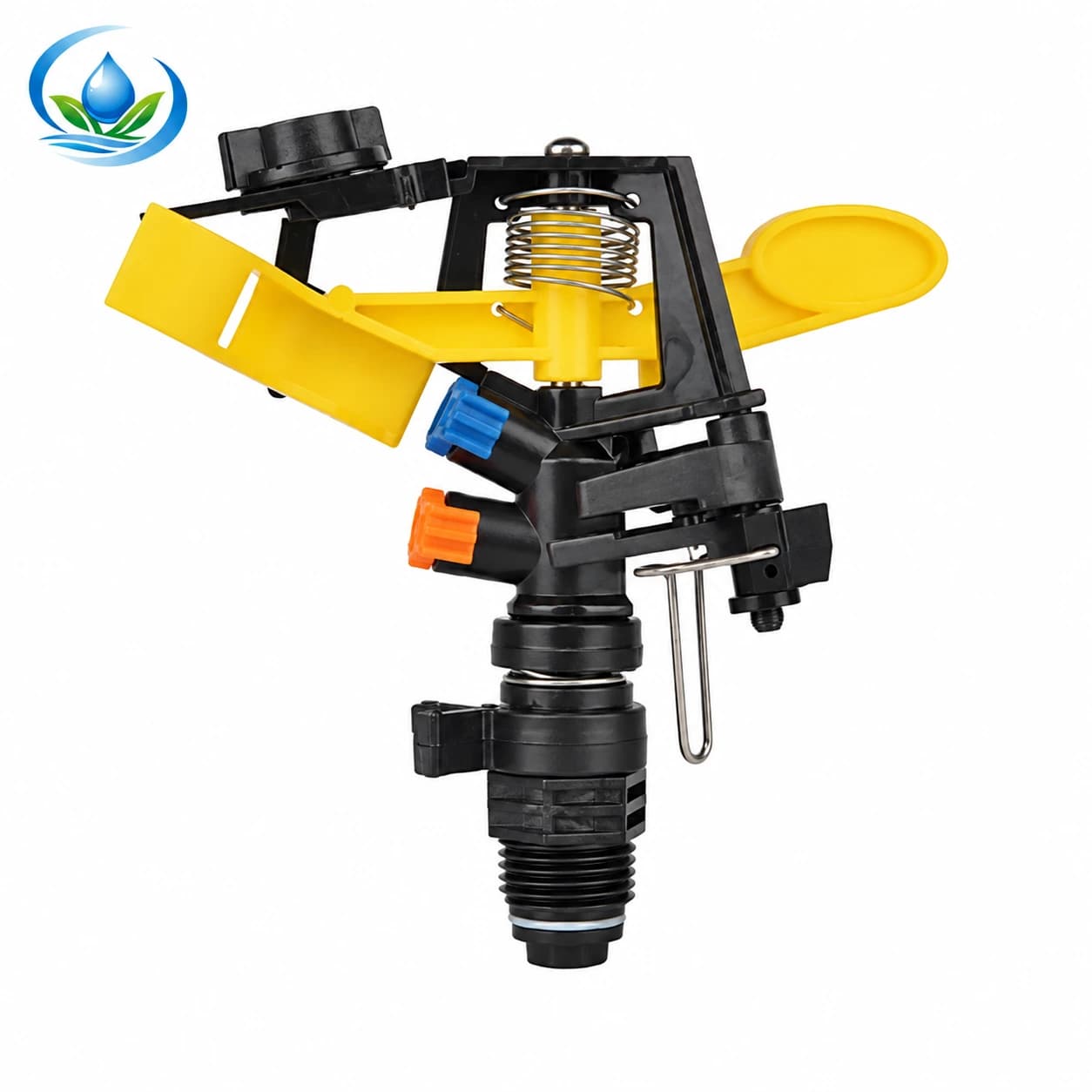
The IrriNex 9703K impact sprinkler lists a 4.0 × 1.8 mm nozzle arrangement and a flow range of 1.1–1.3 m³/h. Treat it as a separate candidate requiring its own operating data. A smaller published flow does not make it a direct substitute for an S50, and a catalogue radius is not the distance at which neighboring sprinklers should automatically be placed. For replacement identity and connection checks, use the field sprinkler replacement guide alongside the measurements.
Keep the active outlet count and valve arrangement unchanged during a baseline run. Pressure recorded with the block stopped cannot explain the conditions experienced by operating heads. If pressure measurements are available, identify their locations and take them while the same outlets are running. The distinction between a static reading and a working reading is explained in the guide to checking irrigation pressure; product-specific pressure requirements still come from the sprinkler documentation.
Use equal catch openings across the sprinkler block
Use clean collectors with equal opening areas and enough capacity for the planned run. Their openings should be horizontal, their supports stable and their placement consistent relative to the surface being assessed. Keep foliage from covering an opening and avoid positions where a support, leaf or adjacent object directs extra water into a container. Record the collection height. Raising only the collectors in the dry strip above the canopy would create a different test at those locations. A sprinkler application catch test should hold opening area and exposure time constant before comparing wet and dry positions.
A purpose-made gauge can provide a direct depth reading when used as instructed. An improvised container needs more care: the depth standing in a narrow bottle is not the water depth applied over its wider opening. For containers whose collection and storage shapes differ, measure the collected volume and use the opening area. A straight-sided container allows a direct internal depth reading only when its geometry and reading method support that conversion. Equal-looking containers are not enough if their openings differ.
Label every collector to match the map and check that it starts empty. Choose a measuring vessel with graduations fine enough to distinguish the expected catches. Write its units on the record sheet, and use the same reading method throughout. If one catch is too small to read reliably, report that limitation instead of writing an invented decimal. Photographs of the collector arrangement and the marked measuring vessel can resolve later questions about how a number was obtained.
Give every catch the same timed exposure
Plan how collection will begin and end before opening the block. One approach is to let the system settle into its normal operation, then expose and cover the collectors over the same measured interval using enough people to keep timing differences small and documented. Another test may deliberately include a complete irrigation event, including startup and shutdown. These answer different questions. Record which boundary you used and repeat that boundary when comparing runs.
Do not leave early collectors exposed while later ones are being read and then describe every catch as having the same duration. Record the start and finish times and any meaningful delay between positions. Access must remain safe around pressurized equipment and moving sprinkler streams; use a practical arrangement that does not require reaching into machinery. If the crew cannot maintain a consistent interval across the planned area, reduce the area or revise the collection method before treating the readings as comparable.
Note wind direction and its behavior during the run, not just a weather description taken earlier. Record rain, visible drift, interruptions, supply changes and unusual nozzle movement. Rain adds water that cannot be assigned to sprinkler application by the catch reading alone. An overflowing, tipped or contaminated collector is an invalid measurement, whereas a stable, unobstructed collector that genuinely receives no water can be a valid zero. Preserve that distinction in the notes.
Convert collected catch volume to depth and application rate
When volume is measured in milliliters and opening area in square centimeters, depth in millimeters equals ten times the volume divided by the opening area. The factor ten converts centimeters of depth to millimeters. As a hypothetical example, an opening measuring 10 cm by 10 cm has an area of 100 cm². A catch of 50 mL through that opening represents 5 mm of applied water. Use the actual opening area, not the base area or an outside dimension of the container.
Application rate is the measured depth divided by the exposure time in hours. The example catch of 5 mm over 20 minutes gives 15 mm/h because 20 minutes is one third of an hour. This is an observed rate at that location during that run. It is neither a recommended rate for a soil nor a claim about an S50 or 9703K. If different containers have different exposure times, converting them individually does not automatically remove startup, wind or operating differences.
| Illustrative measurement | Calculation | Meaning |
|---|---|---|
| 50 mL through a 100 cm² opening | 10 × 50 ÷ 100 = 5 mm | Depth at one collection point |
| 5 mm collected in 20 minutes | 60 × 5 ÷ 20 = 15 mm/h | Rate during that exposure |
Keep raw volumes, opening areas, times and converted depths together. That makes a misplaced decimal or a minutes-to-hours error detectable. If a balance is used instead of a graduated vessel, establish the tare and the appropriate mass-to-volume conversion for the measurement conditions; do not mix mass readings and volume readings without explaining the method. A simple, consistent volume method is often easier for a purchasing discussion than a complicated result nobody can reproduce.
Compare the spread as well as the average
For an equal-area arrangement with complete valid observations, an arithmetic mean summarizes the sampled depth. It does not show whether each part of the sample received a similar amount. Consider two hypothetical sets: 3, 4, 4 and 5 mm; and 1, 3, 5 and 7 mm. Both average 4 mm. The second set contains a much drier point and a much wetter point, a difference hidden if only the average is sent to the supplier.
Put each depth back on its mapped location. Report the minimum, maximum and average for the area represented, alongside the complete readings. Look for a repeated strip, a boundary effect or a decline along the supply rather than selecting the single lowest value as the whole diagnosis. If points represent unequal areas, a simple unweighted average can misrepresent the block. Obtain an appropriate sampling and weighting method before presenting it as a field-wide result.
UF/IFAS guidance on measuring sprinkler application uniformity explains how collection measurements help assess distribution. This practical comparison does not assign a formal uniformity rating or an acceptance threshold.
Repeat under documented conditions before changing the order
Repeat the baseline so you can see whether the observed pattern persists. Keep the collector locations, exposure method, active block and measurement method consistent, while recording any changes in wind or supply. A different pattern on a windy second run may reveal sensitivity to conditions; averaging the two maps into one apparently smooth result conceals that information. Retain each run separately and describe whether the conclusion is repeatable.
Investigate an identifiable fault before adding heads. A blocked nozzle, damaged mechanism or unintended valve setting calls for its own inspection under the equipment instructions. Change one relevant factor at a time where practical, then repeat the same mapped test. Do not alter nozzle holes or make unsupported adjustments to obtain a desired catch number. If a supplier proposes a different nozzle, pressure or spacing, ask for the applicable model data and a testable expectation under your conditions.
Adding heads also changes the demand of the active block. The component flow budgeting guide explains why outlet demand must be counted; use the selected sprinklers’ confirmed working flows in that calculation. If the proposed quantity cannot be supported together, the guide to dividing irrigation blocks can help frame a discussion about which outlets operate simultaneously.
Turn the measured pattern into a purchase brief
Catch depth describes water arriving at the collector. It does not measure how much enters the root zone. Record ponding, runoff and visibly crusted or compacted areas separately: increasing runtime or adding heads can worsen those observations even when a catch average appears low. Crop demand, soil intake and irrigation scheduling need their own assessment. Keep the purchasing question tied to the measured distribution problem that the proposed hardware change is intended to solve.
Send the supplier the block sketch, exact head and nozzle identification, active quantity, working pressure observations, collector opening area, timed readings and separate run maps. State whether the priority is a recurring dry strip, a large spread in catches or a boundary problem. Ask how the proposed change will be checked against the baseline and which operating conditions the recommendation assumes. Agree the acceptance method before ordering a large quantity.
For the proposed S50 or 9703K configuration, ask the supplier to quote its current price and delivery terms. Confirm the quantity available and exactly which fittings and mounting pieces come with it. A successful purchase brief connects each proposed change to a measured field observation and a repeatable follow-up. That gives both buyer and supplier a clearer basis for deciding whether the block needs additional heads, different operating arrangements or attention to equipment already installed.
Before you order
Compare this guide with the specifications for your exact product, selected option, water supply and field conditions. Your equipment requirements take priority over a general example.
Compare irrigation products