Agricultural Sprinkler Irrigation: Check Soil Ponding Before Changing Heads
Map when and where soil ponds, then compare incoming water and soil response before replacing field sprinklers.
Published by IrriNex Store
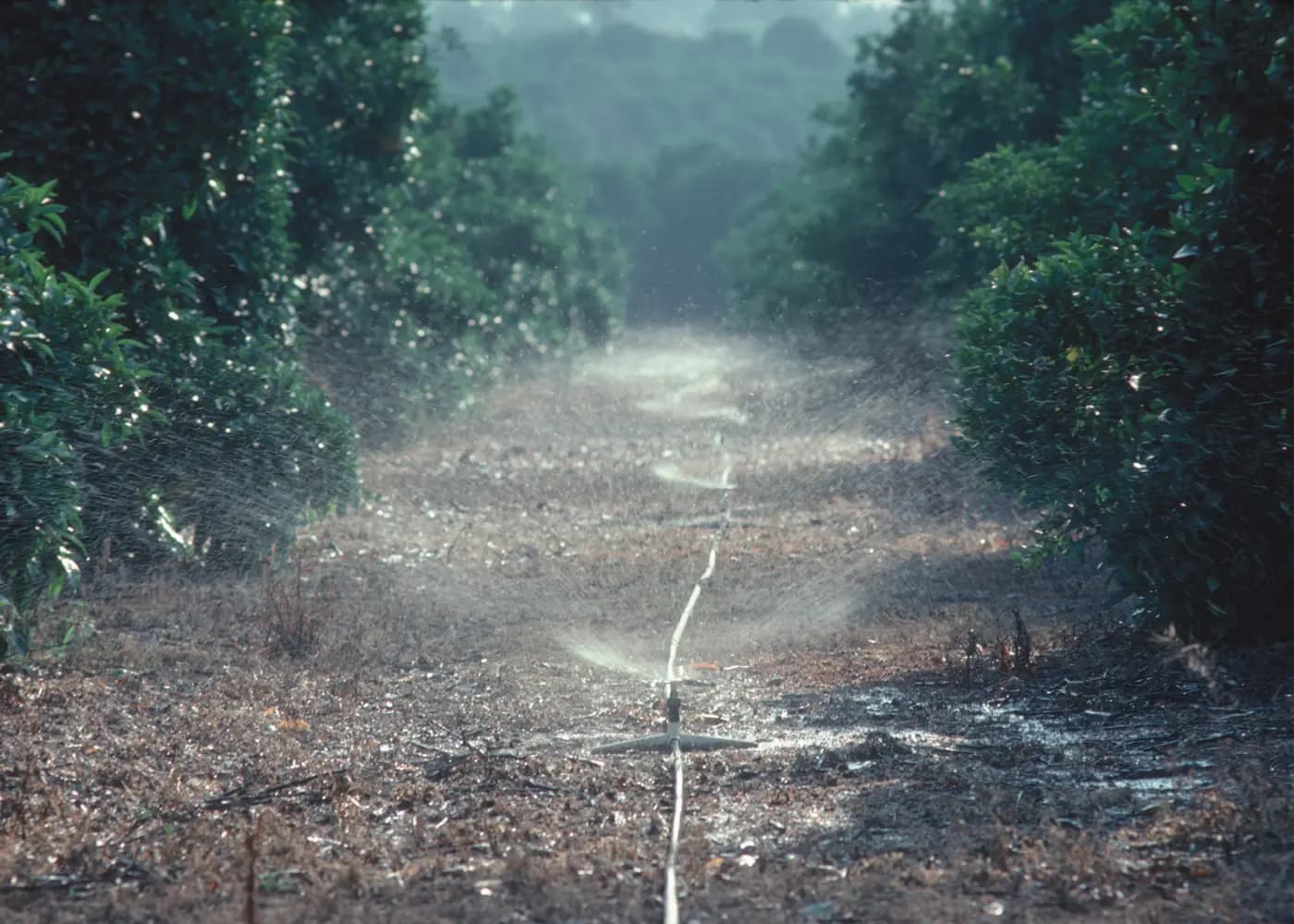
In agricultural sprinkler irrigation, a wet soil surface can become a purchasing clue before it becomes runoff. If water pools under a fixed field block, buying a larger head may put more water on the same surface without helping it enter the soil. Mark where the first puddle appears, when it appears during the operating event, and whether water subsequently moves across the ground. Compare that record with the water arriving at those places and the condition of the rooted soil before naming a replacement sprinkler. Record the time and place of the first puddle beside the actual running head group; the final runoff extent alone cannot show when surface intake began to lag. Sprinkler irrigation soil ponding onset is the first observed time and place water gathers, not merely the final wet area.
Begin with the block already installed and one normal operating arrangement. Record the exact heads, nozzles, active count, pressure observation points, crop cover, recent rain or irrigation, and the surface conditions a worker can see safely. The result should be a purchase brief: retain the present heads, investigate a damaged or mismatched outlet, seek a documented lower-application configuration, or request a soil and site assessment. A puddle alone does not provide a measured infiltration rate or a universal watering time.
Where does ponding first appear during the sprinkler run?
Sketch the block with sprinkler rows, supply direction, crop rows, traffic tracks, slope and a safe observation route. Give the places that tend to collect water fixed names. A low wheel track, a sealed patch between rows, a place receiving two overlapping patterns and a field edge can look similarly wet at shutdown while telling different stories about how water arrived. Mark each place before the event so the observer is not choosing only the most dramatic puddles afterward.
Note when each location first develops a standing film, when water begins to move, and where that water travels. Distinguish a shallow temporary pool that disappears locally from a continuous flow leaving the intended block. Photograph the same marked points at comparable moments while remaining outside moving streams and equipment. A short video can preserve the direction of flow; it cannot turn a visible depth into a soil intake measurement. Keep the observer's position safe and use the installed system's normal controls.
For example, a hypothetical record might show standing water first in a compacted vehicle lane, later in one overlapping sprinkler strip, and no standing water under adjacent vegetated ground before the observed event ends. These are location and timing observations, not a proposed schedule or proof of three separate soil types. If a pipe leak supplies one spot, record it separately before interpreting that spot as sprinkler application. If rain begins during the test, the event no longer isolates sprinkler input.
Is surface application exceeding soil intake at this location?
Water collected in a level catch container describes application at the container opening during its timed exposure. It does not measure water entering the soil below it. If the block already has a catch map, retain its raw locations, openings, collection times and active-head configuration. Place the ponding marks on that map without replacing the original catch readings. The fixed-block sprinkler catch guide explains how to obtain comparable arrival measurements; the extra question here is how that arrival relates to surface ponding and rooted-soil response.
Compare a pooling location with a nearby non-pooling location that received a similar measured amount, where the sampling geometry permits it. If the catches are similar but the soil response differs, investigate traffic, surface sealing, slope, cover, previous wetness and the soil profile. If the pooling point also receives more application because patterns overlap or a part-circle head concentrates delivery, the head arrangement needs review alongside the soil. Neither comparison by itself proves the sole cause.
Do not infer application from the pump's total volume alone. A meter at the block inlet measures water crossing that boundary, including any leak or outlet outside the observed patch. The sprinkler meter-reading guide helps establish that supply total, but a correct total cannot show exactly where the water fell. Retain the meter record with catch and field observations rather than calling them interchangeable measures.
Read the changing soil response through the event
Soil may take water in quickly at the start of an event and more slowly later. UC Agriculture and Natural Resources explains this changing intake in its orchard sprinkler application and soil-intake guide. Surface management, compaction, slope and water quality can also affect the result. Its soil-texture table is preliminary design guidance; a texture label or one puddle cannot be treated as a measured intake curve for your field.
Before assuming the head is too large, note the soil's condition just before operation. A previously wet hollow and a dry rise may pond at different times under similar spray. A wheel track can shed water across a planted row; residue or cover may slow visible surface flow. Observe whether standing water recedes into the local ground after application stops or travels toward a drain, road or neighbouring plot. Persistent shallow water and movement beyond the block justify prompt local assessment, but the visual record still does not quantify an infiltration rate.
Inspect moisture at representative locations and depths relevant to the current crop's active roots, using the farm's established field method. A dark surface is not evidence that the rooted layer has been replenished; equally, rapid disappearance of a puddle does not prove that the crop retained all the applied water. A restrictive layer, lateral movement or drainage below roots may matter. Preserve soil observations from both pooling and comparison positions so a proposed hardware change is checked against the receiving ground, not only the spray pattern.
Separate an equipment fault from a site limitation
Walk the installed sprinkler line with the exact model and nozzle identifiers. Look from a safe position for a damaged stream, an outlet spraying onto a track, a tilted support, leakage at a connection or a head that does not move as intended. Record the active group and any measured operating pressure at a named point. A static source reading cannot establish the pressure at the head while the normal block is running. Follow the system manual to isolate and depressurize before inspecting or changing a part.
If one outlet's stream differs from otherwise comparable heads, use the sprinkler operating-point check to frame the model, nozzle and working-condition evidence. If the wet area is a boundary strip caused by a gun's arc, the field-edge arc guide covers that separate setting and no-wet boundary. Narrowing a sector can increase application intensity in the remaining swept area, so an arc change is not automatically a remedy for ponding.
If several correctly operating heads create a similar pooling pattern on one compacted or sealed soil band, buying another head is unlikely to remove the receiving-ground constraint. Ask the responsible grower or local soil adviser to examine the surface and deeper profile before any cultivation, drainage or water-quality treatment is proposed. A different crop cover or surface practice may need agronomic review. Do not select an amendment or chemical from the photograph of a puddle.
Compare S50 and 9703K without turning catalogue ranges into a runoff cure
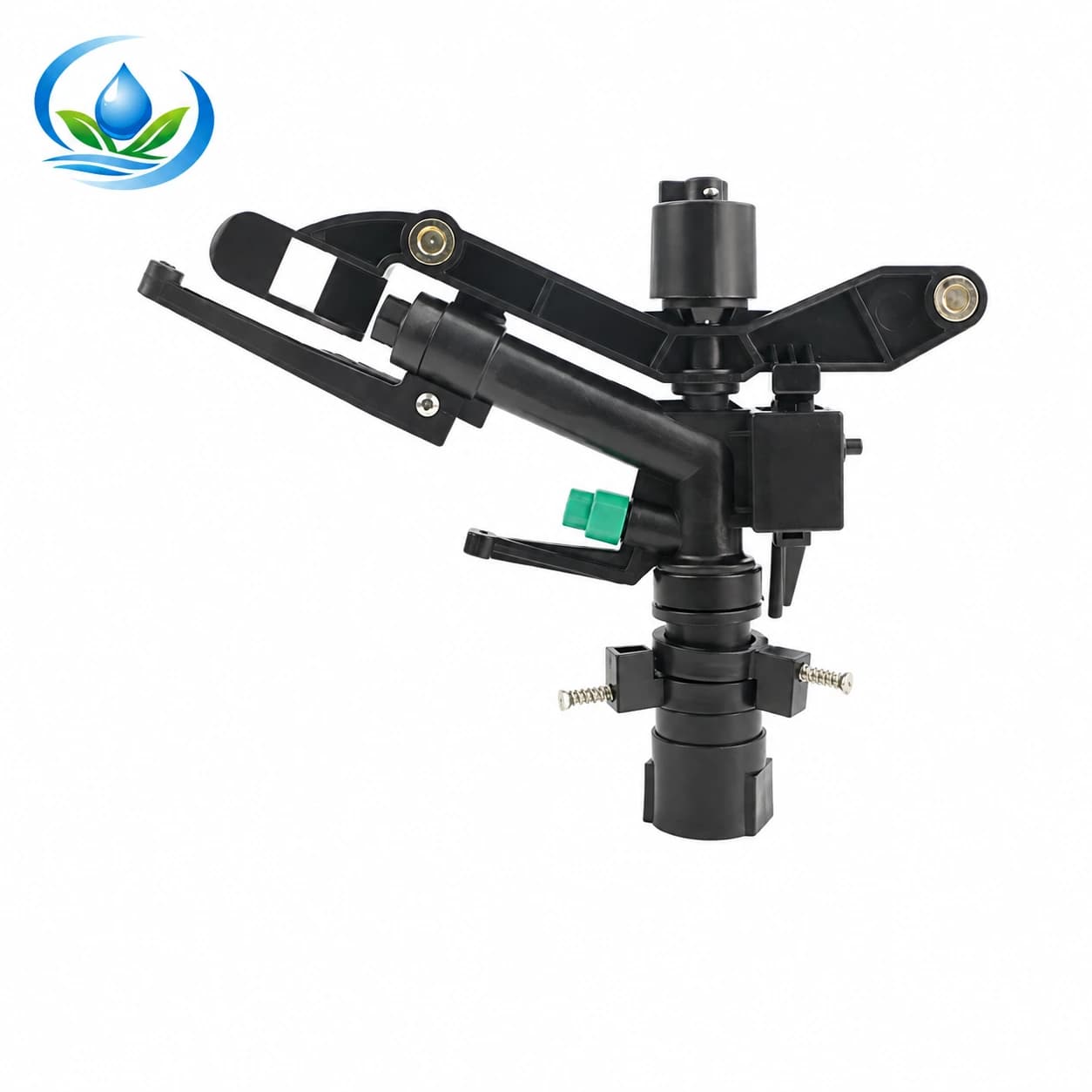
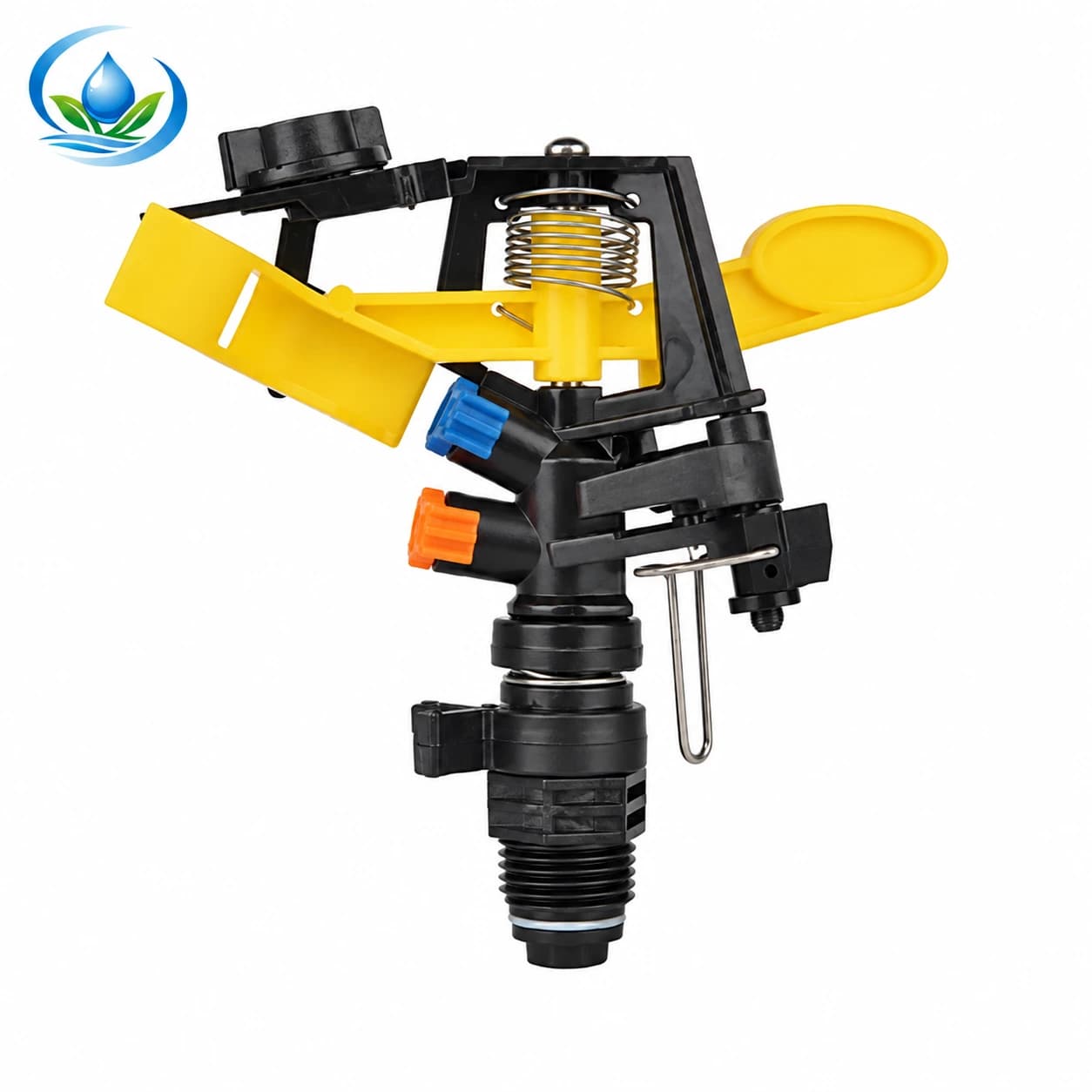
The IrriNex S50 impact sprinkler has a listed 1-inch female inlet; the mating thread still needs confirmation. Its stated working pressures span 2.0–5.0 bar, which must be compared with readings taken while the group operates. The catalogue places its radius at 15–17 m; that does not prescribe the distance to the next head. Its separate flow entry is 3.7–5.0 m³/h. The 9703K impact model identifies a 4.0 × 1.8 mm nozzle combination. Its pressure interval is 1.5–3.0 bar. The stated radius is 6–7 m, while its separately published discharge is 1.1–1.3 m³/h. These are different head families and independent catalogue ranges, not paired pressure-flow-radius test points.
The 9703K's smaller listed flow does not, by itself, mean lower application depth on an existing S50 block. Changing head type can change the number of heads, spacing, arc, overlap and pressure available to all outlets. A smaller radius can leave dry gaps unless the new layout is designed and measured; crowding heads to close those gaps can raise local application. Likewise, replacing an existing head with a larger S50 can increase supply demand and worsen a pooling location. Compare exact nozzle and pressure data for the proposed arrangement, not range endpoints assembled into an imagined duty point.
Before selecting a different head, obtain the manufacturer's data for its exact operating pressure, discharge and distribution under the proposed nozzle, support, spacing and active group. Confirm connection standards and what is included with the sale option. The running-flow head-count worksheet can check how many documented heads may operate together, but available flow is not a soil-acceptance test. Check current model option, price, sale unit, availability and delivery in the product listing; resolve missing fit or operating data before ordering a block of replacements.
Test a documented change against both water arrival and soil response
If a site review supports changing irrigation operation rather than soil management, define one proposed change and its expected field effect. It might involve correcting a damaged outlet, revising an approved nozzle configuration, or using a separately designed operating group with a lower application rate. A pause or shorter event can be evaluated where the farm's crop and equipment programme permits it, but there is no universal cycle length, rest period or soil-rate threshold to copy. Keep the intended crop water supply and the hydraulic behaviour of startup and shutdown in the review.
Run a limited, supervised trial under the documented active group and compare the same marked locations. Retain catch readings where arrival is part of the decision, and note the first ponding time, flow path and rooted-soil observations again. A delayed puddle may be useful evidence; it is not proof that no runoff will occur over a longer event or after another rain. A lower inlet meter total alone may reflect less water delivered rather than a successful soil response.
Do not widen head spacing or lower pressure merely to make a computed average application rate look smaller. Either action can spoil pattern overlap, throw and discharge outside the selected manufacturer's operating conditions. Similarly, running fewer heads together changes working pressure unless the source and controls are designed for that case. The proposed configuration needs its own model data, supply check and field observation before a full purchase. Where the equipment cannot deliver an acceptable pattern within the site's intake constraints, keep the site and irrigation design options open.
Order from the field record rather than from the largest radius
A useful buying note lists the block, crop, active sprinkler count, exact installed nozzle and head models, working pressure observations, catch-map reference, first ponding times and locations, runoff route, recent rain or irrigation, surface condition and relevant root-zone observations. Add the particular fault or limitation the proposed part is meant to address. If the cause remains unresolved, label it so the supplier or adviser can request the correct next measurement instead of guessing from a product photo.
Keep two questions separate when comparing quotes: will the proposed head and running group distribute water acceptably, and will the receiving ground accept that application over the intended event? A positive answer to one does not establish the other. Request the exact compatible model and included components for an equipment change, then compare the post-change block with the saved baseline. If field evidence points mainly to a compacted lane or soil condition, make that assessment before buying new heads. This turns a visible puddle into a defined investigation and a defensible purchasing decision.
Before you order
Compare this guide with the specifications for your exact product, selected option, water supply and field conditions. Your equipment requirements take priority over a general example.
Compare irrigation products