Sprinkler Zone Calculator: Work Out a Head Count From Running Flow
Use a hand worksheet to screen how many identical farm sprinklers may run together from verified flow at pressure, then check head pressure and coverage separately.
Published by IrriNex Store
A sprinkler zone calculator for a farm block begins with a simple hand worksheet: how much water can the source dependably deliver while maintaining the required pressure, what else must draw water at the same time, and what does one identified head require at its chosen operating condition? Divide the available flow by that per-head requirement and round down for a first head-count candidate. Then test pressure and coverage separately. The division is a screening calculation, not approval to open that many heads. Sprinkler head count from available flow requires the named operating group and comparable discharge units before division.
Use the worksheet below to decide how many identical sprinklers might run together and how to divide a larger installed inventory into operating groups. Keep the source measurement, head model and nozzle, pressure location, field map and allowed simultaneous users attached to the number. An existing group drawing 12 m³/h, for example, has demonstrated its own demand; it has not demonstrated that the source can supply another 12 m³/h while maintaining pressure.
Which sprinkler heads are actually running in this zone?
Name the field block, supply point, valve arrangement and number of heads physically installed. Mark which other users can run during this block: another irrigation valve, a livestock line, a wash point or a tank that fills at the same time. Identify the lowest normal source or tank condition relevant to the proposed operation. A count of heads on the property is not a count of heads to open together. Conversely, a group that fits on paper may need further division because the farthest riser cannot receive its working pressure.
Record the exact sprinkler model, nozzle combination and intended working pressure for the candidate group. Heads with different nozzles should not be reduced to an unexplained average. Their separate flow demands must be added. The sprinkler identification guide helps document a replacement head before any arithmetic. A model name without its fitted nozzle and operating condition is an incomplete worksheet entry.
Make the measurement boundary explicit. A meter upstream of all farm users reports combined supply flow, while a meter on a dedicated field branch reports that branch. If a tank changes level during the test, inflow at one location need not equal delivery leaving the tank at another. Keep the boundary diagram with the figures so a later user does not subtract a demand twice or describe a current measured draw as spare capacity.
Are all listed head flows expressed in the same unit?
Cubic metres per hour are convenient for these field sprinklers. One cubic metre per hour equals 1,000 litres per hour; one litre per second equals 3.6 cubic metres per hour. Convert the source and every outlet to the same unit before subtracting or dividing. Keep the source's original display unit beside the conversion. Do not add an m³/h value to an L/min value as if the figures shared a scale.
If a pump document, meter and head sheet use different units, write a separate conversion line and check it once. If gallons occur in a record, establish whether they are US or imperial gallons before conversion. Retain enough digits for the division, then round only the final whole-head candidate down. The component-flow guide explains unit handling in a drip system; this page applies the arithmetic to a sprinkler head count and its field checks.
Use dependable flow at pressure, not an open-outlet bucket figure
The source entry is a dependable amount deliverable at the pressure the proposed sprinkler arrangement needs, through the actual filter, main and relevant elevation, under a credible weaker source condition. It may come from a suitable test and hydraulic review using the pump or supply information. Record when and where flow and pressure were observed and which users were active. A static pressure reading with valves closed does not show delivery during a sprinkler run.
An unrestricted tap or open pipe can fill a bucket quickly because it discharges at a different pressure from an operating sprinkler block. That test can describe its own arrangement; it cannot be entered as dependable pressurized supply for added heads without further verification. Similarly, the present meter rate of one running group is a measurement of consumption at that condition, not the source's maximum sustainable rate or its remaining capacity. Opening more heads changes both demand and pressure. Do not infer a universally safe reserve percentage from either measurement.
If the only trustworthy evidence is the current group rate, label the source-capacity row “unknown” and seek an operating assessment before filling in a head-count limit. The meter-reading guide shows how an event total and a steady segment are recorded. Neither result, alone, establishes how far the source can be loaded beyond the heads already open.
Subtract only other demand that is truly simultaneous
Use this relationship when the source figure covers all users at the shared boundary: sprinkler flow allowance = dependable shared source flow − separately accounted simultaneous non-sprinkler demand. Obtain that other demand from a suitable measurement or supported design value under the operating case. A wash line that is positively shut during sprinkling does not belong in this case. A user that can run unexpectedly needs an operating rule or a separate case, not a hidden assumption that it stays off.
There is an important alternative. If a reliable test already reports the net flow available to the sprinkler branch while the other required users operate, enter that net amount directly. Do not subtract those users again. Keep the word “shared total” or “branch net” on the worksheet, because both may be labelled simply “available flow” in an informal conversation. If a shared-user demand is unknown, record it as unknown; a clean subtraction cannot be made from guessed numbers.
Other sprinklers planned to operate on the same valve belong in the sprinkler demand, not in the non-sprinkler deduction. For unequal heads, add each model and nozzle group's demand and compare the sum with the allowance. Dividing by one head's flow is valid only for a candidate group of identical heads operated at their specified comparable condition.
Work a wholly hypothetical head-count example
The following numbers illustrate the worksheet only. They are not measurements of IrriNex products, a pump, a field or a recommended reserve. Assume an independently verified shared supply allowance of 18.0 m³/h at the required operating pressure for the specified case. Assume a separately confirmed other user will consume 2.4 m³/h at the same time. The proposed, unbranded identical head is documented at 2.1 m³/h per head for its selected nozzle and working pressure. None of these values is taken from the S50 or 9703K ranges.
| Worksheet field | Hypothetical entry | Result or meaning |
|---|---|---|
| Shared dependable flow at required pressure | 18.0 m³/h | Includes the other user at the stated boundary |
| Other simultaneous demand, counted once | 2.4 m³/h | Not already removed from the shared figure |
| Flow available for this sprinkler group | 18.0 − 2.4 | 15.6 m³/h |
| One identical head at chosen condition | 2.1 m³/h | Documented for this example only |
| Flow-only candidate | Floor(15.6 ÷ 2.1) | 7 heads |
| Demand of seven | 7 × 2.1 | 14.7 m³/h |
| Difference before hydraulic checks | 15.6 − 14.7 | 0.9 m³/h, not a universal safety allowance |
| Demand of eight | 8 × 2.1 | 16.8 m³/h; exceeds 15.6 |
The mathematical result is seven, because a fraction of a head cannot be opened and eight would exceed the flow allowance. Seven is still only a candidate. The pressure at each head, the pipe and filter losses, elevation and the spray pattern have not been accepted. The remaining 0.9 m³/h is merely the difference in this example; it is not a prescribed buffer, and uncertainty or a weaker source may force a smaller group.
If nineteen heads are physically installed and all share the same supported demand, this flow screen would suggest a minimum of three separately operated groups, such as seven, seven and five. It does not propose opening nineteen at once. The five-head group also needs a working-pressure and component-operating check; its behaviour may differ from the larger groups. Each group's physical coverage must make sense on the field map before the grouping becomes a valve schedule.
Check pressure and pipe loss independently of the division
At the candidate count, trace water from source through filter, valve, mainline, branch, risers and nozzles. Measure or calculate operating pressure at the relevant near and most demanding heads with that group and every other allowed simultaneous user running. Include elevation, fittings, filter condition and friction under the actual route. A source test at the headworks cannot by itself prove the far head is within the selected nozzle's required operating range. A pipe that seems large by outside diameter may have a different internal passage and pressure loss.
If pressure is inadequate, reduce the simultaneous group or revise the supply and pipe arrangement, then recalculate and retest. Do not treat the unused 0.9 m³/h in the example as pressure that can be spent. Flow and pressure are different quantities. Nor can a regulator restore pressure that the supply and pipes do not deliver. The running-pressure checklist helps organize measurement points, while the exact sprinkler's working documentation controls the final requirement.
A manufacturer guide for another named sprinkler may publish a zone-count table and maximum lateral lengths under a particular nozzle, pressure, riser height, pipe bore and friction limit. Those entries cannot be used as universal lengths, velocities or head counts for the heads on this page. Seek a hydraulic design using the proposed pipe's actual inside dimensions and the site's operating case rather than importing a convenient table number.
Check coverage and application after head count
Place the flow candidate on a scaled block plan: head positions, field boundary, crop rows, obstructions and prevailing conditions. A catalogue's maximum radius describes a throw range under its product conditions; it is not a head-spacing instruction. Real coverage depends on nozzle, pressure, mounting, wind and overlap among operating heads. If dividing the physical inventory into groups changes which neighbours are on at once, each proposed group's wetting pattern must be assessed on its own.
For an existing installation, the field catch-depth test checks what water actually lands at named locations. A flow-feasible group can still have a dry strip or an edge receiving too much. A proposed correction might need a different layout, nozzle or operating case, not simply the largest number of heads that fits the division. Compare pressure and a repeatable collection pattern before accepting an order for more outlets.
Flow in m³/h also does not tell you how much water a crop receives during an event. The metered-event guide deals with the volume crossing a stated boundary and time interval. Catch depth and soil observations answer other questions. Keep simultaneous head count, event duration, coverage uniformity and crop scheduling as separate decisions. Do not infer a universal crop watering schedule, yield gain or water saving from a head-count worksheet.
Use exact S50 and 9703K information without inventing a curve
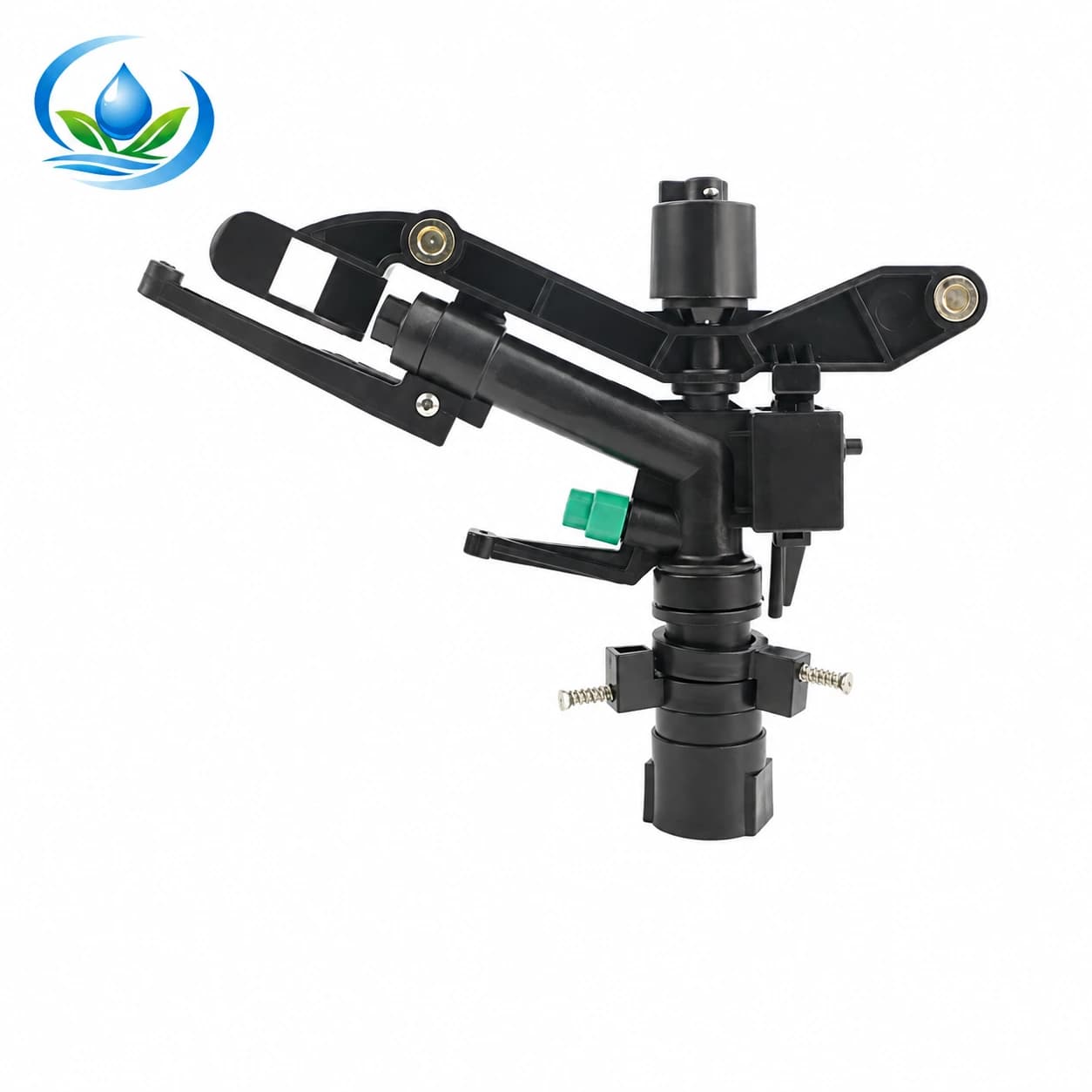
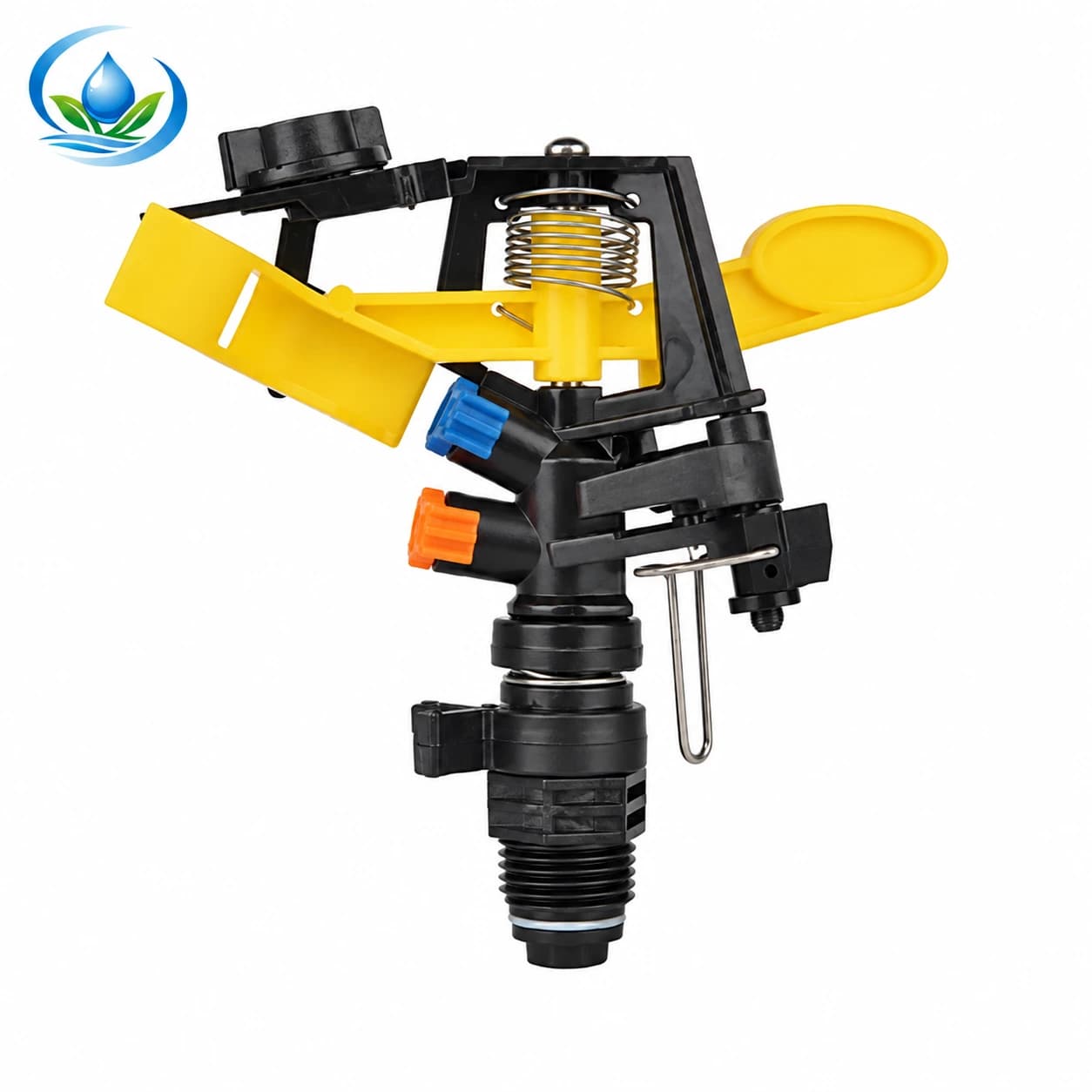
The published IrriNex S50 impact sprinkler lists a 1-inch female inlet, working-pressure range of 2.0–5.0 bar, flow range of 3.7–5.0 m³/h and radius range of 15–17 m. For the published IrriNex 9703K, the catalogue specifies a 4.0 × 1.8 mm nozzle arrangement, working pressure 1.5–3.0 bar, flow 1.1–1.3 m³/h and radius 6–7 m. These are distinct model entries and independent ranges. They do not show which flow and radius coincide at a particular pressure, nozzle setting or field mounting.
Do not insert either model's lowest flow into the worksheet simply to get a larger count, or combine its largest radius with a separate low-flow endpoint to draw a layout. Ask for the exact nozzle and pressure/discharge information needed for the proposed operating point. The two heads are not interchangeable merely because one has a smaller published flow. Connection, throw pattern and application must also match the block. Once the chosen head's comparable per-unit flow is confirmed, run the worksheet again using that number.
Take the worksheet to an order and a field verification
For each proposed group, keep a one-page record: source boundary, test condition, total or net flow label, unavoidable simultaneous demands, exact head and nozzle, per-head rate, arithmetic candidate, pressure observations, route lengths, valve settings and field sketch. Mark unknowns plainly. Request current price, available quantity, delivery and included mounting or connection parts for the exact product configuration. Buying a head does not automatically supply a riser, pressure regulator, compatible valve or approved spacing plan.
After a qualified installation or approved adjustment, run each group under its normal simultaneous case. Compare measured flow and pressure at the source and representative distant positions with the worksheet, inspect leaks and actual spray, and repeat the mapped coverage check when needed. If the measured result differs, correct the model, demand, supply or route record rather than presenting the preliminary quotient as a certified zone capacity. The output of this calculator is a reproducible head-count screen and a list of independent checks; the final number of heads operating together comes from the field verification.
Before you order
Compare this guide with the specifications for your exact product, selected option, water supply and field conditions. Your equipment requirements take priority over a general example.
Compare irrigation products