Low Pressure Irrigation Sprinklers: Check the Head Operating Point Before Buying
Compare the exact head's pressure and flow with running field measurements and check where its spray lands before replacing a sprinkler.
Published by IrriNex Store
Low pressure irrigation sprinklers are useful only when the selected head can operate at the pressure and flow the field actually supplies. A grower replacing one weak field head needs more than a label saying “low pressure”: identify the existing head and its duty, measure the replacement position while the normal group runs, then compare one exact candidate's documented operating point and intended wetting area. A head that spins during a brief trial may still leave the crop-side strip dry. This check turns a vague search for a smaller sprinkler into an order for a specified head and connection, or a clear decision to fix the supply first. Pair each observed pressure with the active head group and the candidate's documented flow at that pressure; a static gauge value alone cannot establish replacement duty. The low-pressure sprinkler operating point pairs measured running pressure with the exact head's documented flow, not a static gauge reading.
Pressure at a pump, an open outlet and a working sprinkler are different observations. The proposed head sees pressure after the filter, valves, pipe, elevation changes and other heads have taken their share of water. Its discharge then changes what the supply must deliver. Keep pressure, flow and water landing on the ground in separate columns. The lowest catalogue pressure and the longest catalogue radius are not automatically one tested operating condition.
Measure low-pressure sprinkler duty while the zone runs
Mark the existing head on a simple block sketch. Note the crop rows, the soil or containers meant to receive water, the nearest field edge, obstructions, access lanes and neighbouring heads that operate at the same time. Record the installed head code, nozzle marks, connection and mounting position. If an old label is illegible, keep a photo and the previous order record; a similar coloured body is weak evidence of identity. The field-head replacement guide helps organize those details before any part is removed.
Describe the reason for considering a replacement. Does this head fail to reach a marked crop strip although nearby heads look normal? Do all heads near the far end weaken together? Is the spray moving but landing beyond the boundary? These observations lead to different purchases. A blockage, changed nozzle, folded feed, leaking joint or altered valve state can mimic a head that is unsuitable for the available pressure. If the whole group is affected, keep the supply question open rather than buying a lower-flow head to mask it.
Make a baseline during ordinary crop irrigation. Record which valves and other water users operate, the source condition, filter condition, approximate wind direction and the head's spray behaviour. Give the near and far reference heads names on the sketch. A photo taken from a fixed safe viewpoint helps compare the pattern later, but it does not measure either pressure or delivered depth. Avoid changing the operating group between baseline and trial merely to make the new head appear stronger.
Can the exact head deliver at the measured operating point?
Use existing suitable measurement points or arrange a qualified measurement method for the system. Record where the gauge reads, its unit, the active group and the time of the reading. A reading with outlets closed is a static condition; the replacement must work while the normal heads are discharging. Measure near the supply and at the relevant far or high-pressure-loss position if accessible by approved ports. Do not undo a live joint to improvise a tap. The running-pressure checklist explains why a named measurement point matters, even though this purchase concerns sprinklers.
Repeat a relevant measurement when the farm normally encounters a weaker source condition, such as a lower source level or a filter nearing its planned service point. Note whether another user operates simultaneously. If the replacement will run only in a controlled group with other users shut, record that as an operating rule. A single favourable gauge reading cannot represent every combination that crews may use later. Conversely, a weak result taken during an unusual temporary restriction should prompt diagnosis before discarding a suitable head.
Pressure at the pump cannot simply be assigned to the nozzle. Pipe friction increases with flow, a rise in elevation consumes pressure head, and the filter and valve introduce their own losses. The difference between a near and a far measurement can direct the next check, but it does not by itself identify which component causes it. Record the route and component condition. If pressure collapses only when an additional head group opens, review that simultaneous arrangement. If it remains low at the source under the intended demand, the issue is upstream of the proposed head.
Find a documented point for the exact head
For each candidate, request model and nozzle identity, a pressure-versus-discharge basis at the intended condition, applicable mounting and connection information, and any published coverage test conditions. A broad pressure range says where the maker presents the family for operation; a broad flow range does not identify the discharge at every pressure. Prefer a table or curve for the selected option over a pair of extreme figures copied from separate rows. State the field's measured pressure beside the chosen candidate point in the same units.
Do a first screen before discussing throw. If the credible low running pressure at the head is below the candidate's documented lower operating boundary, do not order on the hope that the spray will be “close enough.” A pressure-compensating device regulates only inside its stated range; it does not raise a weak inlet pressure. If the actual high condition could exceed the head or connection limit, that matters too. A lower advertised pressure requirement is not permission to run the rest of the group outside its own limits.
The flow at the candidate point must also fit the source and group. Replacing one head with a lower-flow format changes both local application and total simultaneous demand; it may not solve a dry band if the new head wets a smaller area. Replacing it with a higher-flow format can draw down pressure at its neighbours. For a proposed change to several heads, use the sprinkler group flow worksheet to screen the group count, then check pressure at near and far heads. The flow arithmetic does not select the right nozzle for this one position.
An unrestricted hose or bucket can document water delivered with the hose open. It does not establish that the same supply can deliver a selected sprinkler's discharge while retaining that sprinkler's required pressure. Likewise, an existing group's metered consumption is not proof of unused source capacity. Ask for operating evidence at the required flow and pressure together. If the source cannot meet the desired candidate point, decide whether a different approved group, a corrected restriction or a supply change is needed before purchasing more heads.
Compare two actual listings without merging their ranges
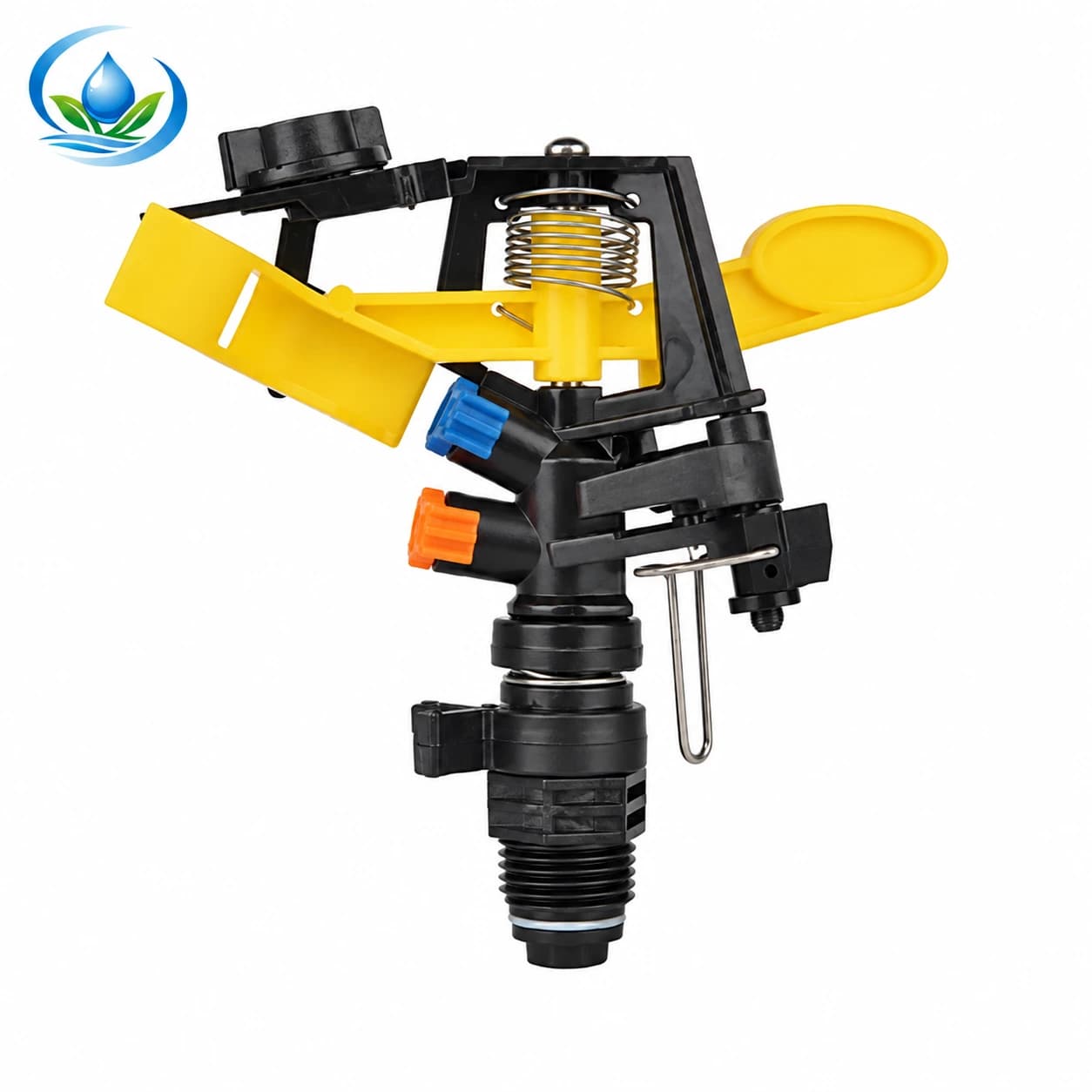
The IrriNex 9703K impact sprinkler is a field-head option with a listed 4.0 × 1.8 mm nozzle arrangement. Its separate catalogue ranges are 1.5–3.0 bar working pressure, 1.1–1.3 m³/h flow and 6–7 m radius. Those numbers identify the family for an initial screen. They do not show that 1.1 m³/h, 6 or 7 m radius and 1.5 bar occur together at one documented setting. Obtain the exact operating data for the selected head and its connection before drawing a circle around a field position or ordering a replacement for a different model.
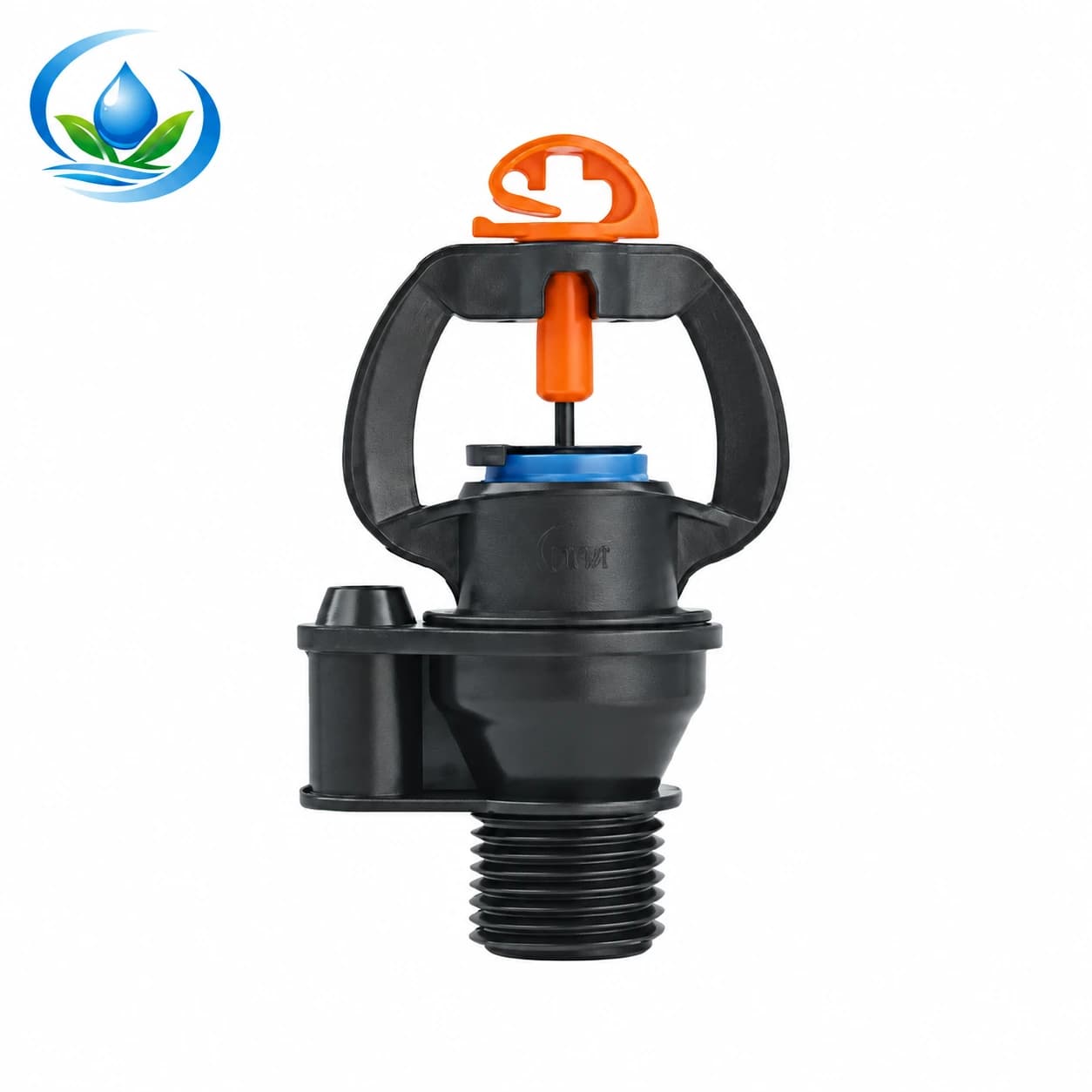
The PCS pressure-compensated mini sprinkler offers a quite different scale. The listed PCS01 green, PCS02 blue and PCS03 red options are 45, 60 and 95 L/h respectively, with family working pressure of 1.5–4 bar and listed radius of 1.8–3 m. Converting units makes the contrast clear: the three nominal flows are 0.045, 0.060 and 0.095 m³/h, far below the 9703K's 1.1–1.3 m³/h range. This is not a direct one-for-one field-head substitute simply because both listings include 1.5 bar. The intended wetted area and the number of heads needed would change substantially.
For PCS, keep the complete variant code with the selected flow and inlet: suffix A is the 6 mm female connection, B the 1/2-inch male-thread option, and C the 4/7 mm barb. Confirm the actual mating part and connection standard instead of treating the nominal label as a fit certificate. A threaded riser from one head is not automatically compatible with a barb or a differently specified thread. For the 9703K, verify its selected connection rather than assuming one from the nozzle size or an illustration. Include any needed approved adapter or support in the parts comparison.
Neither listing provides a pressure-to-radius curve for the actual field position. The PCS family range also does not tell you that every colour gives the same radius at every pressure. If the grower wants a smaller wetted spot near a nursery row, select the PCS variant against its own duty and receiving area. If the aim is to replace a larger field impact head, compare a head of the appropriate format and verified point. The sprinkler-nozzle comparison helps keep dual outlets and their discharge evidence attached to the correct model.
Check water on the intended ground, not only the visible arc
Mark the crop-side point that is currently missed, one place expected to receive a normal share, and any boundary where water must not land. A radius is a distance descriptor from a particular test, not the amount of water received at that distance and not a spacing rule. Mounting height, neighbouring overlap, crop canopy and wind change the real pattern. A thin edge spray may look impressive while delivering too little at the roots. Compare the original and trial positions with the same normal group and a comparable observation period.
Where a measured check is warranted, use equal-opening collectors or another appropriate field method at fixed named points. Record each collection interval, head position, active neighbours, operating pressure and wind. The sprinkler catch-depth guide explains how to measure actual application across a block. For this purchase, a small targeted set can first show whether the candidate reaches the troublesome receiving area; it does not certify whole-field uniformity. A good catch beside the nozzle cannot speak for the far row or an edge that receives less overlap.
If calm and exposed runs disagree, document both. Changing the head based on one windy photograph may miss a feed restriction, while judging only a calm catalogue throw can miss repeated drift into a lane. The wind-exposure field comparison gives a method for comparing water destinations under different conditions. Keep this operating-point check focused on whether the chosen model can be fed and whether it wets its assigned crop area; the farm's workable watering window remains a separate decision.
Do not lengthen watering automatically to make a weak edge look acceptable. Longer operation can increase water everywhere else while the missed strip remains short, and a lower-flow mini head may need a different layout entirely. Crop water demand and event timing require their own basis. If a proposed head satisfies pressure and flow yet cannot provide the needed footprint at this position, mark it unsuitable for that placement and review the layout or another documented format.
Turn the trial into a precise order or a supply repair
Leave a compact comparison record: existing head and connection, proposed exact model and option, measured low and normal running pressures with locations, selected documented flow point, simultaneous head count, route condition, and a sketch of the intended and observed wetting. Record unknowns as questions for the exact product rather than filling them with a nearby family's rating. Check the selected product page for current price, sale unit, availability and delivery; confirm any mounting or connection part separately. The product photograph cannot establish what comes in the package or how it fits the old riser.
If the measured pressure falls outside a candidate's documented operating conditions, keep the order open while the supply and route are investigated. If pressure and discharge fit but the crop-side catches do not, revise the head format, position or field layout with the appropriate instructions and repeat the targeted comparison. If one trial head passes the same checks under the normal group, keep its exact code and measured record before extending the change to more positions. For an installed head that is physically stalled rather than wrongly selected, the stalled-rotor inspection frames a different repair decision.
Isolate and depressurize the section under the site's equipment procedure before changing a connection or support, then restart according to the selected model's instructions and watch from a safe place. A successful purchase is the head whose documented pressure and discharge can be supplied in the intended group and whose field trial delivers water to the marked crop area. Keep the pressure point and receiving map with the order so the next replacement is compared with a measured baseline, not merely with the words “low pressure.”
Before you order
Compare this guide with the specifications for your exact product, selected option, water supply and field conditions. Your equipment requirements take priority over a general example.
Compare irrigation products