Big Gun Irrigation Sprinkler: Plan a Portable Field Layout Before Buying
Mark the working positions, hose routes and supported moves before choosing a P40 or P50 rain gun and deciding how many assemblies to buy.
Published by IrriNex Store
A big gun irrigation sprinkler purchase starts with the places where it will work and the route used to move it. A long advertised throw is only one part of that decision. You also need a suitable water supply, a supported operating position, a manageable hose route and enough time to complete the planned moves. Writing those details down can reveal whether one portable assembly is practical before you order additional equipment.
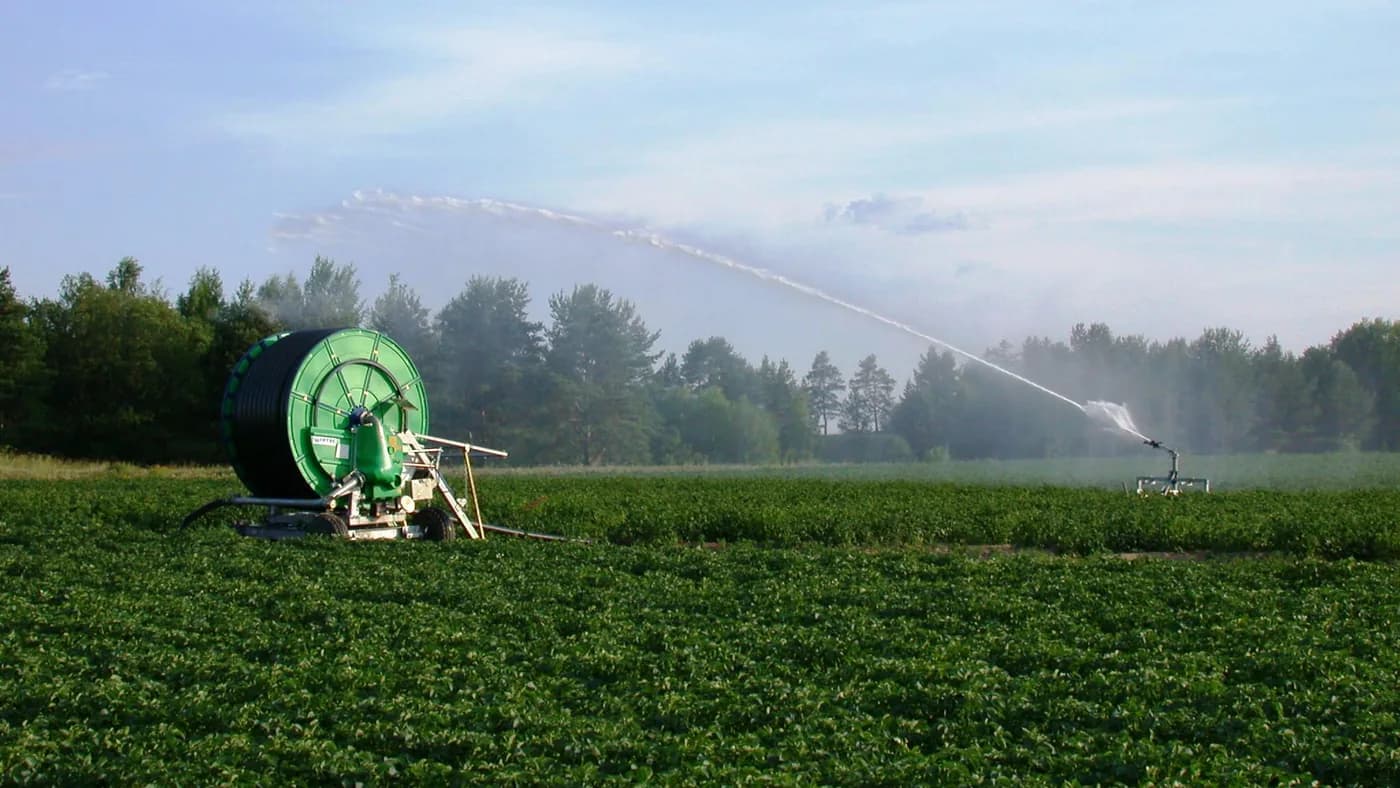
This guide considers a rain gun that is stopped, isolated and moved between stationary watering positions on an agricultural field. The opening photograph shows a real travelling hose-reel installation in Sweden; it illustrates field use, rather than the manual arrangement described here or a particular IrriNex model. Use the planning record below to compare the P40 and P50 and prepare a specific equipment request.
Name every portable rain-gun working position
Walk the field with a sketch that includes planted boundaries, access lanes, water connections, gates, ditches and changes in elevation. Mark candidate positions A, B, C and so on. A mark means “investigate this location,” not “this location covers a confirmed area.” Keep a separate list of places that must remain dry, such as a neighbouring property, public route or sensitive work area. A portable big gun irrigation sprinkler layout should show each stop and its hose route before it is converted into a count of complete sprinkler assemblies.
At each mark, record where the assembly could stand without obstructing cultivation. Look upward as well as across the ground: branches, overhead electrical lines and other obstacles matter to the complete spray path. A position that looks convenient on a map may be unsuitable when the support, hose and moving head are considered together. Obtain appropriate site guidance where clearances or installation restrictions are uncertain.
Photograph the position facing the water source and then facing the intended watered area. Include the access route in the record. These views help explain why two locations with similar distances from the source may require different hose arrangements. They also give you a way to recognize the intended position after the crop becomes taller.
Count portable gun positions, assemblies and simultaneous demand separately
These are three different counts. A position is a place visited during the irrigation round. A complete assembly is the head with the confirmed support and connection equipment needed to use it. The simultaneous count is the number receiving water together. Writing “six sprinklers” without identifying which count you mean can produce an unsuitable quotation.
For a hypothetical planning exercise, a grower has six candidate positions and intends to operate one gun at a time. Buying one complete assembly means moving it through those positions. Buying a second assembly may allow equipment to be prepared at the next isolated position, if the layout permits this safely. It does not automatically mean that two guns will run together, and it does not double the verified supply capacity.
A stored spare is another separate line. If one assembly is operating and one spare head is kept for interruptions, the spare is not a second supported field assembly. State whether the extra item is a bare head, a complete movable set or a reserve connection component. This distinction makes comparisons between offers much more meaningful.
Walk the moves before committing to the layout
Trace the practical journey from A to B, then B to C, rather than drawing only straight distances between the marks. A ditch, a closed gate or a crop row that cannot be crossed can turn a short move into a long return along the headland. Record the usable route and where the equipment can be turned or set down.
Consider the whole item being moved, including a hose that may retain water, the support and the fittings at its ends. Confirm the actual mass and handling method of the proposed assembly. Do not assume that a wheel, handle or tripod visible in a photograph is supplied with the head or suitable for your ground. Soft soil, uneven access and narrow gates can change what is manageable.
Try the route with appropriate unpressurized equipment or a safe dimensional mock-up before the irrigation round is urgent. Record the people and handling equipment required. The result may favour a different sequence or a different water connection, without changing the selected rain gun. Operational convenience comes from the route as much as from the head itself.
Measure hose routes as installed lengths
For each position, measure the intended hose path from the selected connection point. Include necessary bends and a documented allowance for connection and handling, following the hose instructions. A route around the field edge is longer than the straight-line distance across the crop. Buying by the shorter distance can leave the final connection under strain.
In a hypothetical record, routes to three positions measure 42 m, 57 m and 49 m. Those measurements identify the longest route as 57 m; they do not establish that a 57 m hose is an appropriate finished assembly. End connections, permissible bends, handling allowance and hydraulic suitability still need confirmation. If one hose serves each position in turn, do not add all three route lengths and mistake that total for the length in use.
Write whether the hose moves with the gun, remains on the headland or connects to separate branches. Mark crossings used by vehicles and provide an agreed way to protect or remove the line. The agricultural irrigation pipe buying guide helps organize size and pressure questions; it does not establish the hose diameter needed for this rain-gun layout.
Use P40 and P50 ranges to frame the enquiry
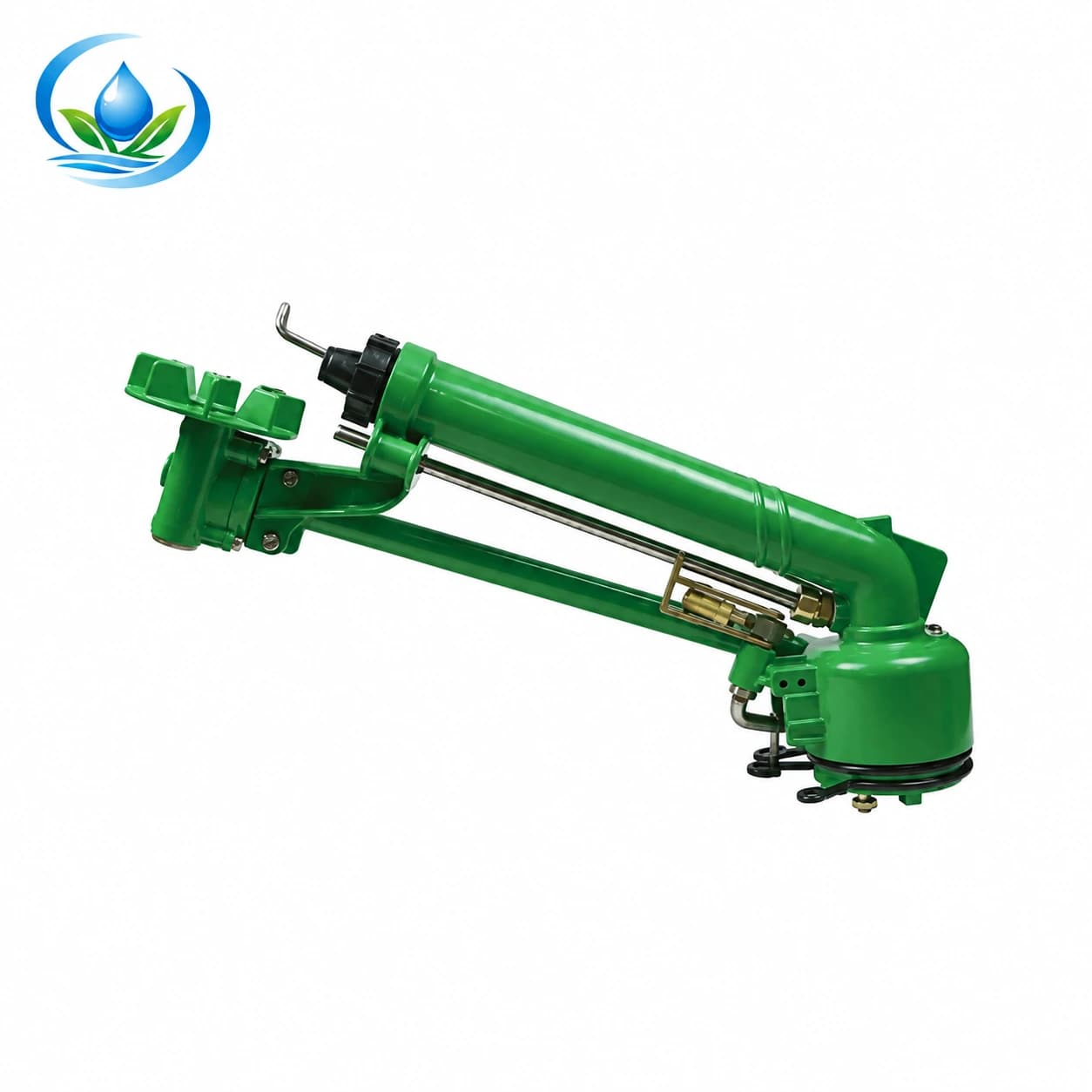
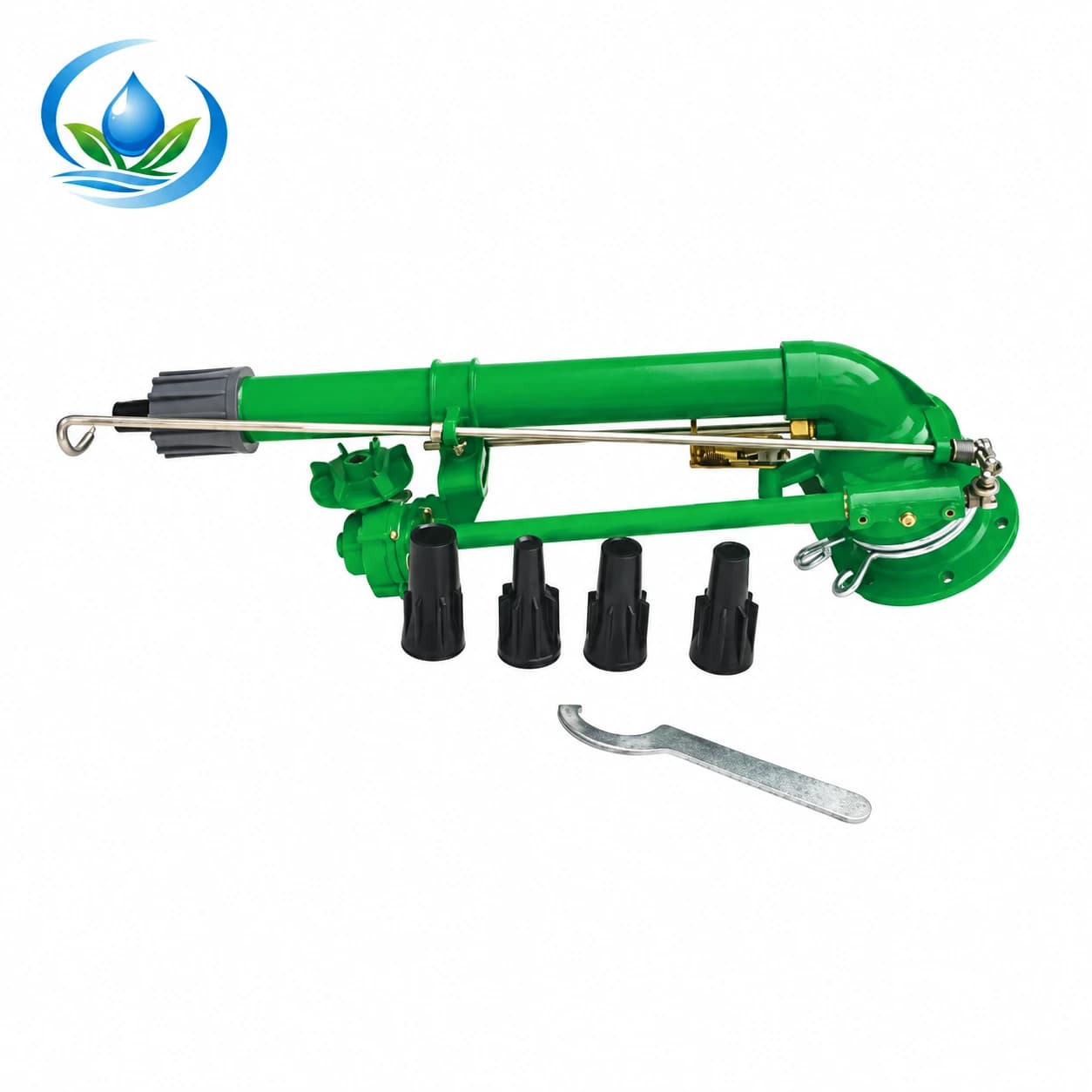
The P40 metal agricultural rain gun and P50 metal agricultural rain gun provide two specific models to investigate. Their catalogue entries below are separate ranges. They help identify the information you must obtain for the proposed configuration, rather than supplying a completed field design.
| Catalogue entry | P40 — IRRINEX-P40 | P50 — IRRINEX-P50 |
|---|---|---|
| Nominal inlet | 1.5 inches | 2 inches |
| Nozzle entry | 12 × 20 mm | 16 × 26 mm |
| Working pressure | 2–5 bar | 2–7 bar |
| Spraying radius | 22–41 m | 26–53 m |
| Flow | 9.5–37 m³/h | 17.8–75 m³/h |
The multiplication sign in the nozzle entry does not tell you how many interchangeable nozzles are included. Ask for the exact supplied nozzle arrangement and the performance information for that arrangement. Likewise, the nominal inlet size does not establish thread standard, connection geometry or compatibility with a particular support.
Do not pair the lowest pressure with the lowest flow, pair the maxima, or interpolate a verified operating point from this table. Ask for a documented pressure, discharge and radius combination for the offered configuration. Keep that answer alongside the model and SKU. A larger maximum radius is not sufficient reason to choose P50 when the complete supply and move arrangement remains unresolved.
Bring supply evidence to the furthest practical position
Identify where available flow and pressure were measured, what equipment was running and which supply route was connected. A closed-valve pressure reading and an unrestricted discharge test describe different conditions; together they do not prove that the required flow is available at the required pressure at the gun.
Give the supplier the intended hose lengths, elevation changes, fittings and simultaneous operating count. Ask how the selected operating point will be maintained at the more demanding positions. The longest route is an obvious candidate for review, but a shorter uphill route or a more restrictive connection may also be important. Keep each route attached to its position label.
If the supply needs reconsideration, the pump buying questions provide a way to collect the missing evidence. They are not a statement that a particular small pump can run either rain gun. Do not purchase a pump from a maximum-flow headline while treating the gun's required pressure as an unrelated detail.
Check support and isolation at every stop
A compatible connection is only one requirement of a working support. The complete arrangement must suit the rain gun, operating forces, ground conditions and required clearance. Ask for the manufacturer's permitted mounting arrangement and a suitable support specification. Avoid choosing a stand solely because its nominal connector size appears to match the head.
Write down how each position is isolated and how pressure is confirmed released before equipment is disconnected or moved. Follow the instructions for the actual system. Do not carry over a quick-coupler procedure from another manufacturer's equipment or assume that a connection can safely be opened while pressurized. The manual valve selection guide helps record connection and access requirements.
Include access to the shut-off point in the move route. A valve beyond a muddy area or behind a locked gate can make a supposedly simple change impractical. Mark which closures stay at unused outlets, and identify their confirmed specifications separately from the travelling assembly. Each stop needs a complete arrangement even when the gun itself moves away.
Confirm useful wetting instead of adding circles on a map
A circle drawn from a listed maximum radius describes a geometric boundary, not uniform irrigation throughout that circle. Wind, the selected nozzle, operating pressure, mounting and interactions with nearby positions affect where water lands. Treat the first sketch as a question for layout review, not as an acreage promise.
Ask for spacing and overlap guidance for the exact configuration and field conditions. Identify boundaries separately: an interior position and a position beside a lane may have different constraints. If part-circle operation is required, obtain confirmation that the offered head supports it and the relevant instructions. Do not infer an adjustable arc from a lever in an image.
When a supervised trial is available, record the operating conditions and examine representative locations, including between positions and near edges. Arrange an appropriate distribution assessment rather than judging by the furthest visible droplet. Observe any ponding or movement of the support. A problem may call for layout or supply changes before purchasing more heads; extending runtime alone does not establish uniform coverage.
Make a short purchase list with unresolved fields visible
Put the confirmed head model and nozzle configuration on the first line. Then list the support, hose assembly, inlet connection, necessary isolation components and closures that belong to the agreed layout. Mark what is included with each offer. Keep fixed parts at the field positions separate from items travelling with the gun.
Attach the position sketch and route record. In the six-position example, a request might identify one complete moving assembly, six locations for review and one active gun. Those numbers are planning assumptions, not a recommendation that six positions can be served by either model. The agreed layout may change after supply and distribution checks.
Use the fittings identification checklist for the connection details and the filtration buying guide for water-source questions. Obtain the actual filtration requirement of the offered gun. A large main nozzle does not prove that every passage or moving component is suitable for untreated field water.
Accept the complete arrangement before repeating it
Compare the delivered equipment with the agreed list before taking it into the field. Confirm identification, supplied nozzles, connection parts and support instructions. Label reusable items so that the hose and fittings intended for this assembly are not silently exchanged with similar equipment from another block.
Evaluate the first assembled position under the planned conditions, then review the most demanding route before buying duplicates. Record operating pressure, visible leakage, support stability and distribution observations with the position name. An acceptable result beside the source does not automatically establish an acceptable result at the far side of the field.
Finally, walk through the stop, isolation, pressure-release and move sequence with the people who will perform it. Keep the route record with the equipment list. The purchase is ready to repeat when the selected configuration, water supply, support and practical moves have been checked together, and when each person knows which parts remain in the field and which travel to the next position.
Before you order
Compare this guide with the specifications for your exact product, selected option, water supply and field conditions. Your equipment requirements take priority over a general example.
Compare irrigation products