Irrigation Filtration Buying Guide: Match the Filter to Water and Emitters
Choose screen, disc, media and hydrocyclone stages from water contaminants, emitter requirements, zone flow, pressure loss and cleaning access.
Published by IrriNex Store
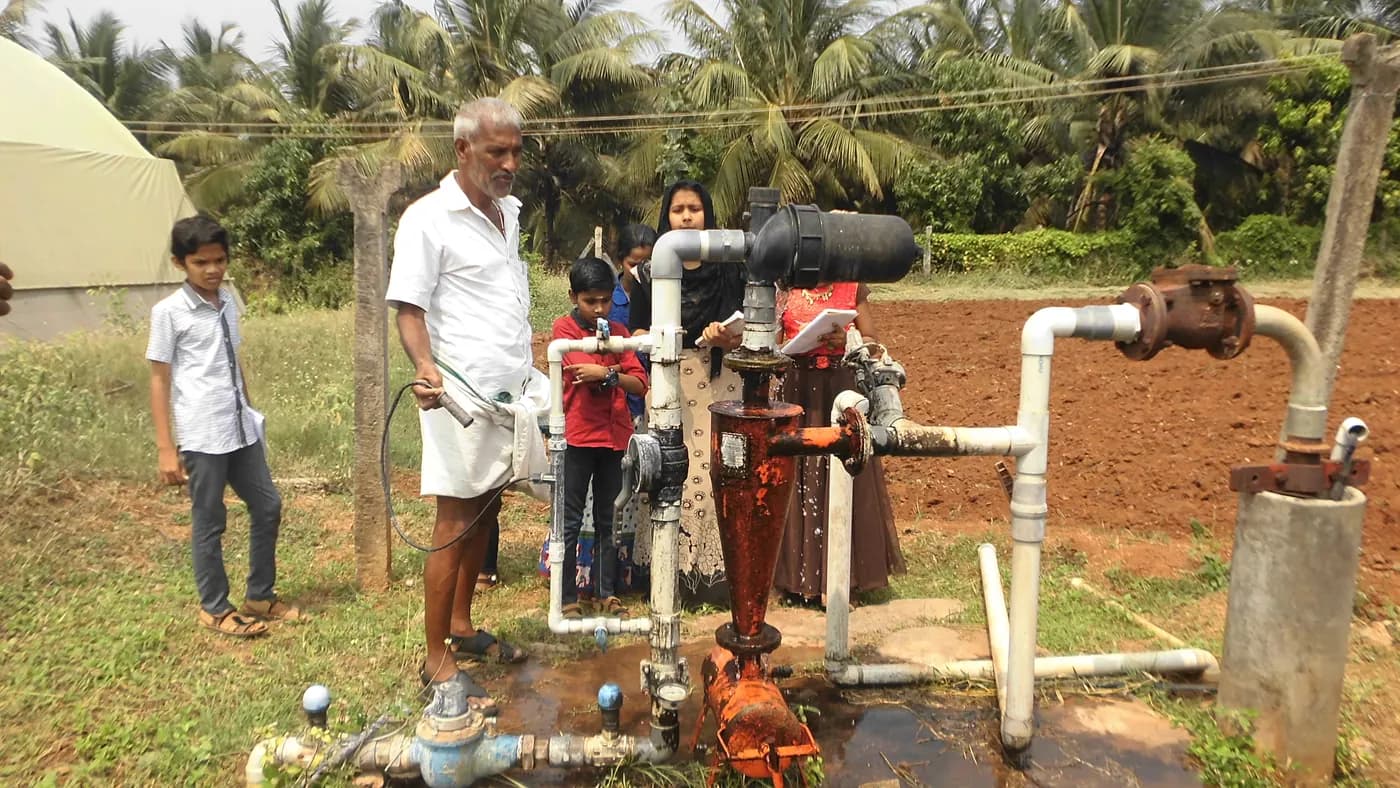
Irrigation filtration removes selected contaminants from farm water before they reach valves, fertilizer equipment, drip tape, dripline and emitters. A filter should be chosen from the water source, a representative sample, the smallest downstream water passage, zone flow, allowable pressure loss and cleaning plan. Connection size alone does not establish filtration capacity, and one element cannot correct every biological, chemical and mineral problem. This retail guide compares screen, disc, media and hydrocyclone products, shows when stages may be combined and turns field measurements into a complete purchase checklist.
Identify the water contaminant before choosing a filter body
Collect water while the source operates under representative conditions. A canal may change after rain or maintenance; a reservoir can change with season and depth; a well may produce sand during start-up or drawdown. Look for visible grit, silt, plant fragments and biological material, but do not assume clear water contains no troublesome particles.
Record when each problem appears and whether particles settle, float or remain suspended. A clean container and consistent sampling point make comparisons useful. Where chemical precipitation, salinity, pathogens or dissolved constituents are concerns, obtain an appropriate laboratory analysis. Mechanical filtration captures particles; it does not automatically treat dissolved chemistry or disinfect water.
Utah State University Extension recommends evaluating the source, collecting a representative water sample and checking sediment and organic contaminants before committing to drip equipment in its agricultural drip-irrigation guidance. Use the result to define a filtration job rather than buying a familiar housing first.
Match the filter grade to the smallest downstream water passage
The protected device sets the filtration requirement. Drip-tape outlets, inline emitters, button drippers, micro-sprayers, control valves and fertilizer equipment have different passages and manufacturer requirements. When several devices share a filtered supply, design for the finest verified requirement among the equipment that can operate. A drip irrigation filter selection should name the observed sand or organic load and the emitter passage it must protect, then compare service access.
Read the exact data sheet for the chosen emitter variant. A product family may include several flow paths, spacings or discharge options. Do not import a generic mesh recommendation from an unrelated brand or assume that two products with the same nominal flow have the same passage.
Make a downstream list using the agricultural drip-system component checklist. The filter protects more than the final emitter: particles can interfere with regulators, meters, solenoids, small valves and injector check components before water reaches the row.
Understand what screen filtration does
A screen presents openings that intercept particles larger than its effective passage. It is easy to inspect and can be a practical choice for relatively low loads of hard debris when the selected grade meets the outlet requirement. Its usefulness depends on element area, construction, seals, flow and the way contaminants behave on the surface.
Sticky biological material can mat over a screen and cause pressure loss quickly. Very heavy sediment can also demand frequent service. In those situations a screen may still serve as a final stage, but a separator, media stage or larger cleaning arrangement may be needed ahead of it.
The 1–2 inch irrigation screen-filter family is a retail comparison point for compatible clean-water or sediment-control applications. Select the actual connection option and confirm its published grade, maximum flow, pressure and service orientation before adding it to the cart.
Understand how a disc element differs
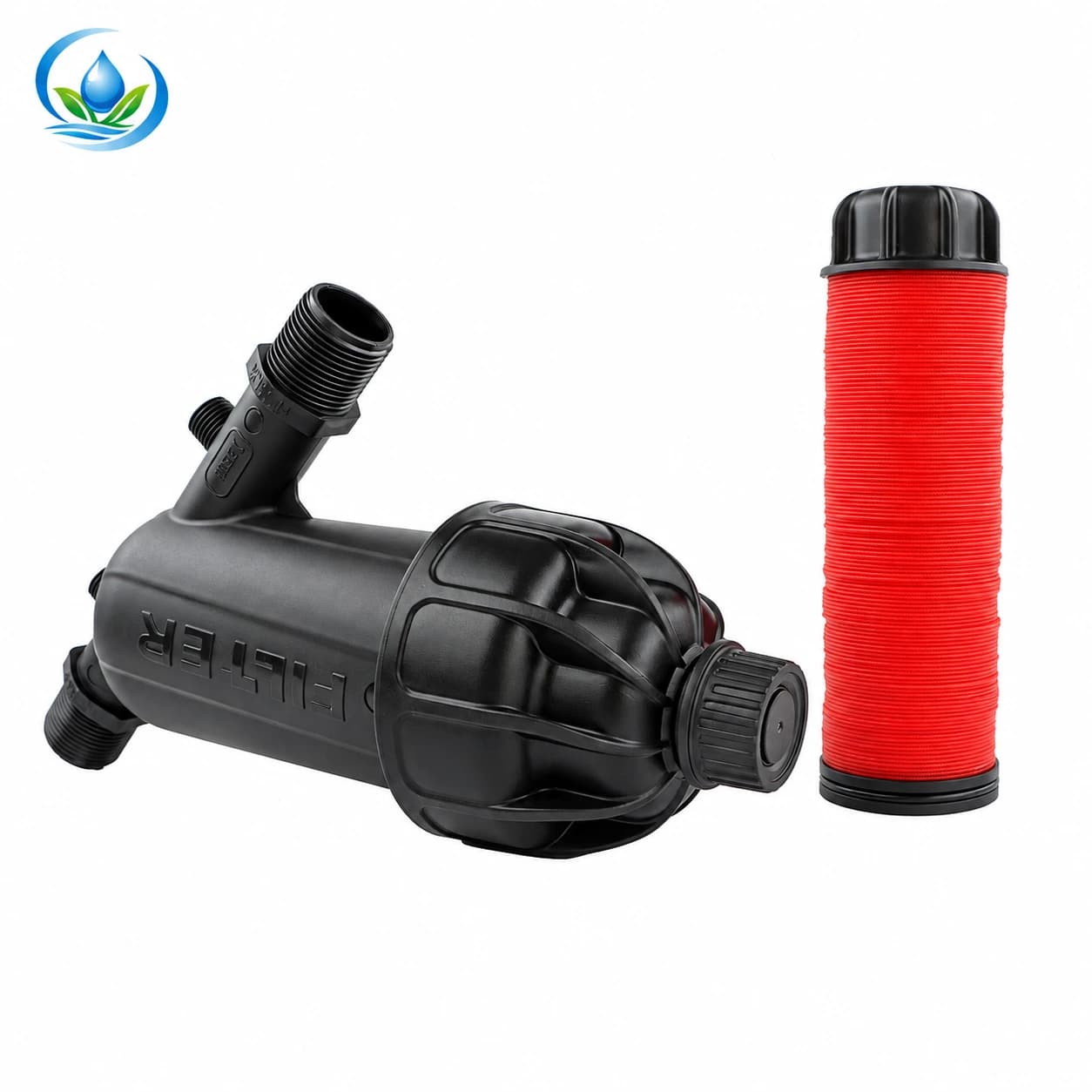
A disc cartridge compresses a stack of grooved rings to create many filtration paths. The three-dimensional path can retain a mixture of particles and organic debris differently from a simple screen surface. Performance still depends on the stated grade, stack compression, flow direction, seals and cleaning condition.
A disc element normally needs to be opened or released so its grooves can be cleaned thoroughly. Rinsing only the outside of a tightly packed dirty stack may leave material inside. Confirm that operators can reach the housing, remove the cartridge, separate or loosen the discs as instructed, rinse them and reassemble seals correctly.
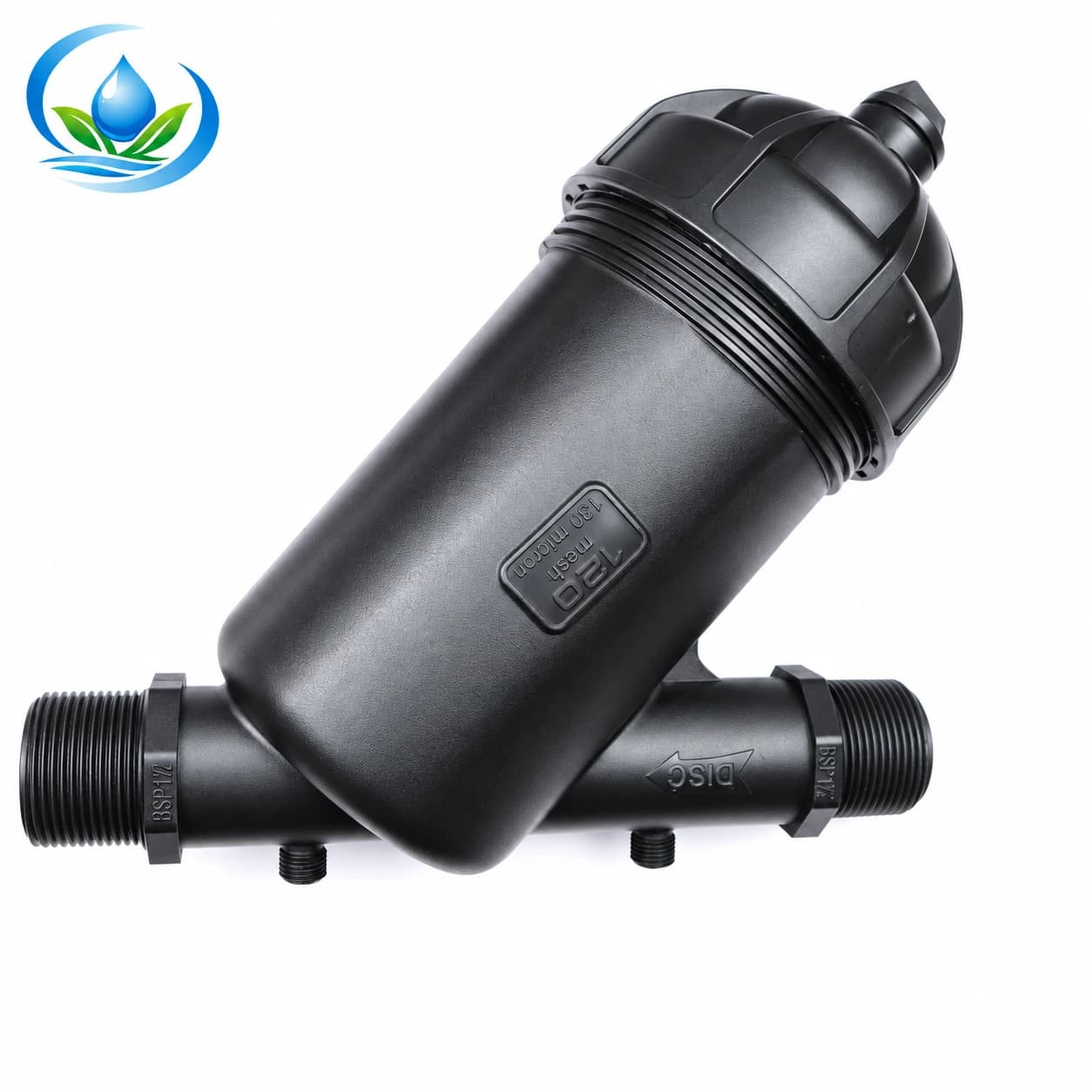
The Y-body disc filter offers multiple connection variants in the current store. Compare the chosen disc grade and flow information with the emitter requirement and zone calculation. A larger connector does not justify operating beyond the listed flow.
Use media filtration for suitable organic loads
A media filter passes water through a bed selected to retain contaminants. It can be useful where surface water carries algae and other organic load that would cover a compact element rapidly. The complete system needs the correct media specification, underdrain or collection arrangement, valves, pressure monitoring, a backwash path and a place for dirty discharge.
Media filtration is not simply a large empty tank. Bed type and depth, service flow and backwash flow must match the product documentation. Insufficient backwash may leave channels and retained material; uncontrolled backwash can lose media or disturb the bed. Confirm what is included in the item and what must be sourced separately.
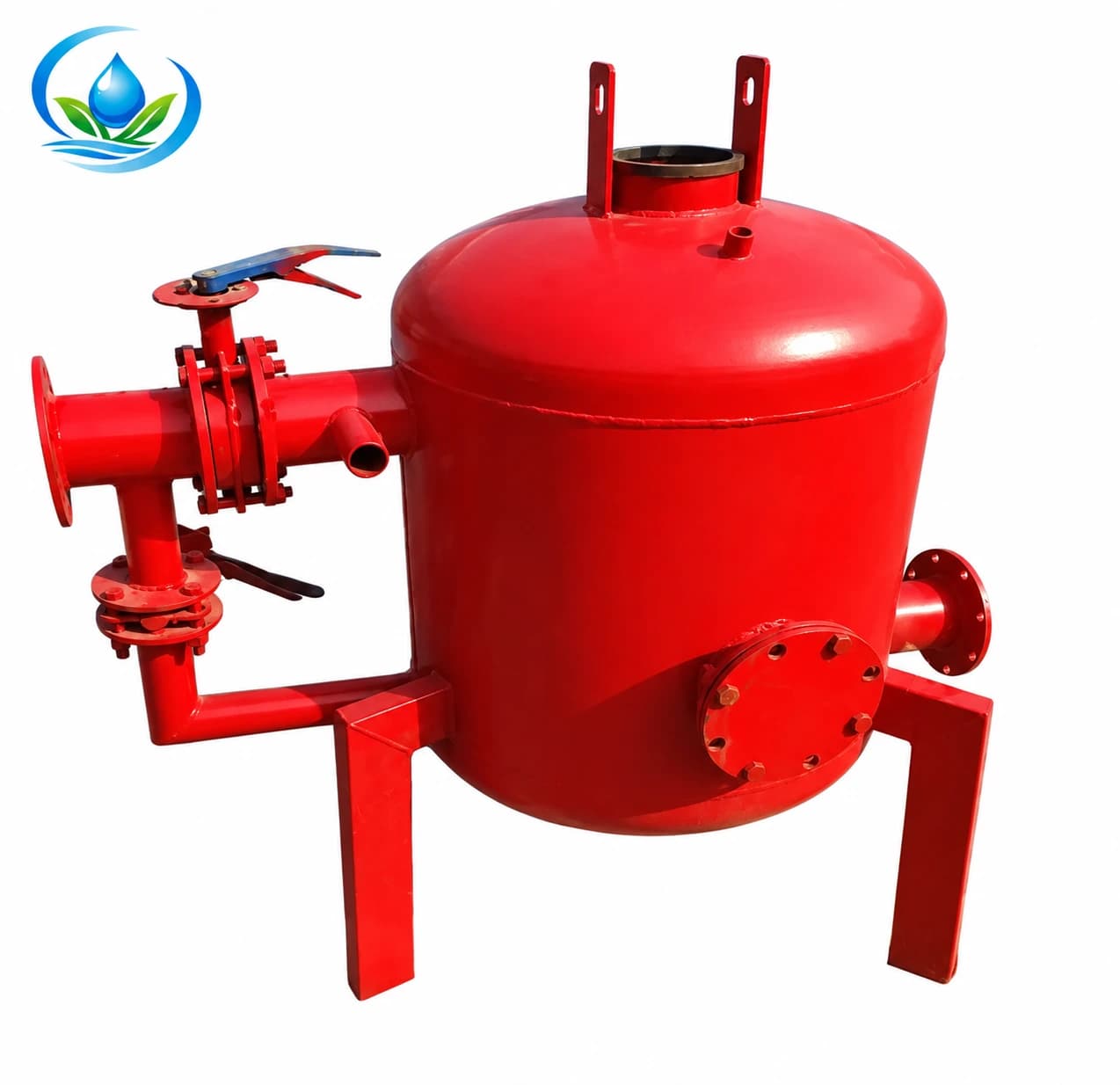
The single-tank sand media filter listing is a starting point for an agricultural head unit. Before purchase, write down the service and backwash cases, required valves, available space, drain route and whether irrigation must continue during cleaning.
Put a hydrocyclone ahead of final filtration when heavy sand is present
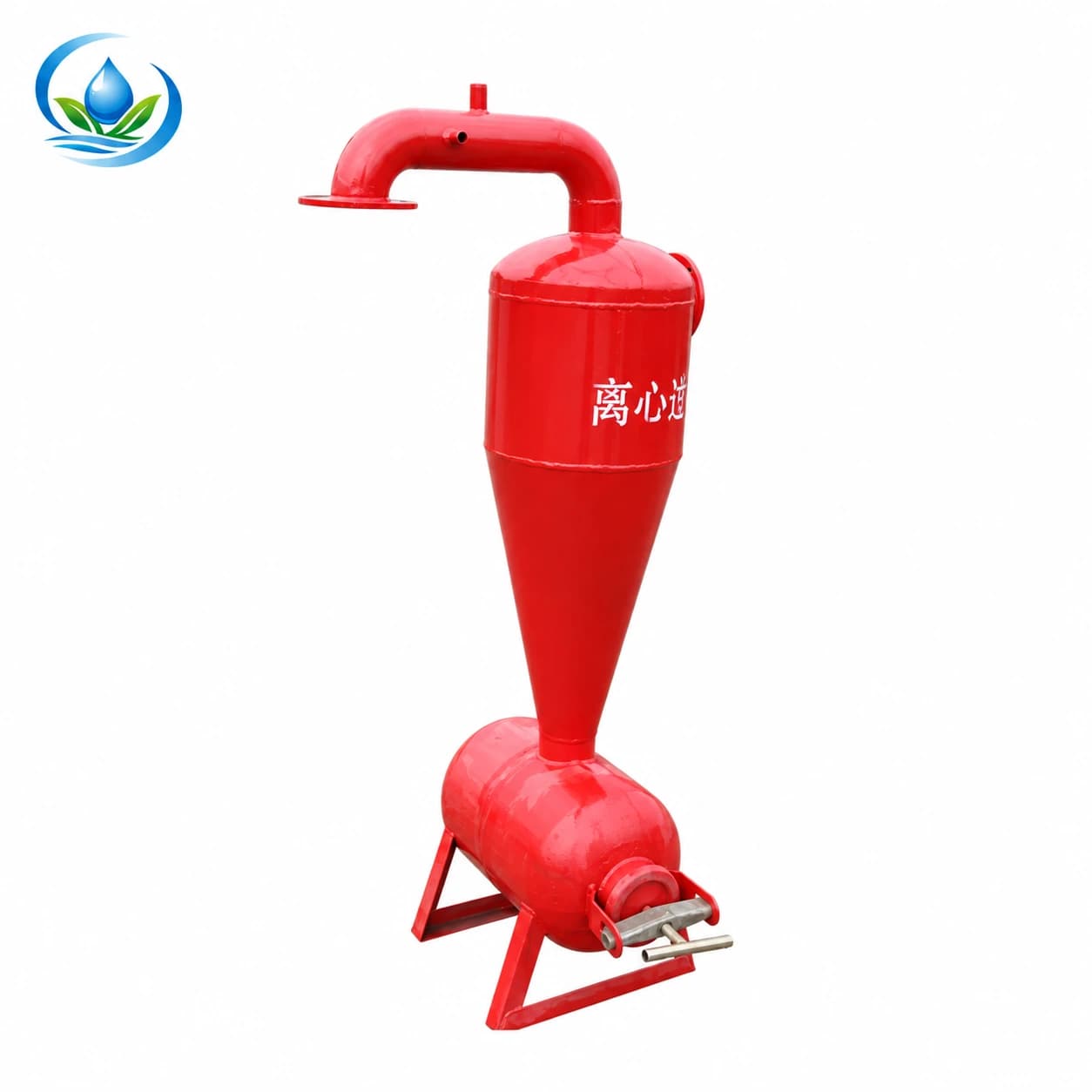
A hydrocyclone uses flowing water to separate heavier particles by their different motion and collects them for discharge. It is a separator rather than the final fine barrier protecting emitters. Fine and light particles can remain, so a screen, disc or other verified final filter normally follows when drip outlets require it.
Separation depends on operating flow and on the density and size of the material. A hydrocyclone chosen only by pipe diameter may not create the intended action at the actual zone flow. It also needs a safe, accessible sediment chamber or purge arrangement.
Compare the hydrocyclone sand-separator variants with measured flow and connection needs. Treat the downstream final filter as a separate cart line and include the valves and fittings required to isolate and clean both stages.
Build a filtration train instead of expecting one element to solve everything
A filtration train assigns each stage a job. A coarse intake barrier can stop leaves and large debris. A settling or centrifugal stage can remove suitable heavy particles. Media can handle an appropriate organic load. A disc or screen element can provide the final verified grade before drip equipment.
Not every farm needs every stage. Extra components add pressure loss, cost and maintenance. Use sampling, emitter requirements and observed loading to justify each one. The order should stop material before it can damage or overload the next component and should allow every stage to be isolated and serviced.
Draw the clean and dirty sides. Mark sample ports, pressure gauges, drain valves and bypasses. A bypass that can deliver unfiltered water to drip zones must have a documented operating rule or physical protection against accidental use.
Do not treat mesh and micron as interchangeable labels
Mesh describes a screen construction by opening count, while micron is a particle-size unit. The relationship can vary with wire or thread diameter and element design. Disc manufacturers may also publish a nominal grade that should be taken from their own documentation rather than from a generic conversion chart.
Use one verified requirement and confirm the selected element meets it. A higher mesh number usually describes a finer screen within a comparable system, but “higher” is not automatically better. Finer filtration loads faster, increases cleaning demand and may add pressure loss without solving dissolved or biological problems.
Record the exact replacement element as well as the housing. If several grades fit the same body, a later operator must be able to identify which one belongs to the installed emitters. Colour alone is not sufficient unless the manufacturer's current documentation assigns it unambiguously.
Size the filter for normal, maximum and cleaning flow
Calculate the simultaneous outlet demand for each permitted zone using the drip-irrigation flow guide. A shared head filter must pass the combined flow of all valves allowed to open together. A per-zone filter sees its zone only, but may experience different minimum and maximum cases as rows close.
Compare the calculated value with the published working range of the exact filter variant. Leave a reasonable operating margin rather than selecting at a theoretical maximum. A filter near its limit can develop greater loss as it loads and may require cleaning too often for the available labour.
Backwash or flushing can demand a different flow from normal irrigation. Determine whether the source can provide it at the required pressure and whether irrigation continues at the same time. A twin arrangement may be considered when continuous supply is necessary, but its valve logic and combined flow must be planned.
Budget pressure loss from clean to service condition
A filter consumes pressure even when clean, and the loss rises as contaminants accumulate. The hydraulic plan must leave enough pressure for regulators, fertilizer equipment, distribution pipe and the last emitters after a realistic service loss. Do not size from static source pressure.
Provide pressure measurement on both sides when the installation and product allow. The difference is more useful than one gauge because it separates source variation from filter loading. Set cleaning decisions from the manufacturer's limit and the field baseline, not from a universal number copied from another filter.
Use the zone-planning guide to check combined flow and the farthest row. If a larger body lowers loss at the required grade and flow, compare the total cost with the labour of frequent cleaning; connection size remains only one field in that decision.
Check housing pressure, connection standard and orientation
Confirm maximum working pressure against the highest credible pressure, including pump control behaviour, static periods and surges where applicable. Verify whether the housing is rated for continuous pressure in the intended position. Protect the filter from loads created by unsupported pipe or forced alignment.
Write both connection size and standard. Nominal inch labels can use different threads, and a millimetre pipe connection may require a specific adapter. Confirm male or female ends, gasket or thread sealing method, and whether unions are needed for cartridge removal.
Follow the flow arrow and required orientation. Leave clearance to unscrew the cover and withdraw the full element without dismantling the surrounding head unit. Measure this service envelope before buying a large body for a confined pump room.
Place filtration in the correct relationship to valves and fertigation
A central filter before a manifold protects the downstream valves and all zones, but it must be sized for every allowed simultaneous flow. Individual filters after valves can be tailored per zone and isolated separately, but multiply equipment and maintenance points. Some sources justify preliminary filtration before the pump or storage stage as well.
Fertilizer injection adds another question. The source water should be filtered sufficiently to protect the injector, while precipitate or undissolved material introduced during fertigation may require downstream protection. Chemical compatibility, backflow prevention and local rules remain separate requirements.
Draw the complete head-unit order and label every clean-water flush path. Never create a bypass that sends untreated water directly into drip tape during normal use. If maintenance requires temporary bypassing, close the zones it would expose and document the sequence.
Plan cleaning before purchasing the filter
Ask who will clean the unit, how often it can be inspected, where dirty water will drain and how heavy a wet element will be. A compact inexpensive filter that needs attention twice during every irrigation event may cost more in labour than a larger serviceable choice.
Screen elements need careful removal and washing without tearing or deforming the mesh. Disc stacks need grooves exposed and fully rinsed before correct compression. Media systems need a verified backwash sequence. Hydrocyclones need accumulated sand purged before the chamber fills.
Include replacement seals and the correct spare element where downtime is costly. Store them clean and labelled. Do not use a brush, chemical or pressure washer unless the product instructions permit it. Damaged elements can look clean while allowing harmful particles through.
Compare listed products as a retail buyer
| Published family | Primary comparison | Additional cart checks |
|---|---|---|
| Screen filter | Verified grade, operating flow, pressure and element area | Connection standard, removal clearance, spare screen and seals |
| Disc filter | Verified disc grade, flow, pressure and cleaning method | Stack access, replacement cartridge, gauges and isolation |
| Media filter | Water load, service flow and backwash requirement | Correct media, valves, drain, gauges and service space |
| Hydrocyclone | Heavy-particle load and actual operating flow | Purge arrangement and downstream final filtration |
Open the exact option before checkout. Catalogue families can contain different connections and capacities. Copy the selected item number and specification into the zone sheet instead of relying on the first image or broad category description.
Use a complete filtration cart checklist
- Selected filter stages and the contaminant assigned to each.
- Exact element grade supported by the downstream product requirement.
- Normal, maximum, minimum and cleaning flow cases.
- Clean and service pressure loss in the zone pressure budget.
- Correct inlet and outlet adapters, unions, seals and supports.
- Isolation, drain, flush and backwash valves required by the layout.
- Pressure gauges or ports where differential monitoring is planned.
- Replacement element, seals and safe cleaning supplies.
Keep quantity and package contents explicit. A catalogue installation photograph may show gauges, valves or manifolds that are not included with the filter body. The selected product record, not the photograph, controls what arrives.
Commission the clean and loaded system
Flush new upstream pipe before exposing the element to construction debris. Confirm flow direction, seals, drain closure and support. Open water gradually, vent trapped air as designed and inspect the entire housing and connection set at operating pressure.
Record source pressure, inlet pressure, outlet pressure and flow when the element is clean. Inspect water or retained material during the first events. A rapidly rising differential indicates the source load or surface area differs from the assumption; removing the element is not an acceptable operating correction.
After cleaning, verify that pressure loss returns close to the clean baseline and that the element is intact. At representative drip rows, compare near and far pressure and collect equal-time emitter samples. Filtration protects passages, but uniform delivery still requires sound hydraulics and flushing.
Avoid common filtration purchase errors
- Choosing by pipe connection without checking flow and element grade.
- Buying a fine element before identifying the contaminant and cleaning load.
- Using a hydrocyclone as the only barrier for small drip passages.
- Expecting mechanical filtration to correct dissolved chemistry.
- Ignoring dirty-element pressure loss in the far-row budget.
- Installing a body where its cartridge cannot be removed.
- Omitting backwash flow, drain route, spare seals or gauges from the cart.
- Operating an unprotected bypass into drip zones.
Frequently asked filtration questions
Is a disc filter always better than a screen?
No. Their loading and cleaning behaviour differs. Choose from the contaminants, verified grade, flow, service method and downstream requirement.
Does a well always need only a screen?
No. Wells vary. A representative sample may reveal heavy sand, fine sediment, biological growth or chemistry requiring different stages or treatment.
Can I select a filter by connection size?
Connection is one compatibility field. The element grade, operating flow, pressure limit, pressure loss and cleaning access must also match.
Where should a hydrocyclone go?
Where suitable heavy sand is present, it normally precedes the final screen or disc stage. Use the product's flow direction and operating range.
How often should the element be cleaned?
Use differential pressure, the manufacturer's limit and observed source load. A fixed calendar alone can miss a rapid seasonal change.
Turn the water analysis into a purchasable filter train
A reliable filtration order states what each stage removes, the required final grade, the flow cases, pressure budget, connection standard and cleaning procedure. It includes the valves, gauges, adapters, drains, replacement elements and space needed to keep the system working.
For a product compatibility review, send a water-source description, representative analysis, zone-flow table, pressure readings, downstream emitter requirement and proposed cart to IrriNex Store support. The review can compare currently published variants against those measurements without presenting a product as a substitute for water testing or complete treatment design.
Before you order
Compare this guide with the specifications for your exact product, selected option, water supply and field conditions. Your equipment requirements take priority over a general example.
Compare irrigation products