Impact Sprinkler Choices for Full-Circle and Part-Circle Zones
Compare centre and edge heads by working flow, water depth and run time. Decide whether one valve can serve both patterns before ordering the full quantity.
Published by IrriNex Store

An impact sprinkler near a field boundary has a different watering job from one in the middle of the crop. The centre head may need a full circle, while an edge head must sweep a permitted sector. Buying both with the same nozzle does not automatically give the crop the same water depth. A useful purchase comparison therefore asks two questions together: can the head make the required sweep, and can its application pattern work with the other heads on the same irrigation valve?
This guide is for a grower choosing replacements or adding edge positions to a small agricultural sprinkler block. It develops the decision to keep full-circle and part-circle heads together, specify a documented alternative nozzle arrangement, or operate the edge separately. The result is a position-based order, rather than a box of apparently similar sprinklers that need incompatible run times.
List centre and edge positions as separate jobs
Give every proposed position an identifier. Mark its crop area, permitted sweep, neighbouring heads and current supply valve. A centre position, a straight boundary and a corner are different jobs even when their risers have the same thread. Record the actual installation position rather than using the angle of the field corner as an automatic sprinkler setting. The head may stand inside the cropped area or beside an access track, changing where its two sweep limits belong.
For each position, distinguish a requirement from a confirmed capability. “Half-circle needed” describes the site; it does not establish that the existing head can operate that way. Check the exact offered model's instructions for full-circle operation, reversible sector operation, permissible limits and adjustment procedure. A lever or stop visible in a photograph is insufficient. Keep any unresolved arc feature on the comparison sheet before selecting a replacement quantity.
The field-edge arc guide covers the separate task of marking no-wet boundaries and observing a supported head at them. Use those boundaries as an input here. A part-circle setting cannot guarantee that wind will keep droplets inside a road or property line. Where that consequence is unacceptable, revise the position or irrigation method before deciding whether the edge and centre can share a watering event.
Do not multiply pipe demand by the fraction of a circle
Restricting a rotating head's sweep does not, by itself, create a proportionally smaller nozzle. With the same nozzle and operating pressure, a part-circle setting may continue to discharge approximately the same volume each minute while directing it over a smaller sector. Always use the actual documented or measured discharge for the selected configuration. A label of 180 degrees is not an instruction to halve the flow when sizing the supply.
Consider an explicitly hypothetical purchase: three full-circle positions and two half-circle positions run together. Suppose the selected configuration at each position is confirmed for the example to discharge 0.9 m³/h. The combined demand is five times 0.9, or 4.5 m³/h. It is not 3.6 m³/h obtained by counting each half-circle position as half a nozzle. A 30-minute event would deliver 2.25 m³ through those five outlets, before any separately counted system use. These numbers teach accounting; they are not ratings for the Store models discussed below.
The crop question is different from that pipe total. In a simplified geometric comparison, the same water volume spread over half the area would mean twice the average depth. Actual sprinkler delivery has overlap, nonuniform distribution, reversal behaviour, wind and soil effects, so this simple ratio cannot prescribe a field runtime. It does explain why an edge can become wetter than the centre even though both heads have the same flow and run for the same minutes.
Record full nozzle discharge in the hydraulic list and the observed water-depth pattern in the agronomic record. Keeping these two records separate prevents an apparently lower zone-flow estimate from concealing an overwatered edge. Changing an arc may solve a direction problem while creating a timing problem that still needs a purchase decision.
Compare working points before mixing head families
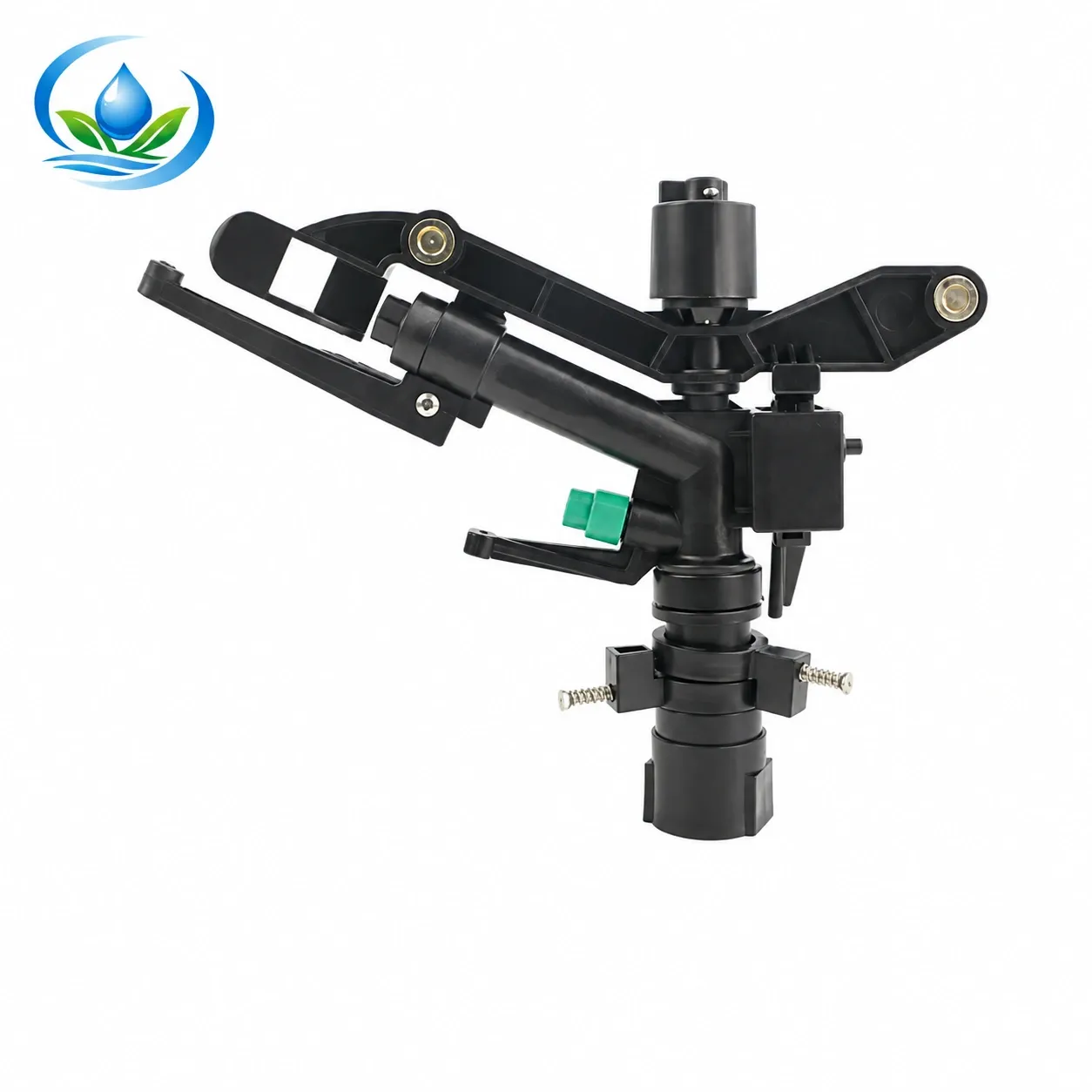
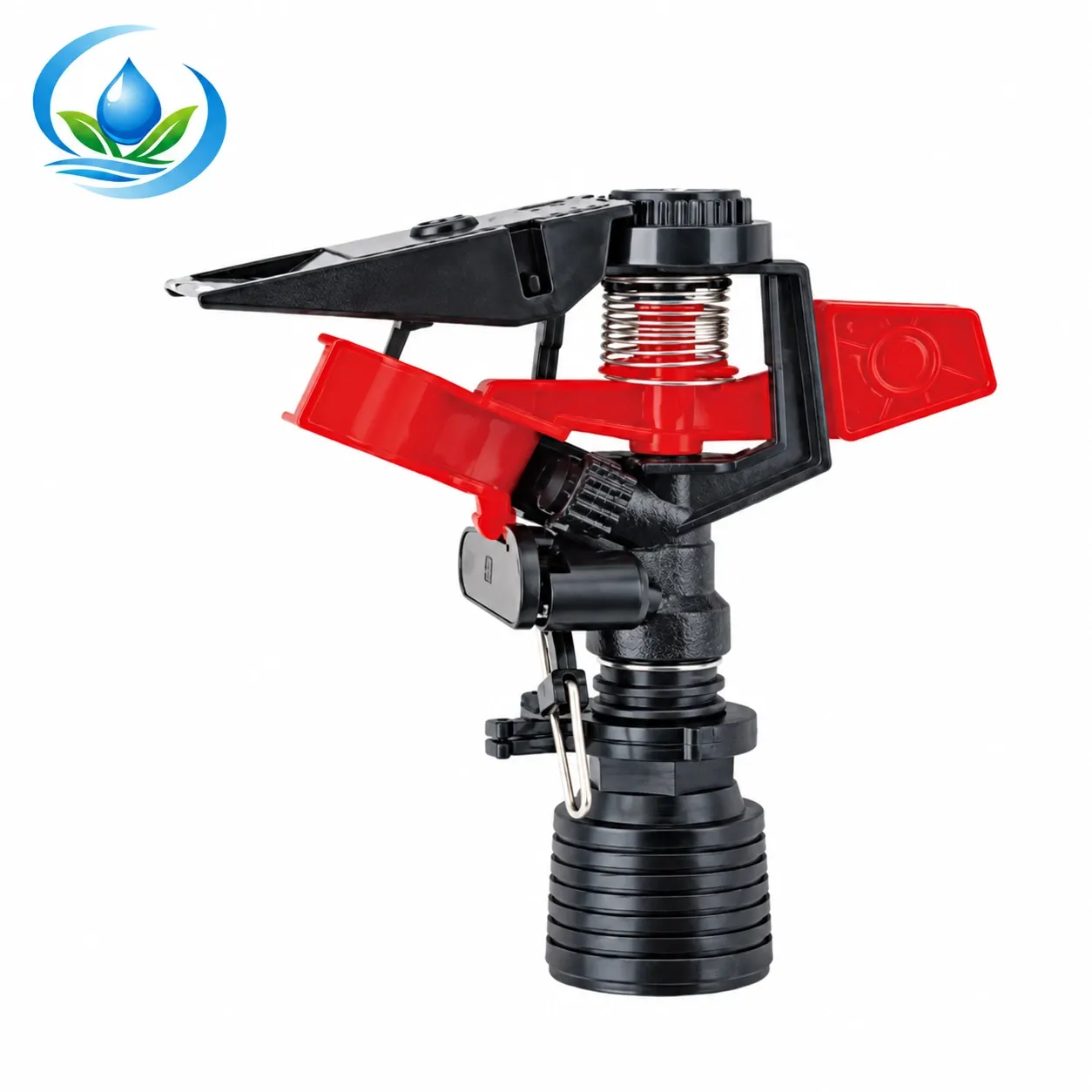
The S50 agricultural impact sprinkler has a listed 1-inch female inlet, a 2.0–5.0 bar working-pressure range and a 3.7–5.0 m³/h flow range. The S6-R adjustable impact sprinkler lists a 3/4-inch female inlet, 2.0–3.5 bar and 7.2–19.4 L/min. Those are catalogue ranges, not paired flow and pressure points, and the word adjustable does not supply its full sector instructions. Obtain the exact nozzle and operating table before treating either as the edge or centre choice.
Pay attention to units when comparing them. The S6-R's stated flow endpoints convert to 0.432 and 1.164 m³/h. That conversion makes the units comparable; it does not establish the pressure at either endpoint or show that a selected S6-R matches an S50's application pattern. A smaller flow is not automatically a matched half-circle option. Its radius, distribution and operating conditions may also differ.
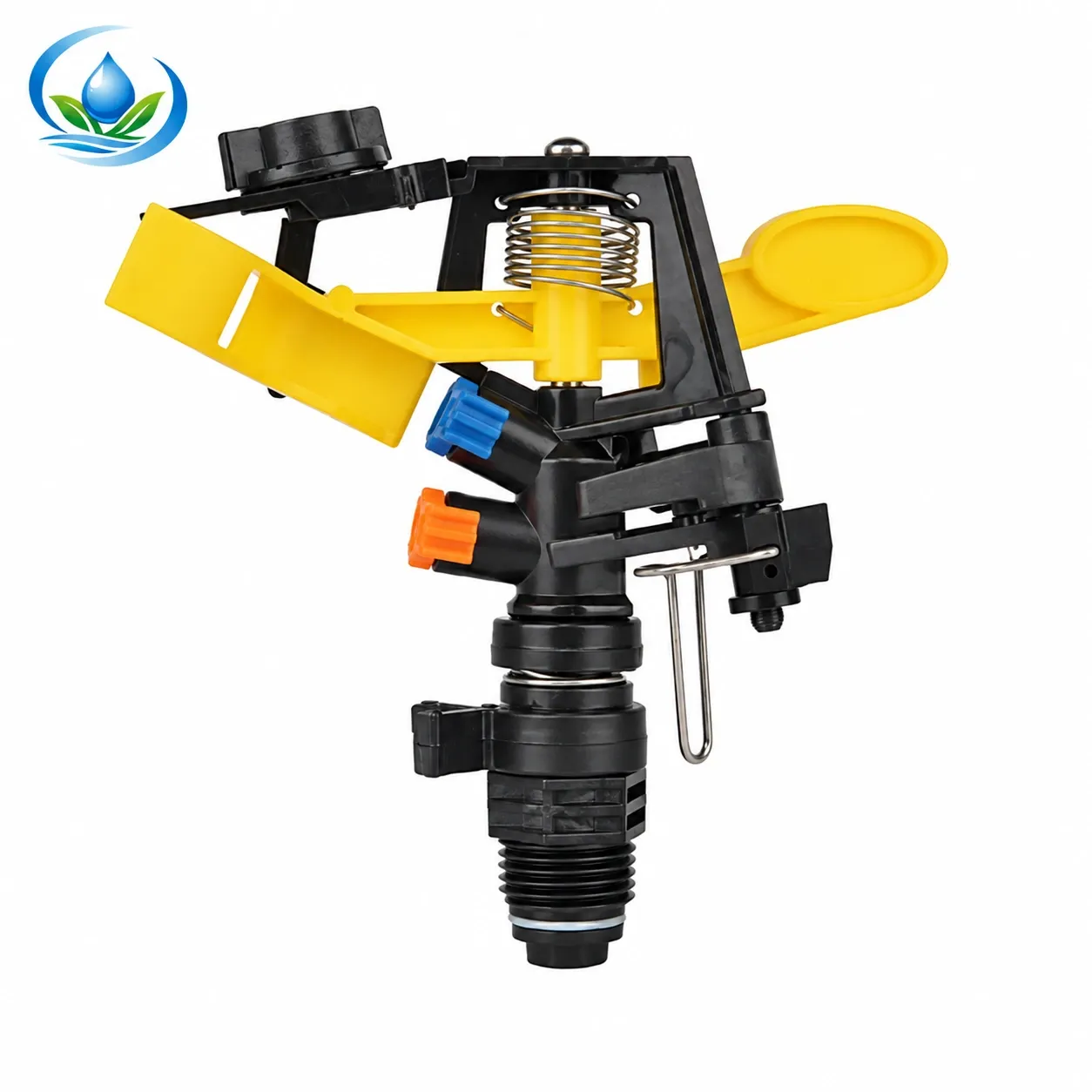
The 9703K plastic impact sprinkler lists 1.5–3.0 bar and 1.1–1.3 m³/h. It is a third family to investigate where its documented configuration suits the position, not a ready replacement simply because its flow looks nearer to a target. Do not infer sector control, interchangeable nozzles or the correct inlet from another model's information. The impact-head replacement guide helps organize those model and connection checks.
These three models do not currently offer direct online ordering. Confirm the exact option, supplied components, present price and availability through the product page before committing the field schedule. Keep model-specific flow, pressure and sector evidence with that confirmation. A published range cannot substitute for the data needed to combine different heads in one running group.
Choose between a shared zone and separate edge operation
A shared zone is practical when the confirmed heads and nozzles deliver a compatible water-depth pattern under the same event duration. Some sprinkler families provide documented nozzle selections intended to coordinate application across different arcs. Do not assume that feature exists for these Store models or that another manufacturer's nozzle fits. Ask for the exact supported head/nozzle combination and its spacing and pressure conditions, then verify it in the crop layout.
If a supported lower-flow option is proposed for the edge, review its throw and overlap again. Lower flow by itself does not prove that the first crop row and the gap toward the next head receive adequate water. Similarly, using a diffuser, radius screw or a partly closed valve to make the spray look smaller does not establish a matched application rate. Any permitted adjustment must follow the selected head's instructions and retain an acceptable observed pattern.
A separate edge zone can allow a different event duration when its required pattern cannot be coordinated with the centre. Count the additional accessible isolation or control parts, the operator's extra changeover and the demand when only that zone runs. Fewer active heads may change pump and line pressure. Verify that the smaller operating group remains within the supply equipment and sprinkler limits; the previous all-heads operating reading is not enough.
A third option is a revised position or a different irrigation method for the narrow boundary strip. That can be more workable than continually adjusting an unsuitable part-circle head. Compare the extra pipe, connection and operating work with the consequences of keeping the present layout. The purchase should solve the crop's delivery problem under routine operation, rather than only make a demonstration look tidy.
Test the edge and centre together before buying the full quantity
Trial the proposed arrangement with the same heads operating together that will share the valve in normal use. Record nozzle identities, sector settings, working pressures, run time, wind and the positions of collection points. Keep edge observations separate from the interior observations. An overall mean can hide a wet boundary beside a dry centre, which is exactly the mismatch this purchase needs to avoid.
Utah State University Extension's irrigation-uniformity guidance explains that pressure variation, spacing, worn or mismatched equipment and weather can change distribution. Check those causes before attributing every difference to the sector setting. A worn nozzle or a lower-pressure far riser can undermine the comparison even when the two heads have the intended arc.
For example, suppose a worksheet contains three illustrative interior collections of 10, 11 and 12 mm and three edge collections of 16, 17 and 18 mm during the same event. Their means are 11 and 17 mm. These invented figures show why a buyer should ask for a different combination or separate timing; they are not a measured result, a full uniformity assessment or recommended depths for a crop. Shortening the whole zone would reduce delivery to the already drier interior as well.
Use a properly planned set of collectors and repeat observations under representative conditions before accepting a design. The field catch-test guide explains the detailed measurement procedure. Inspect the soil for ponding or runoff and check the relevant rooted layer after irrigation. A head that stays inside its intended sweep can still apply water faster than the edge soil can accept it.
Include the riser, mounting and replacement parts
Once the water pattern is acceptable, check the complete installation at each type of position. An S50's listed 1-inch female inlet and an S6-R's 3/4-inch female inlet describe different nominal connections; neither label establishes the thread standard or an approved adapter chain. Record the existing riser's actual size, gender, standard and condition. Use the 3/4-inch head and riser check when a similarly named connection is creating uncertainty.
A reversing head must retain its orientation on a suitable support. Movement of the riser or stand changes where the sector falls even if its mechanism works. Check the manufacturer's mounting instructions, head clearance and access for permitted adjustment with the equipment isolated and depressurized. The riser and tripod guide covers the support assessment. Do not make a thread adapter carry a load or correct an alignment problem it was not specified to handle.
Ask which replacement nozzle, seal or other service part belongs to each selected model. A spare is useful only when its identity and function are clear. Label edge and interior spares separately if their confirmed configurations differ, even when the bodies look the same. Do not assume a separately sold nozzle or repair pack exists merely because the product photograph shows a removable component.
Order by accepted position type and retain the settings
Split the final order into centre assemblies, edge assemblies, confirmed adapters and supports, and deliberately chosen spares. In the five-position example, the three centre and two edge positions remain separate lines even if the final decision uses the same body at all five. State the nozzle, confirmed arc function and supplied contents beside each line. If the edge moves to a separate zone, add its confirmed control and connection parts instead of assuming they arrive with a head.
Keep the trial map and operating record with the installed equipment. Mark which heads run together and which approved configuration belongs at each riser. When a damaged head is later replaced, this record prevents a convenient spare from quietly changing the field's water balance. Recheck the edge and centre after any nozzle, pump, zone or support change that affects the accepted arrangement. The best replacement is the one that preserves the verified delivery task, not simply the one with the same inlet size.
Before you order
Compare this guide with the specifications for your exact product, selected option, water supply and field conditions. Your equipment requirements take priority over a general example.
Compare irrigation products