Sprinkler Head Gallons per Minute: Read US and Metric Flow Labels
Identify whether a sprinkler's GPM label uses US or Imperial gallons, then compare its documented head and nozzle flow with metric ratings.
Published by IrriNex Store
Sprinkler head gallons per minute is a useful shopping figure only when the label says which gallon it means. A head advertised at “6 gpm” could mean six US liquid gallons or six Imperial gallons each minute. Those are different water volumes. Before comparing that listing with an IrriNex head rated in litres or cubic metres, copy the original label, confirm the gallon definition and keep the head, nozzle and operating condition attached to the number. Keep the nozzle and operating pressure beside each converted rate; matching units alone do not make two different operating points comparable. Sprinkler head gpm unit conversion needs the named gallon type, nozzle and operating pressure attached to the rate.
This guide helps a grower translate one documented sprinkler-flow entry for a purchase comparison. It does not choose the number of heads in a zone or predict where their spray will land. The immediate output is a short record that another person can check: original rate and unit, named gallon, time basis, conversion factor, metric result and the exact product configuration to which the rate belongs.
Does this sprinkler gpm mean US or Imperial gallons?
Start with a photograph or saved specification of the offer. Write “6 gal/min” rather than “6 gallons,” and record whether the document calls the gallon US liquid or UK Imperial. A marketplace listing may abbreviate either as “gpm.” The seller’s country, price currency and pipe-thread description are not reliable substitutes for a definition in the actual flow data. If the definition is absent, ask the seller before putting the figure beside a metric product rating.
Find out whether the number applies to one complete sprinkler head, one nozzle in a multi-nozzle head, a set of operating heads or a pump outlet. Six gallons per minute from one head is a different purchasing fact from six gallons per minute for a whole line. Copy the model suffix and nozzle designation with the rate. For a double-nozzle head, the advertised discharge might represent both outlets together; it is not safe to assign half to each outlet without a model-specific breakdown.
Also preserve the condition under which the number was obtained. A table row may specify pressure at the head, nozzle size and perhaps a test configuration. A catalogue range may instead list pressure and flow as separate family ranges. Those two forms of evidence cannot be turned into the same claimed point. If a seller says “6 gpm at 40 psi,” keep the 40 psi beside the figure; if pressure is omitted, mark it unknown. The paired sprinkler-nozzle guide explains why the two outlets and their markings belong to the same head record.
Convert gpm to L/min only after identifying the gallon
The NIST Guide to the SI conversion table lists 3.785412 litres for a US gallon and 4.54609 litres for a Canadian or UK Imperial gallon. The displayed US figure is a rounded conversion factor in that table. For a transparent field comparison, multiply a rate in the named gallons per minute by its listed litres-per-gallon factor to obtain litres per minute. Multiply that result by 60 to display litres per hour.
For a purely hypothetical pair of labels, 6 US gal/min becomes approximately 22.7125 L/min, or 1,362.75 L/h. A separate label reading 6 Imperial gal/min becomes 27.27654 L/min, or 1,636.59 L/h. The printed numeral “6” stayed the same, while the represented water volume changed. Neither label describes an IrriNex product, a measured field discharge or a recommended operating point. The example shows why a bare “gpm” value cannot complete a purchase comparison.
A useful note next to the calculation is “factor and gallon convention confirmed from source.” If the seller later clarifies that “6 gpm” meant US gallons, retain that response with the original page capture rather than silently rewriting the source label. If the seller cannot identify the gallon, put two possible metric results in a provisional comparison and leave the product decision open. Selecting the smaller interpretation just because it fits an existing supply would turn an unknown into a false specification.
Keep per minute, per hour and cubic metres separate
The time denominator matters as much as the gallon. GPM means gallons per minute; GPH means gallons per hour. At the same named gallon and numerical value, a 6 GPH label represents one-sixtieth the hourly flow of 6 GPM. To compare 6 US gal/h with an hourly metric rating, multiply six by 3.785412 to obtain about 22.7125 L/h. Do not multiply by 60 again. For 6 US gal/min, the same first multiplication gives 22.7125 L/min and a second multiplication by 60 gives about 1,362.75 L/h.
Check a copied table for “per head,” “per nozzle,” “per line” or “per 100 feet” beside the time unit. A line rating already aggregates whatever outlets its stated length contains. Treating it as an individual-head rate would inflate a proposed order. Conversely, a per-head rating cannot describe a whole running block until the actual installed models and simultaneous conditions are known. The sprinkler zone flow worksheet deals with that later head-count calculation; keep this label check to one rate and its identity.
When the comparison sheet uses cubic metres per hour, convert one cubic metre to 1,000 litres. Thus 1.2 m³/h is 1,200 L/h and 20 L/min. Those two values are equal descriptions of one flow, because 20 × 60 equals 1,200. Neither value becomes the discharge of an unknown head simply because the arithmetic is valid. The original model and pressure information still decide whether the number belongs in the buyer’s comparison column.
Compare the IrriNex heads in their original metric units first
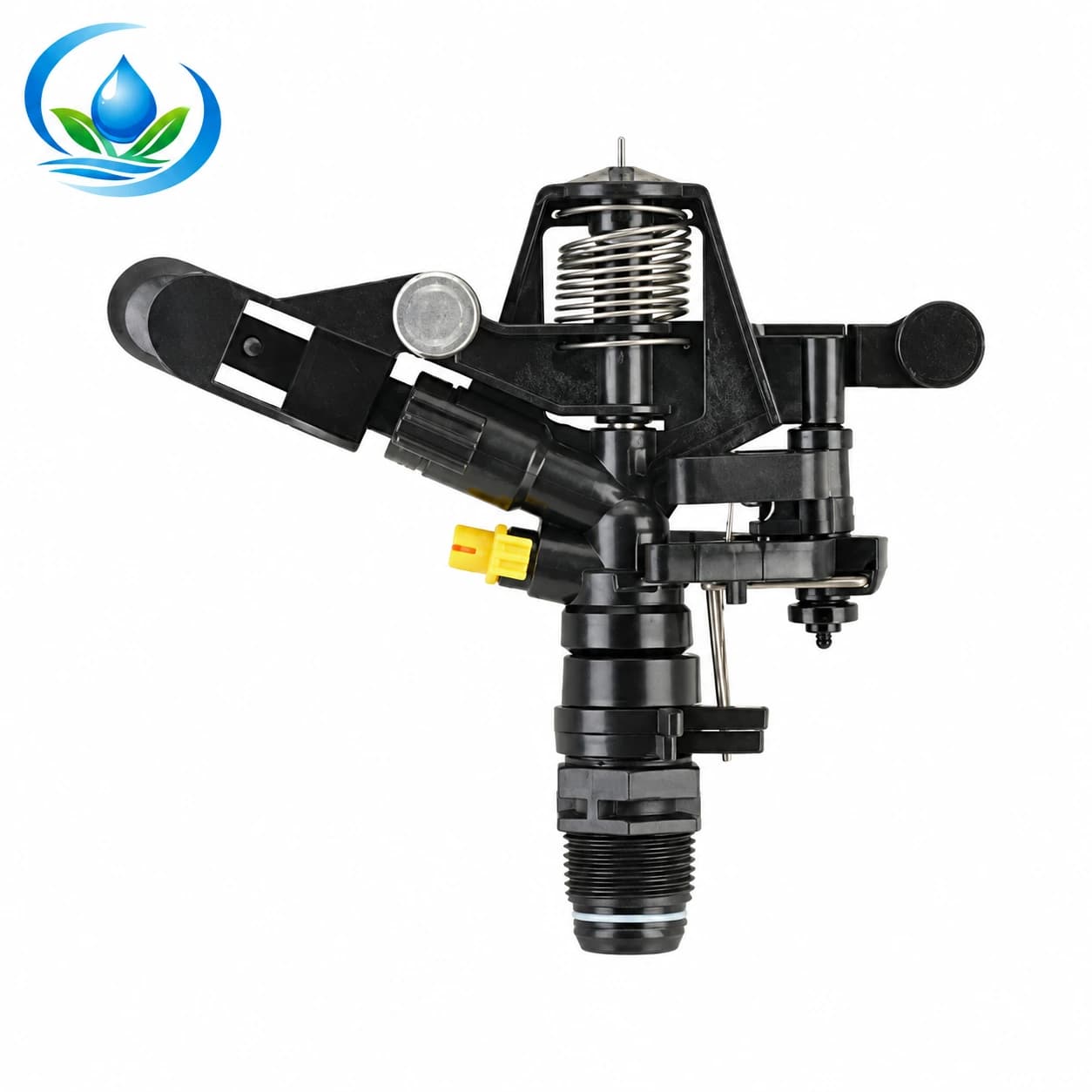
The S30-1 double-nozzle impact sprinkler listing identifies a 5.0 × 2.5 mm nozzle set and a flow interval of 11.6–41 L/min. It separately lists 2.0–5.0 bar of working pressure and a radius interval of 13–18 m. Write the flow exactly as listed before making a gallon conversion. The two flow endpoints correspond arithmetically to 696 and 2,460 L/h. Using the rounded NIST US-gallon factor, they are about 3.06 and 10.83 US gal/min. These are converted endpoints of the listed flow range, not a table pairing either endpoint with 2.0 or 5.0 bar.
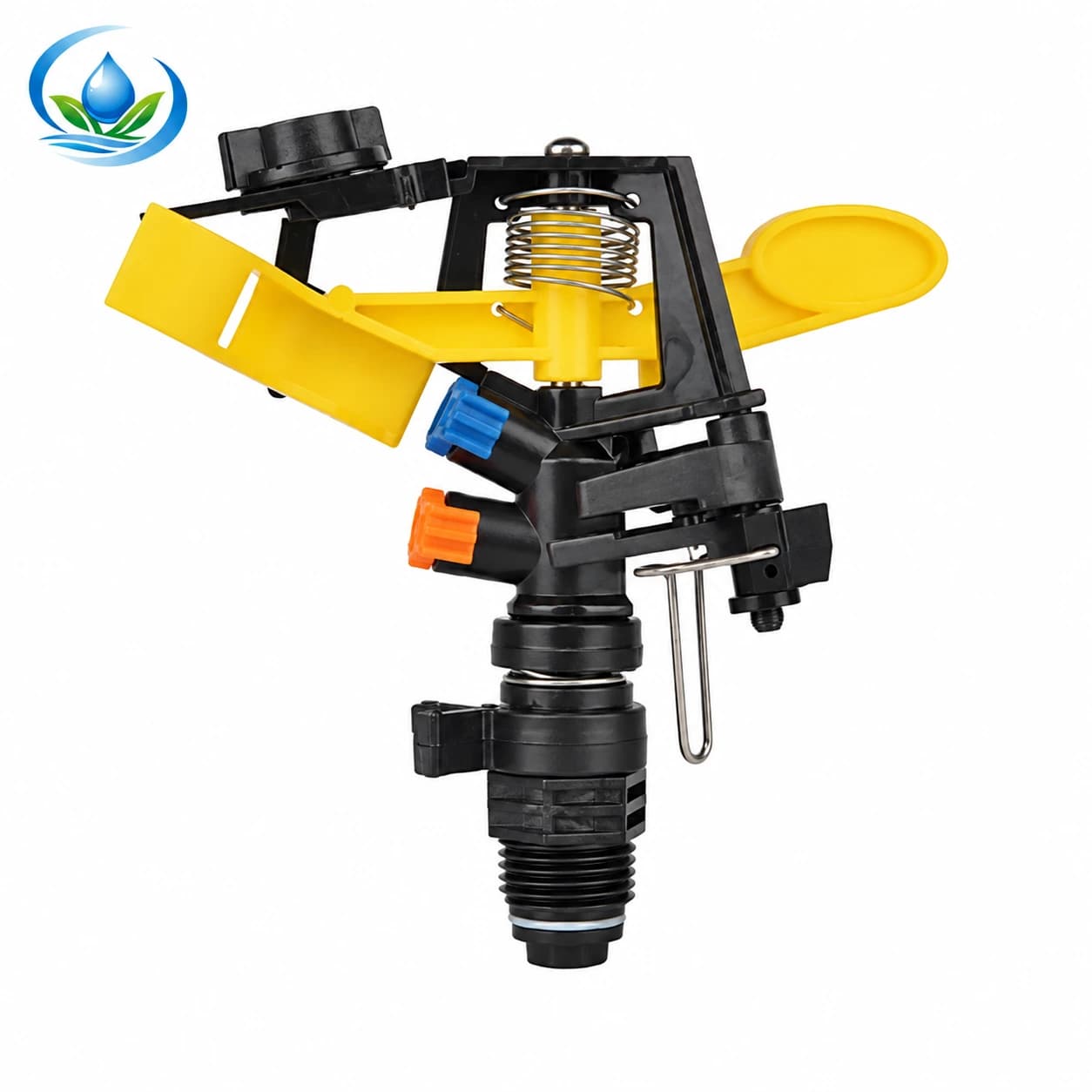
The 9703K plastic impact sprinkler has a 4.0 × 1.8 mm nozzle entry and a listed flow interval of 1.1–1.3 m³/h. Its independent pressure interval is 1.5–3.0 bar, while the radius interval is 6–7 m. The flow range converts to 1,100–1,300 L/h, or about 18.33–21.67 L/min. That is approximately 4.84–5.72 US gal/min using the same rounded conversion factor. It is a distinct product entry, not a second nozzle option for the S30-1 or evidence that either head runs at a particular converted endpoint under a named pressure.
Converting both ranges into US gal/min can make a foreign label easier to read, but it does not make the heads interchangeable. The S30-1 and 9703K differ in nozzle specification and wetted reach, and the pressure ranges are not a pressure-by-flow curve. The impact-head replacement guide covers the connection and model record for a physical swap. For the unit comparison, ask for the exact head and nozzle discharge at the pressure the proposed installation will actually supply before treating any converted rate as a performance match.
Use one line per claimed operating rate
A compact comparison card prevents a single attractive number from losing its meaning. Give each source its own line with the original wording, model, nozzle arrangement, whether the rate covers one head or more, pressure if stated, gallon definition, time basis, metric conversion and evidence reference. Leave blank fields visibly blank. If an online offer states only “6 gpm,” the card should say “gallon type unknown; pressure unknown,” even though both conditional conversions can be calculated.
Consider an old invoice that says “six GPM head” and a new page that says “1.2 m³/h.” First identify which old model and nozzle were supplied and whether the invoice meant flow per head or per set. Next ask whether “GPM” on that invoice meant US or Imperial gallons. The new number is 20 L/min after unit conversion; the old rate remains either approximately 22.71 or 27.28 L/min until its gallon definition is resolved. None of those figures confirms a direct replacement without the old and new operating conditions, connection and required coverage.
For a comparison involving an actual running head, record a measured flow and its measurement boundary separately from a catalogue rating. A source meter may include other irrigation branches, flushing or a tank change; its readout is not automatically one sprinkler’s discharge. The sprinkler event-water guide explains what an event total describes. Do not insert that whole-event total into a head-flow field or divide it by an arbitrary number of heads and call the quotient a tested head specification.
Ask for the missing product row, then check the offered item
If a foreign-language or imported listing gives a table, request the row for the exact model, fitted nozzle and working pressure. A pressure point from one nozzle and a flow point from another do not form an honest comparison. If the table instead supplies separate broad ranges, retain them as ranges and ask for the model-specific pressure–discharge information needed for the intended site. The low-pressure head checklist addresses whether the selected operating point can be supplied at the actual field position. Unit conversion answers only what the flow label means.
Bring the comparison card to the product page. Check the selected head and variant, current displayed price and sale unit, availability, delivery terms and what parts are included. A listed sprinkler head may require a separately identified riser or mating fitting. If a purchase option is not shown, send support the exact model and nozzle, the original GPM wording and your metric comparison, and ask about current availability and missing fit or operating data. Avoid ordering a visually similar head simply to resolve an undefined gallon label.
On receipt, compare the delivered model and nozzle markings with the accepted order record. Preserve the original documentation and conversion line, so the field crew can read the same discharge basis rather than a rounded number copied into a new unit column. Installation and field checking then follow the selected product’s instructions. If observed running pressure or spray differs from the promised configuration, investigate that discrepancy as an operating issue; changing US gallons to litres cannot correct it.
Three label questions that catch expensive mistakes
Does “gpm” always mean US gallons per minute? No. NIST lists a US gallon and a larger Canadian or UK Imperial gallon. A document must identify its convention, or its numeric GPM claim remains ambiguous. Seller location may prompt a question, but it is not proof of the unit used in a particular product table.
Can a converted catalogue range replace a pressure–flow row? No. The S30-1 and 9703K ranges allow correct conversions of their listed endpoints. They do not tell which endpoint occurs at a chosen pressure, what the installed head emits after pipe losses or whether the resulting spray covers the intended crop area. Keep the source range and ask for the relevant documented point.
Is L/h a more precise rating than GPM? The printed unit does not establish measurement precision. A figure such as “1,200 L/h” may be a rounded nominal rating, a converted seller value or a measured result under stated conditions. Record which kind it is, its model and its operating basis. A useful purchase comparison preserves that provenance and makes unlike units comparable without changing the underlying claim.
Before you order
Compare this guide with the specifications for your exact product, selected option, water supply and field conditions. Your equipment requirements take priority over a general example.
Compare irrigation products