Large Farm Irrigation Sprinklers: One Rain Gun or Several Impact Heads?
Compare one portable rain gun with a group of impact heads by operating flow and pressure, field coverage, complete parts and move labour.
Published by IrriNex Store
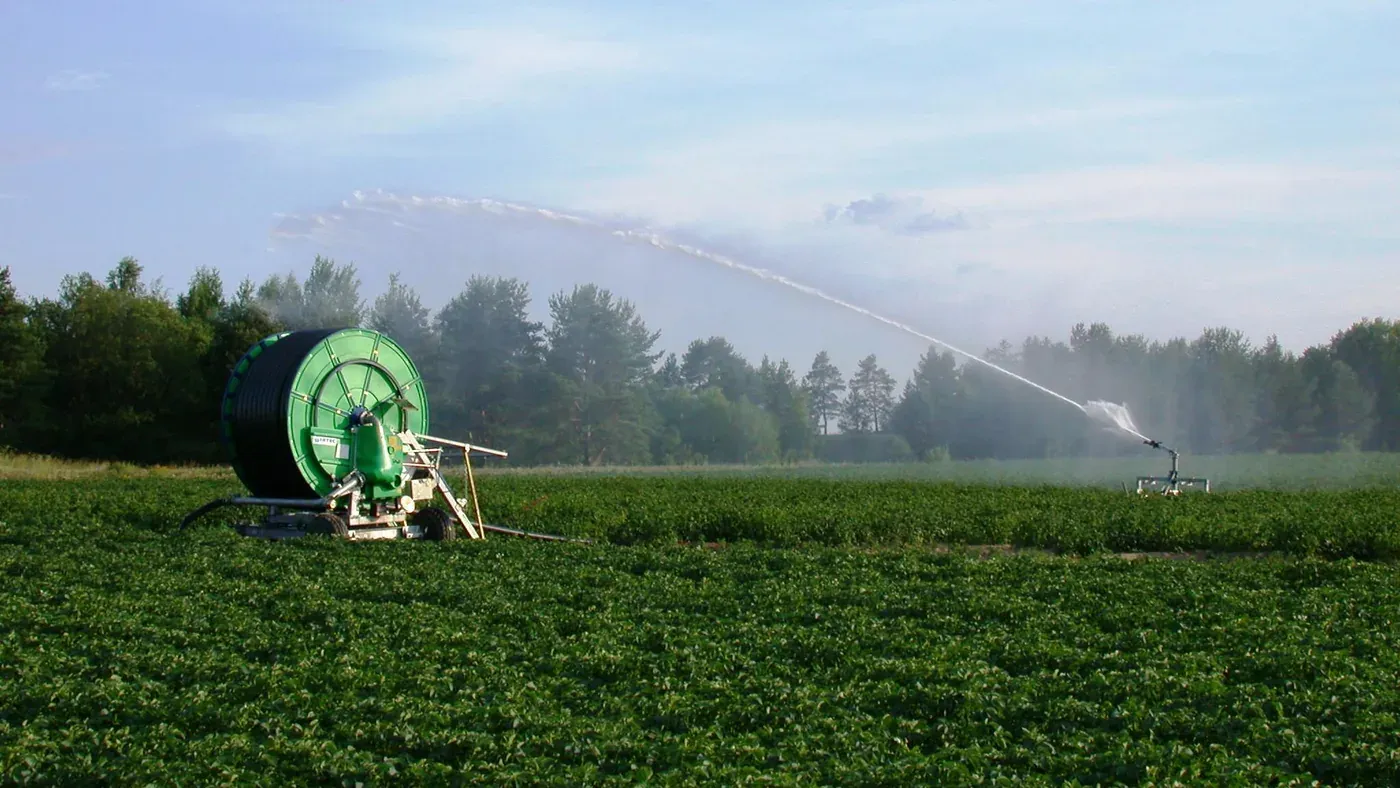
Large farm irrigation sprinklers can serve the same field in very different ways. One rain gun may visit several supported positions during an irrigation round; a group of smaller impact sprinklers may remain installed and run together or in separate valves. The buying question is which complete arrangement delivers the required water to the actual crop block with a supply the farm can support and a workload the crew can repeat. Start with the field boundary and the operating case, then compare the head models. A long advertised throw or a low per-head price cannot settle the choice.
Define the field block and the job each route must finish
Draw the area that needs water, not just its outside rectangle. Include crop rows, access lanes, roads that must stay dry, neighbouring land, trees, power lines, changes in elevation and any corner a circular spray cannot reach cleanly. Mark the water connection and the parts of the field a hose or fixed lateral can cross without obstructing cultivation or harvest. A field-edge constraint can matter more than the nominal radius printed for a head.
Write down the established crop water target and the time window in which this block must receive it. This article does not set that agronomic target. It makes the two hardware routes comparable against the same target. If the portable arrangement needs several stops, include every stop and the time to move between them. If the impact arrangement runs in two or three groups, include every group and its valve transition. A comparison that counts only the first gun stop or the first impact zone is incomplete.
Identify whether the decision concerns a new field block, a replacement for an existing head, or a change in operating method. Keep a working installation's measured delivery as the baseline. A dry strip may come from a blocked nozzle, changed pressure or a poor overlap pattern; buying a different format before diagnosing it may preserve the dry strip. For a head already installed, the impact-head replacement guide helps document its nozzle and connection. For a portable gun already selected, the portable rain-gun layout guide develops the separate stop-and-hose plan.
Count installed positions, operating heads and moves separately
A position is a place where a sprinkler works. An operating head is a head actually taking water at a particular time. An installed head is hardware left at a position even while its valve is closed. A move is a separate job of stopping, safely isolating, draining as required, disconnecting, carrying and reconnecting a portable assembly. These quantities lead to different parts lists and different labour requirements.
For example, a sketch might show five proposed gun positions but only one gun operating at a time. That is one active head, five locations to verify, and four transitions during a complete sequence if the first position is already set. A separate impact layout might show twelve heads installed in two valves of six. That is six heads operating at once if only one valve opens. The numbers do not say either layout wets the block correctly; they only prevent twelve installed heads from being mistaken for twelve simultaneous demands, or five gun locations from being mistaken for five gun purchases.
Give every position a label and record the actual route to it. A gun stop behind a ditch may require a long return along the headland. A fixed impact head beside a machinery lane may need protection or a removable riser, subject to the selected equipment instructions. Identify where unused outlets are closed and how the active route is isolated. Do not assume a quick connector can be opened under pressure. The time and equipment needed for safe moves belong in the purchase comparison, not in a later surprise during irrigation.
Use three listed sprinkler models as separate screening candidates
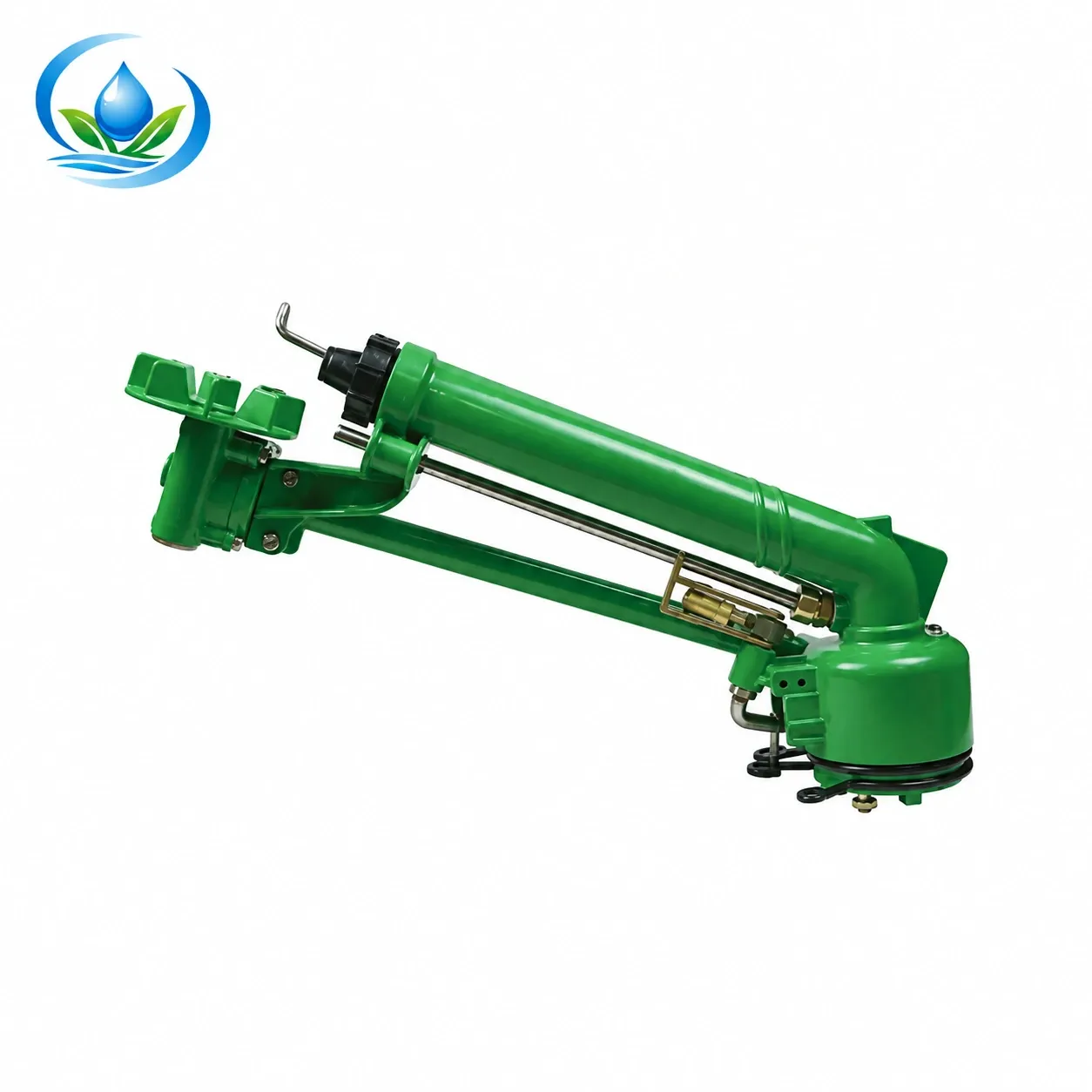
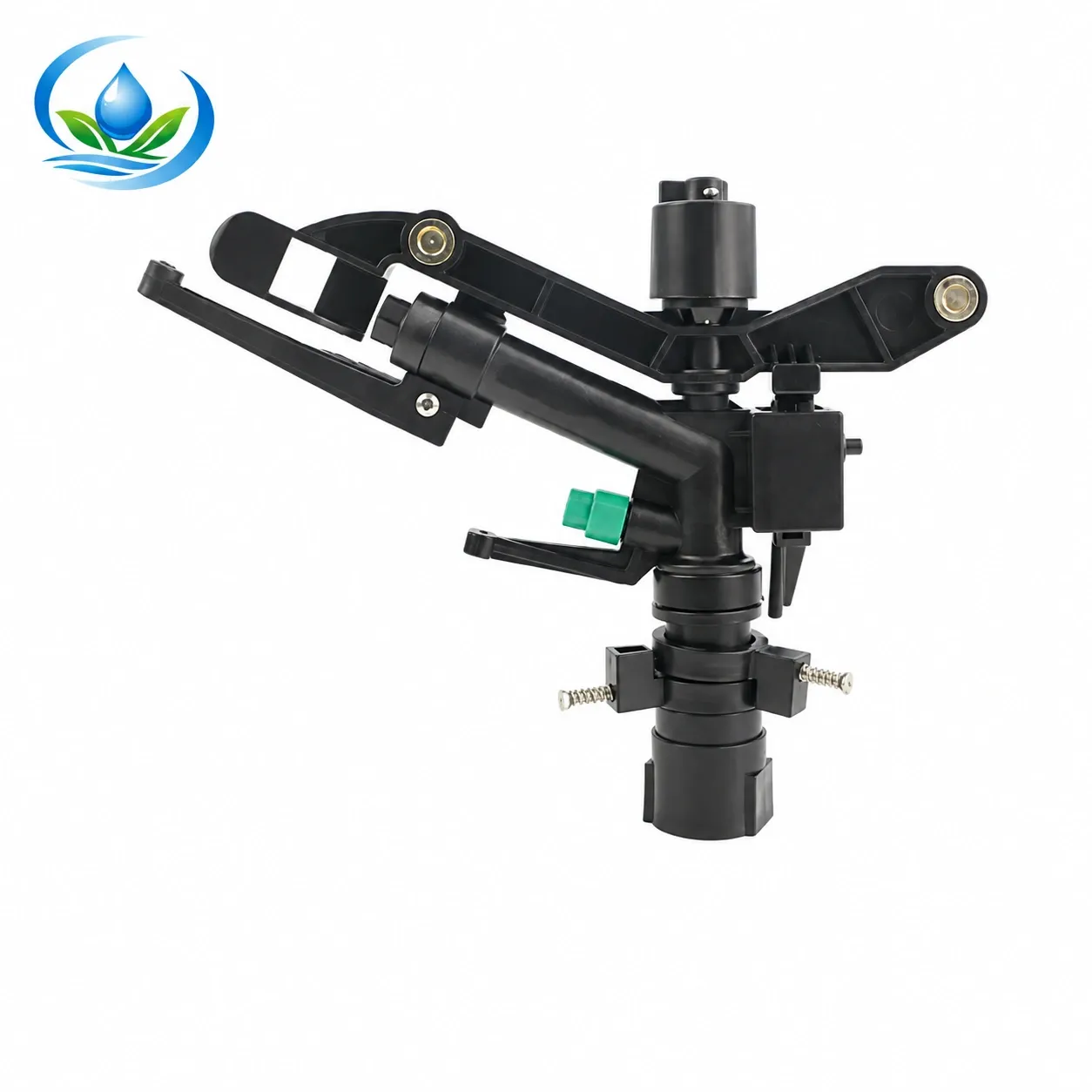
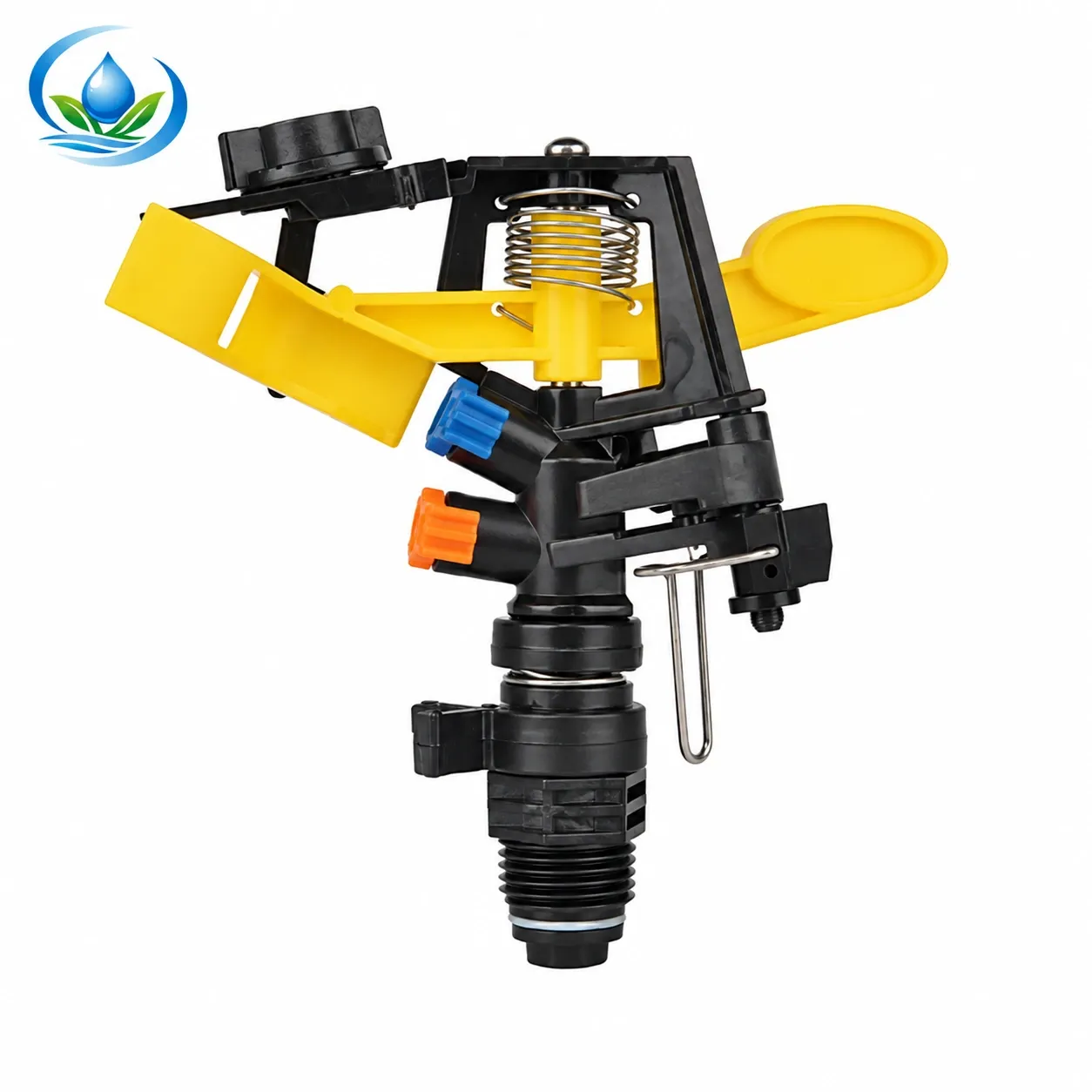
The P40 metal rain gun is one gun-format candidate. For that model the pressure interval is 2–5 bar; the separate catalogue entries give 9.5–37 m³/h for discharge and 22–41 m for spraying radius. The S50 impact sprinkler shows 2–5 bar, with a discharge interval of 3.7–5.0 m³/h and a radius interval of 15–17 m. The 9703K impact sprinkler has a 4.0 × 1.8 mm nozzle entry; its stated pressure is 1.5–3.0 bar. The separate discharge range is 1.1–1.3 m³/h, while its radius entry spans 6–7 m. These are different model entries and scales, not a matched gun-and-impact performance test.
Read every pressure, flow and radius interval as an independent catalogue range. The P40's 41 m maximum radius cannot be paired with its 9.5 m³/h lower flow endpoint to claim a low-demand wide-throw working point. Neither can the S50's 15 m lower radius be assigned to a convenient flow endpoint. Ask for a pressure, discharge and radius combination belonging to the exact proposed nozzle and model. Keep that point with the model code and the position where it must operate. A family photograph does not prove which nozzle, mount or hose connection arrives with an order.
A smaller head does not automatically become the cheaper route. A twelve-head impact arrangement needs the heads plus its actual risers, branches, valves, fittings and perhaps a different supply route. A gun route needs a suitable complete support, hose, connection and handling arrangement. Compare what is included in the selected offers and the current price of the exact configuration. All three product pages are useful model references, but their published listing does not establish immediate checkout, stock or delivery. Confirm the purchasing path and lead time for the components needed to finish the block.
Screen simultaneous flow at a real operating pressure
For impact heads, add the discharge of every head open in the proposed valve group at its documented operating condition. For one portable gun, use the gun's documented discharge at its selected condition, then repeat the pressure-loss check for each hose route. Do not calculate either total by using the lowest number in a broad flow range simply because it makes the proposed group look feasible. Mixed head or nozzle sizes require separate lines before the demands are summed.
Here is an arithmetic illustration, not an IrriNex performance claim. If six hypothetical identical impact heads have a verified discharge of 1.2 m³/h each at their chosen operating pressure, their simultaneous head demand is 7.2 m³/h. If a second valve of six will run only after the first closes, the head demand is still 7.2 m³/h per group, not 14.4 m³/h simultaneously. If both valves could open together, the case changes to 14.4 m³/h. A portable gun at a separately documented 12 m³/h would create a different single-head demand. The 12 m³/h is an invented example input, not a P40 rating at any named pressure.
Compare each demand with dependable supply while that pressure is maintained through the source, filter, valve, main pipe, hose or lateral, fittings and elevation change. A gauge with all outlets closed records static pressure. An open-ended hose or bucket measures another duty. Neither alone establishes the water available to a working gun or six impacts. The running-flow sprinkler head-count worksheet gives the flow screen for a selected impact group. It does not choose the group layout, gun support or crop application depth. If the source is a pump, review its curve at the required flow and head together; the pump comparison guide explains why separate maximum figures cannot be treated as one operating point.
Record the weakest normal source condition, the most demanding position and every other user allowed to run concurrently. If the gun route rises uphill or uses a longer hose at its last stop, the result beside the headworks may not represent that stop. If the impact arrangement opens six heads on a far branch, measure or calculate the working pressure at representative near and far heads. A pressure regulator cannot create pressure absent upstream. When neither route has a defensible working point, keep both as candidates and obtain the missing hydraulic evidence before ordering a fieldful of heads.
Compare actual wetting patterns, not drawn throw circles
Place the proposed working positions on a field map, including the neighbours that contribute water to the same ground. A gun's farthest visible drop is not a statement that its whole circle receives an adequate depth. Impact heads likewise depend on overlap, mounting, nozzle, pressure and wind. The Utah State University Extension discussion of sprinkler application uniformity explains why pressure variation, spacing, disrepair and weather can change the pattern. Those principles support field checking; they do not provide a spacing rule for the three IrriNex models.
Compare an interior area, a boundary and any awkward corner separately. A single gun may need a sector near a road, but do not assume that P40 has a particular part-circle setting or adjustment procedure from an image or another model. Obtain the exact unit's instructions if a no-wet boundary depends on the arc. A narrower working sector can put similar discharge on less ground during that stop; it does not automatically make the application gentler. Several smaller impacts may allow a different edge arrangement, but only if their documented arc options, supported mounts and operating groups meet the same boundary.
On an existing block, compare representative water depths rather than relying on appearance. The field catch-depth guide shows how to record water reaching named locations under a timed operating case. The decision here is which hardware format to buy, so use that measurement as evidence of an existing pattern or a supervised trial, not as a promised design result. Check soil ponding and runoff as a separate constraint. Extending a run to reach a dry corner may overwater another part of the block even if the head continues to turn normally.
Put labour, access and support on the same comparison sheet
A portable gun can reduce the number of heads purchased while increasing handling and set changes. Record how many moves complete the block, who makes them, the route walked, the hose length at each stop and the work possible during the farm's actual watering window. An illustrative four transitions at 18 minutes each would occupy 72 minutes of handling before counting water-on time; 18 minutes is not a universal move time. Time a safe dry-run with the proposed assembly if labour capacity is decisive. Avoid assuming that one person can move a water-filled hose and stand because the head itself looks compact.
Several installed impacts may reduce routine head moves while requiring more permanent fittings and later inspection locations. Work out how the valves will be identified and opened, what remains accessible after crop growth, and which risers risk machinery contact. Count installed positions separately from heads opened together. A spare head cannot stand in for an installed supported position, and a stand pictured beside a gun is not evidence that the stand is included. For elevated or movable impacts, the riser and tripod guide addresses the support purchase separately.
Both routes need a safe isolation method before a connection is removed. Follow the instructions for the actual pump, valves, hose and head. Do not hold an unstable pressurized sprinkler by hand, loosen a live coupling or improvise anchoring based on a photograph. Plan storage and access between irrigation rounds. If the block must be watered while another crew cultivates or harvests, mark the routes that cannot be obstructed. The practical winner can change when the water source stays the same but the crop access pattern changes.
Make a two-route purchase brief and test one representative case
Prepare one line for the gun route and one for the impact route. On each, record the selected exact head and nozzle, documented working point, operating quantity, source flow and pressure evidence, most demanding path, valves, support, fittings, field access and current component quote. Add an unresolved column for facts still to establish. The gun line should include stop count and move sequence. The impact line should include installed-head count and the number running per valve. Compare the total arrangement that can water the same defined block, not one expensive head against one inexpensive head.
When a representative field test is available, use the normal water source, intended active group and supported assembly. Record source and distant operating pressures at named safe points, leaks, support behaviour, boundary drift and where water actually lands. Retain the baseline crop and soil observations. Do not infer an entire season's performance from one calm run, and do not introduce a second change midway through the comparison. If a candidate fails its pressure or boundary condition, correct the route or consider the other format before ordering multiples.
Choose the gun route when its documented operating point, supported moves and field pattern fit the complete block better than the installed alternative. Choose the impact route when its confirmed groups, connections and distribution fit better, including the work of maintaining all installed positions. Either decision can be conditional on missing supplier data or a revised source arrangement. The useful final order names the exact components and quantity for a verified operating case, with the remaining field checks scheduled before the choice is repeated across the farm.
Before you order
Compare this guide with the specifications for your exact product, selected option, water supply and field conditions. Your equipment requirements take priority over a general example.
Compare irrigation products