Micro Irrigation Supplies: Measure a Hanging Sprinkler Drop Before Buying
Measure the header-to-head position and changing crop clearance before choosing a 40 cm, 80 cm or custom hanging sprinkler assembly.
Published by IrriNex Store
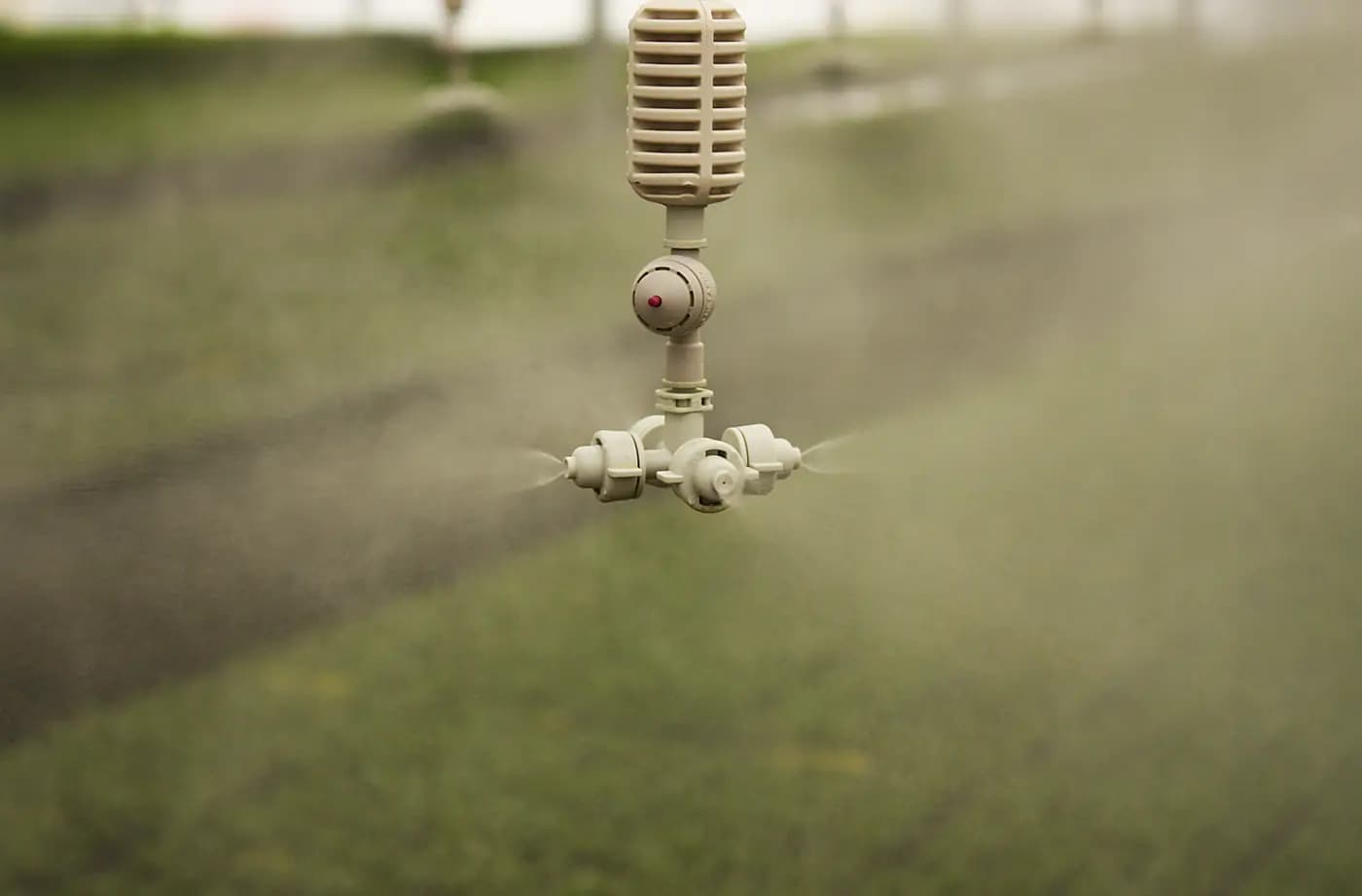
Micro irrigation supplies for a greenhouse overhead line include more than a sprinkler head. The hanging assembly must put that head at a useful height without putting a tube, weight or spray frame in the way of plants and routine work. A 40 cm or 80 cm label helps identify a listed assembly, but it does not tell you the final vertical distance from your header to the working sprinkler. Measure the actual route first, then choose a sample assembly whose documented components can be fitted and checked at that position. Put the header takeoff, suspension attachment and working head position on one dimension sketch; a 40 cm or 80 cm product label is not the final installed height. Hanging micro-sprinkler drop length is an installed dimension from header to working head, not merely the tube length printed on a listing.
Consider a propagation house with two bench types under one supported water line. The first bench has low trays and ample space below the pipe; the second carries taller stock plants and a trolley passes between rows. Buying the same hanging length for every position because the pipe is at one elevation can put heads at very different clearances from leaves, benches and workers. This guide turns a walk-through into a short set of dimensions and an order record for the two IrriNex hanging assemblies pictured in different lengths.
Measure hanging sprinkler drop from header to working head
Give each proposed outlet a bench, bay and line identifier. Mark the supported supply takeoff, the point where the sprinkler is intended to operate, and the highest plant or object that could interfere with that position. Record all three relative to the same floor or bench datum. A measurement taken from the top of a pipe to the bottom of a pot cannot be subtracted meaningfully from one taken from the bench to the sprinkler frame. Keep the measurement marks visible in a photograph so the installer can repeat them.
Use the actual takeoff point rather than assuming the centreline of a header is where a hanging assembly starts. Note whether the proposed connection sits on the underside or side of the supported pipe, and whether an existing fitting or branch drops below it. At the lower end, mark the part of the chosen assembly whose height affects spray position, not an arbitrary point on the tube. If a hanger or adapter is already installed, identify it separately before it becomes an invisible part of a guessed length.
For a simple illustrative survey, suppose the takeoff datum is 2.35 m above the floor and the desired head reference is 1.65 m above that same floor. The vertical difference is 0.70 m. That arithmetic states a space to be filled by the complete installed arrangement; it does not specify a 70 cm catalogue tube or make the 80 cm listed assembly the automatic choice. Connector bodies, support details, tube shape and the maker's measurement endpoints still determine the finished position. Ask for the assembled dimension from the chosen top connection to the relevant sprinkler reference point, and verify it with one sample.
Keep a second measurement for the crop. If the present top foliage in that illustrative bay is 1.15 m above the same floor, the desired head reference is 0.50 m above it today. If the crop is expected to reach 1.45 m before the next layout change, the gap would be 0.20 m at that future stage. Those figures describe geometry only; neither is a recommended spray clearance. The crop's actual growth, the head's documented placement requirements and a representative operating check decide whether either position is suitable.
What clearance remains for crops and routine greenhouse work?
A suspended head occupies more than a point on a ruler. Trace the intended vertical path past roof bracing, shade supports, hanging baskets, crop wires, labels and the edge of a bench. Mark where a person carries trays, where a cart turns and where a crop canopy will expand. A tube may fit the measured vertical gap while its weight or sprinkler frame strikes an obstacle. Conversely, placing the head above all obstacles may leave water caught by a crossbar before it reaches the receiving crop.
Look at the spray path and the physical clearance as separate observations. A head can hang freely while the water stream hits a structural member; a clear stream can coexist with a suspended component that blocks an aisle. If the task is deciding whether the crop needs air mist, leaf wetting or direct substrate water, use the greenhouse mist and root-zone guide first. This purchase check begins after an overhead sprinkler has a defined job and the grower needs to place that assembly in the available space.
Measure at representative positions, not only at the easiest central bay. Include a low header point, a bench edge, a taller crop group and a normal handling route. Supports can sag or shift across a long house, and benches may not have identical elevations. Record whether the water line and crop position are fixed or will move during the production cycle. For nursery pots that have already changed places, the line-reset guide after pot relocation deals with the outlet count and reach; here the record identifies the overhead drop needed at each retained takeoff.
Read 40 cm and 80 cm as options to identify, not head heights
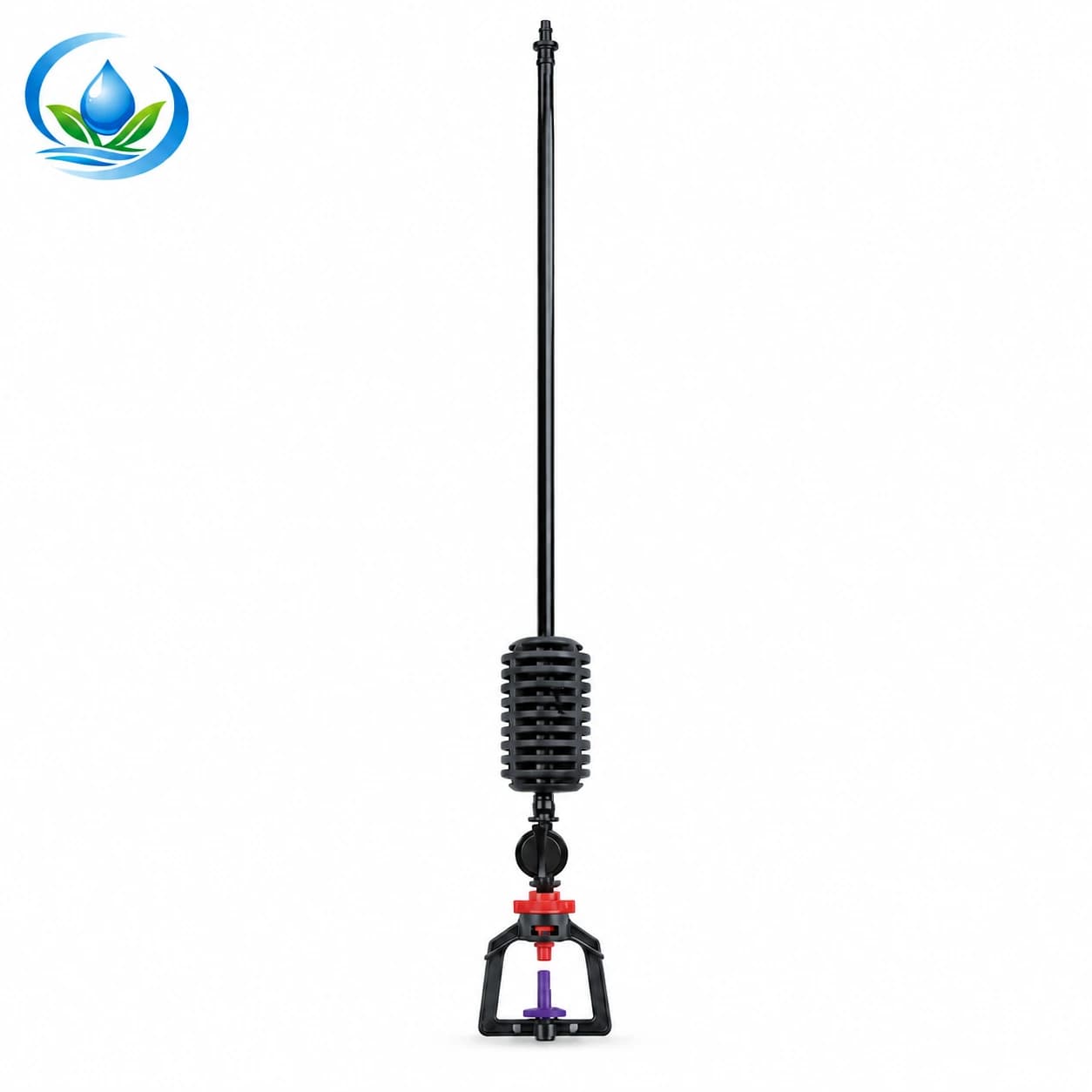
The IrriNex catalogue pictures hanging arrangements labelled 40, 45, 50, 60 and 80 cm and says the tube length can be customized. The 40 cm black and purple hanging assembly and the 80 cm black and green hanging assembly are two published configurations to compare. The shorter listing has a purple centre in the pictured sprinkler frame; the longer listing has a green centre. Write down the full chosen listing, length label and pictured head appearance together so a colour memory does not replace a model record.
The pictured assemblies include a feed tube, stabilizing weight, intermediate body and sprinkler frame. The length label does not state a universal installed nozzle elevation, and the catalogue does not define for this comparison whether the dimension is measured between the ends of the tube, between connections or across the complete assembly. Ask for the measurement endpoints for the exact offered configuration. If a custom tube is requested, record what is being customized and how the assembled unit will be identified on delivery.
The two listings also depict different sprinkler-head appearances. A grower replacing an established 40 cm purple assembly with an 80 cm green assembly is therefore proposing more than a length change unless the complete head and its performance are documented as equivalent for that installation. Obtain the selected head's operating pressure, discharge, coverage, inlet, filter requirement and permitted suspension arrangement from its own documentation. None of those hydraulic values follows from a coloured insert or a hanging-length label.
Do not confuse a separate bare head with an assembly. The 251T hanging-versus-standing guide compares two named heads and their intended orientation. It does not establish that either 251T head is the one shown in these 40 cm and 80 cm product images, or that its inlet will mate with their tubing. Keep the exact offered assembly and any proposed replacement head on different lines until the connection and package contents are confirmed.
Ask for one assembled dimension and one parts list
Send the seller or Store support a labelled photograph of the takeoff, the three measured elevations and the desired working head position. State whether the listed 40 cm, 80 cm or a custom length is being considered. Ask for a drawing or measured sample showing the top connection datum, the lower sprinkler reference, the tube portion and any included adapter, weight and intermediate component. A reply that repeats only “80 cm” has not answered where the installed head will land.
On the same record, write the top pipe or outlet specification, the connection already fitted there, and the connection required by the offered assembly. Do not choose a barb, thread or tube by visual similarity. The two product listings do not provide a verified universal inlet or pressure rating for every pictured part. Confirm each mating size and the allowed pressure and service conditions for the whole chosen arrangement before ordering a house-wide quantity.
Package contents matter as much as the measured drop. Is the sale unit a complete hanging assembly with the pictured head, or does it require a separate header fitting, mount or replacement part? Are the weight and intermediate body included in the selected option? If the tube is customized, will it arrive cut and assembled, or will the installer receive a separate approved tube length? Put the answer beside the item code and quantity. That prevents a delivery of correct-looking heads with no documented way to suspend them.
Keep a reference piece from an existing installation when matching a replacement. Photograph its top connector, tube marking, lower connector and head marking after the relevant line has been isolated and depressurized under the site's procedure. A removable old assembly can provide a better comparison than a distant photograph of water running. Avoid cutting a whole batch of new drops until one confirmed mating arrangement has been assembled and accepted.
Use one trial to check position and water delivery together
Choose a sample bay that represents the difficult clearance, not the empty end of the greenhouse. Mount the selected configuration by its supplied instructions and record the actual distance from the same takeoff datum to the working head reference. Photograph the assembly while dry, then observe it during a normal approved irrigation event from an appropriate location. Check whether the tube hangs without strain, the weight and frame clear surrounding work, and the spray reaches the intended receiving area without striking structure.
Use two readings in the trial record: the physical head position when installed and the operating result when the planned outlet group runs. A level mark on the frame does not show where water lands. A wet bench does not show that the head has the intended clearance or delivers evenly to the crop. If a coverage check is needed, the sprinkler collection guide explains why a defined collection area and operating state matter; adapt the method to the actual greenhouse task rather than copying a field grid into a narrow bench.
Record the operating group, the selected head, the pressure measurement point and the positions that receive water. Compare the sample with the crop's current and expected height. If the sample misses part of the intended surface, identify whether a member intercepts spray, the head is poorly positioned, or the supply and head are unmatched before changing the order. A longer tube moves a head; it does not by itself increase discharge or guarantee a wider wetted pattern. The nursery-container footprint guide addresses the separate question of how a particular spray lands inside pots.
Watch the normal stop as well as the run. A hanging head can occupy the right place and still release residual water onto one tray after the valve closes. The overhead drain-down guide separates retained line water from a valve that continues feeding and from water falling off the frame. This article does not treat a pictured intermediate body as proof of a particular opening or closing pressure. If post-stop deposition matters at the selected bay, make it a separate recorded performance question for that exact assembly.
Choose lengths by position groups, then count the order
Make one row for each type of location, with columns for bay, takeoff datum, intended head reference, current crop height, expected crop height, physical obstruction, trialled assembly and observed result. Group positions only when their measurements and crop handling are genuinely alike. Ten outlets along one rail may use one confirmed drop; an edge row under a lower brace may need a different arrangement. Do not assign all positions from the first attractive photograph of a sample in the centre.
For a practical hypothetical order, suppose a nursery has 12 central-bay outlets and four edge outlets. A successful trial identifies one documented configuration for the central positions and another for the edges. The shopping list has 12 units of the first configuration and four of the second, plus any separately confirmed connections or spare units. The number 16 counts physical assemblies to buy; it is not the number of heads necessarily running at once. Mark the actual simultaneous group separately so the selected sprinkler flows can be checked against the supply.
Review the latest product listing for the chosen price, sale unit, available option, delivery terms and purchase path. Where the page does not offer a direct purchase option, ask Store support about availability of the exact pictured configuration before buying matching tube or fittings elsewhere. Give support the measured takeoff-to-head dimension, chosen colour and length label, proposed quantity, old connection sample and any unresolved fit question. Request a clear itemized answer that can accompany the field order.
At receipt, compare labels, head appearance, tube and included pieces with that record before distributing assemblies to crews. Keep the accepted trial measurements in the installation map. When benches move or the crop grows, recheck the head position and receiving surface at the same marked locations. A measured hanging assembly can then be repeated where it fits, while a position with a different header, crop height or obstacle is assessed on its own dimensions.
Before you order
Compare this guide with the specifications for your exact product, selected option, water supply and field conditions. Your equipment requirements take priority over a general example.
Compare irrigation products