Micro Sprinkler Irrigation: Compare Mist Heads for Propagation Trays
Compare MJ10A and MJ40A mist-head layouts over marked propagation trays before ordering nursery irrigation parts.
Published by IrriNex Store
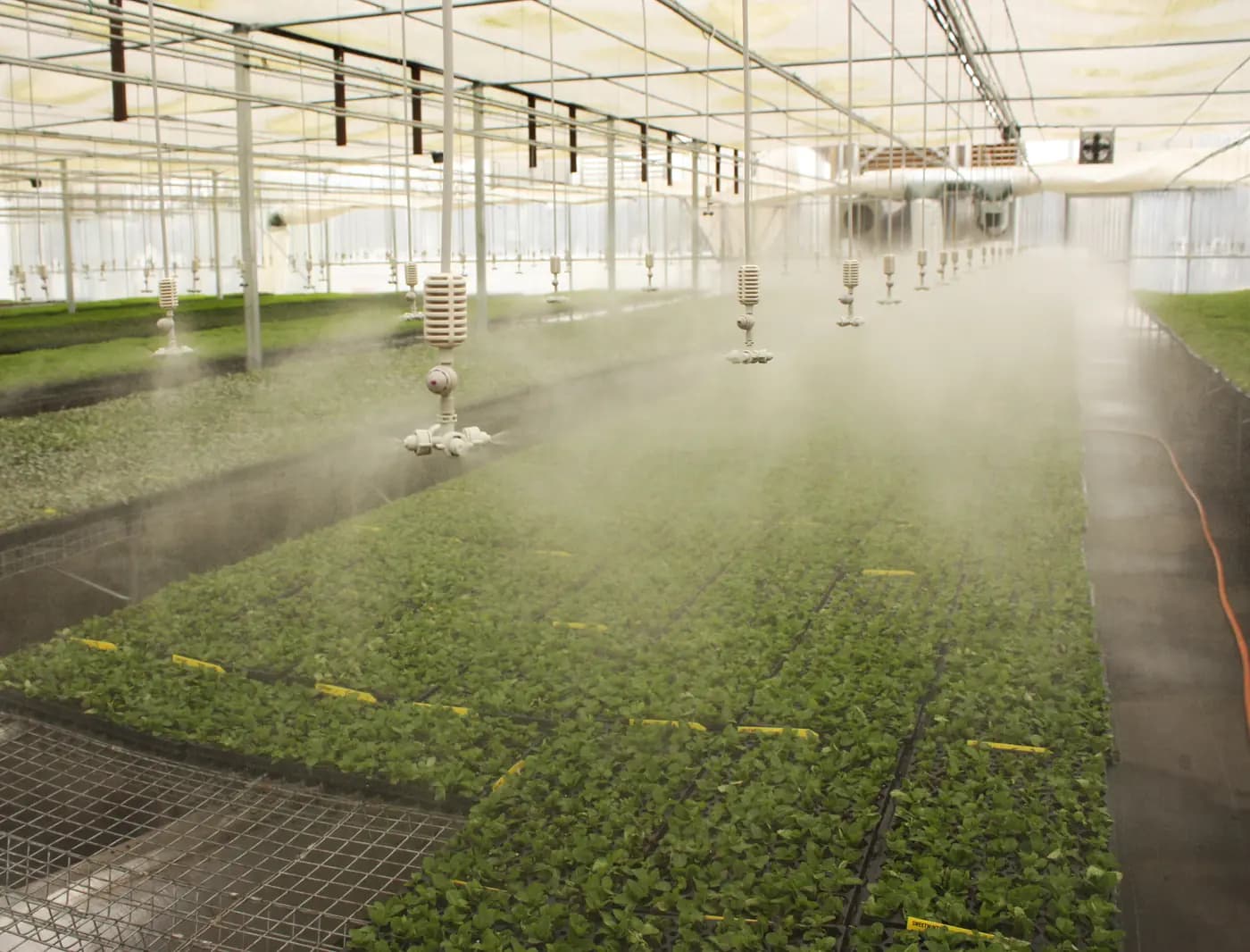
Micro sprinkler irrigation over a propagation bench needs a head layout that reaches the trays the nursery intends to mist. A bench of recently stuck cuttings may show wet foliage in the centre while edge trays receive little spray. Before ordering more nozzles, compare where water lands from the existing arrangement with a small trial of two documented mist-head options. The question here is whether a larger number of single-outlet heads or fewer four-outlet heads gives the nursery a more workable pattern at its actual mounting positions. Crop-stage moisture targets and the decision to use mist in the first place belong to the nursery's propagation programme; this comparison turns that established task into a checkable parts order. Mark the occupied edge trays beside proposed head positions on the trial plan; equal nominal head flow does not establish equal spray deposition across the bench. Propagation tray micro-sprinkler edge coverage belongs in the same bench trial as the central trays before a head count is ordered.
Which propagation trays are misted at the bench edges?
Mark the bench length and width, the positions of occupied propagation trays, open gaps, a walkway edge and the overhead or side supports that can carry an approved mist assembly. Record where the current water line runs and which valve supplies it. Add the cutting group, stage, tray type and substrate, because a tray being filled today may move tomorrow. A mist layout should be assessed against the occupied area expected during the intended production shift, not a completely empty bench photograph.
Choose observation positions before testing. Include a tray at the supply end, one in the centre, one at the far end and a difficult edge under ordinary ventilation. Label them so the same positions can be revisited after a sample head is moved. Note any shelf, hanging basket, label board or dense foliage that interrupts the spray path. A head may reach a nominal radius while much of that water lands in the aisle or on a support. Conversely, a visually dry gap between spray clouds does not prove the tray below received no water. Use measured deposition and the nursery's plant observations to resolve it.
First watch an ordinary permitted mist event without moving any hardware. Record which heads actually run, the time, the active valve group, air movement, and whether water reaches the marked trays. The mist-versus-root-watering guide helps identify which crop response the overhead group is meant to provide. This layout check begins once the grower has already decided a mist duty is appropriate. It does not use a wet leaf as proof that a plug has adequate root-zone water, or a wet plug as proof that exposed cutting leaves were served.
MJ10A single outlet or MJ40A four outlets: which pattern fits?
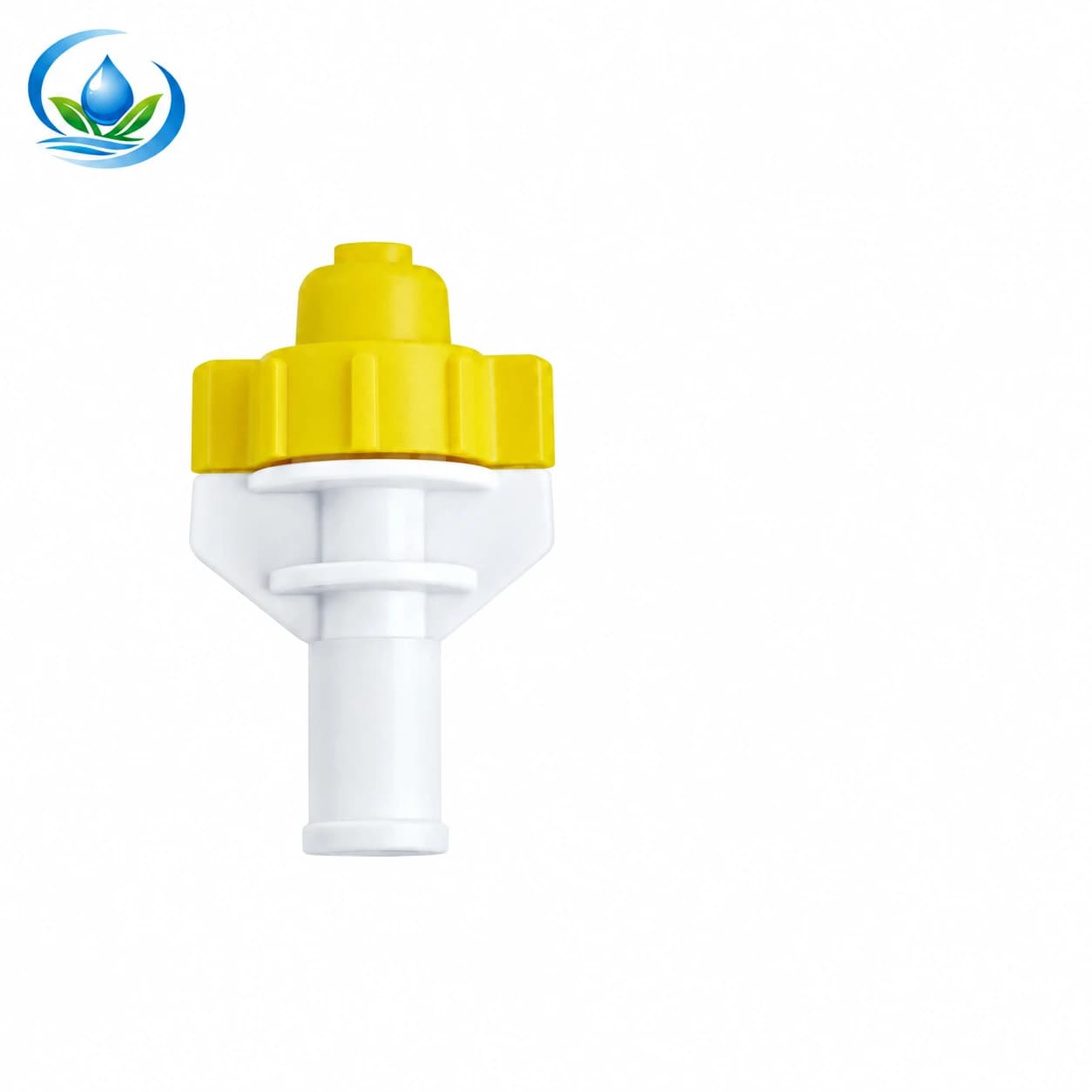
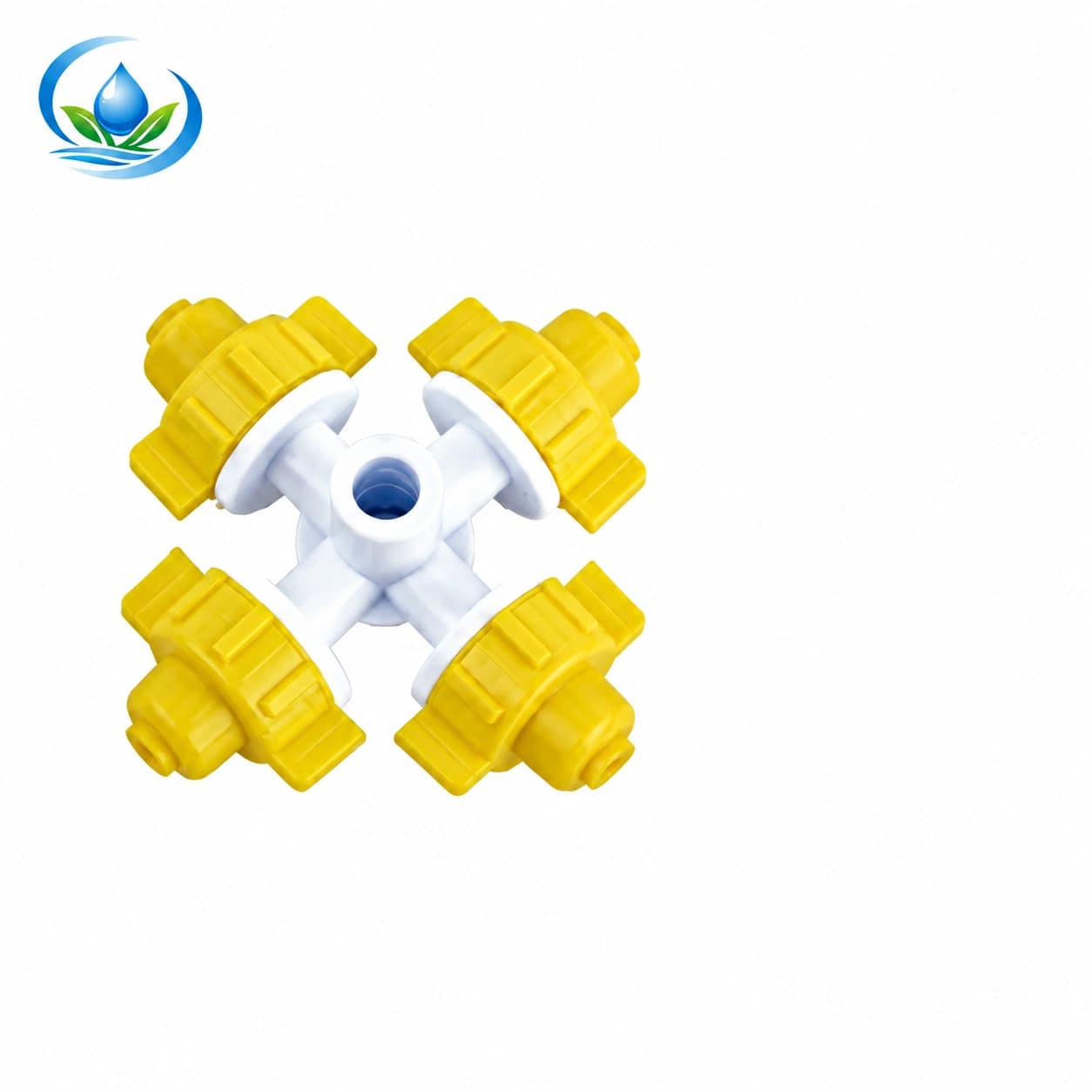
The current MJ10A single-outlet mist nozzle and MJ40A four-outlet mist nozzle are two separate product choices. The original IrriNex catalogue, printed page 04, lists a 0.8 mm diameter, a 2–3 bar working-pressure range and a 1 m spraying-radius reference for each. It lists 12 L/h for MJ10A and 48 L/h for MJ40A. Those are labelled catalogue figures, not a measurement on this bench. The same page gives its spray-reference condition as 0.2 MPa, 2 m above ground and windless. Do not turn the 1 m entry into a guaranteed mounting grid under a different height, ventilation or crop canopy.
| Listed model | Outlet arrangement | Listed discharge | What the buyer still needs to test |
|---|---|---|---|
| MJ10A | One outlet | 12 L/h | Deposition at the marked trays from the chosen head positions |
| MJ40A | Four outlets in one head | 48 L/h | Deposition and overlap from fewer, differently placed bodies |
The four-outlet body is not four independently purchased MJ10A heads. The catalogue does not provide a droplet-size measurement, a complete pressure-versus-flow curve, the inlet specification, an included hanger, or a propagation certification for either option. A matching 0.8 mm label and 1 m radius do not prove identical droplet formation or a matching distribution across a tray. Ask for the exact connection, permitted orientation, filtration requirement and supplied parts for the chosen model before building a production line. The hanging-versus-standing head comparison shows why orientation and model code are separate order facts; its 251T parts and performance are not MJ-series specifications.
Use equal nominal flow to expose the layout difference
Consider a hypothetical bench with eight positions at which a single-outlet sample could be mounted. Eight MJ10A heads at their listed 12 L/h add to 96 L/h of nominal simultaneous discharge. A different sketch with two MJ40A heads at their listed 48 L/h also adds to 96 L/h. These arithmetic totals help compare a proposed valve-group demand at the catalogue reference. They do not claim that either arrangement supplies the same tray, that the installed system delivers 96 L/h, or that every position can maintain the pressure needed for those listed outputs.
Draw both sketches over the same occupied trays. With eight bodies, the nursery has more separate mounting positions and connections to specify; with two bodies, each selected location distributes through four outlets. Neither layout is inherently more uniform. Head orientation, height, spacing, nearby structure and ventilation can move water away from the intended cells. Use the sketch to identify likely gaps and unwanted deposition, then let the sample test decide. Do not apply a spacing rule from another manufacturer's greenhouse kit or multiply a catalogue radius into an automatic head count.
Record the operating group, not just the number in the purchase basket. Two test heads may run while other mist heads on the same line remain active. The supply must serve the complete simultaneous group at each relevant head's working condition. Measure pressure at a suitable representative point during discharge, under the site's approved method, and record every other active demand. A static reading at an isolated header cannot show what the far mist head sees when the group runs. If a change of layout alters the number of live joints or the head positions, the equal-time catch-test guide gives a measurement principle; adapt collector placement to this bench and do not import field-sprinkler spacing or depth targets.
Trial one comparison with the nursery's normal crop programme
Set up a limited, approved sample arrangement for each option while preserving the nursery's established crop-care plan. Identify the exact head code, connection, mount height, tray labels, ventilation state, active valve group and running pressure measurement point. Use the chosen manufacturer's instructions for mounting and opening the supply; isolate and depressurize before changing a connection. If the two options cannot be trialled under comparable supply and crop conditions, record that limitation rather than reporting one as the winner from unlike runs.
Place equal-opening collection vessels at the same marked tray positions, clear of splash from adjacent trays where the method requires it. Run each candidate for a recorded interval that belongs to an approved test, then measure collected water with the same units and vessel method. The catch readings describe deposition at those positions over that test interval. They do not by themselves measure droplet size, leaf retention, evaporation, root-zone moisture or crop response. Retain the raw readings: a total alone hides a dry edge beside a very wet centre. If water strikes a rail and later drips into a collector, note that path rather than crediting it as useful direct coverage.
Observe representative cutting leaves and the medium separately under the nursery's established criteria. The University of Florida's mist-system explanation for propagation describes why a leaf-surface film matters before roots form; it does not establish a universal event schedule for these Store heads. Look for persistent missed groups, splash, saturated pockets or runoff, and note when observations were taken relative to the event. Do not respond to a dry edge by extending every event until the centre is over-wet. Adjust only one tested variable at a time under the responsible grower's plan, then repeat the marked observations.
Keep mounting, filtration and post-stop water in the order
A successful mist pattern still needs a buildable assembly. For each proposed position, record the support, exact inlet and mating part, tubing or drop, isolation arrangement, outlet orientation, and clearance for tray handling. Neither MJ10A nor MJ40A should be assumed to include the illustrated header, hanger, anti-drip part or controller. If a head must hang below a supply rail, the hanging-drop measurement guide helps document the actual top and bottom reference points; it does not certify the MJ head's inlet or a ready-made drop length. Leave the connection question unresolved until the selected product's exact instructions and supplied-piece list answer it.
Check source water and the maker's filtration requirement for the exact nozzle. A 0.8 mm diameter in a catalogue does not translate into a specified screen mesh or micron grade, and another seller's nozzle strainer is not automatically included here. The filter selection guide helps frame the water-source and operating-flow questions. Keep any new filter loss within the actual head pressure budget. Install only a documented compatible assembly; do not punch a header or improvise a barb size from a catalogue photograph. For repeated service, the operator should be able to identify and isolate the affected bench section without handling a live nozzle.
Watch a normal stop as well as a run. Water falling from an elevated header after closure can make one tray wetter even if its during-run catch was acceptable. The overhead drain-down check separates finite stored-water discharge from fresh water crossing a closed valve or water tracking off a support. Do not describe either mist head as having an anti-drain valve unless its exact documentation confirms it. If post-stop deposition changes the crop result, record that as a separate assembly requirement rather than silently adding run-time spray to a catch total.
Order the demonstrated layout, or hold the decision
Summarize each trial on one page: selected crop-stage goal, tray map, MJ10A or MJ40A code, head locations, number operating together, running pressure and where it was read, equal-time catch results, leaf and medium observations, unwanted wetting, mounting parts and open compatibility questions. A comparison can favour more individually placed single outlets, fewer four-outlet bodies, another documented mist arrangement, or no new head until supply or mounting issues are corrected. The smaller physical head count is not a saving if it leaves a documented tray position inadequately served.
Only then count confirmed heads and separately required parts for the complete occupied bench. Include a defined spare quantity separately from the simultaneous operating count. Check each selected product listing for the actual model, sale unit, current price, availability and delivery route; if the page does not allow direct ordering, ask Store support how that exact model and its matching pieces can be obtained. Keep the tested assembly record with the order so a replacement does not substitute another coloured nozzle or an unverified four-way fitting.
After one representative section is installed, repeat the same marked-position observations during normal operation and after the normal stop. Recheck when tray occupancy, crop height, ventilation or the support layout changes. The useful outcome of this micro sprinkler irrigation comparison is a mist-head quantity tied to observed tray coverage and a buildable connection list. Nominally equal litres per hour help compare the two sketches, while the actual crop-facing pattern decides whether either one belongs on the propagation bench.
Before you order
Compare this guide with the specifications for your exact product, selected option, water supply and field conditions. Your equipment requirements take priority over a general example.
Compare irrigation products