Drip Irrigation for Plants: Compare Two- and Four-Branch Arrow Assemblies
Count watering positions before complete arrow assemblies. Compare the documented 2121AD and 2141AD per-arrow and whole-unit flows, routes and order quantities.
Published by IrriNex Store

When buying drip irrigation for plants in nursery containers, a four-branch arrow assembly is easy to mistake for an upgrade that gives every plant more water. Its four outlets may simply serve more watering positions from one inlet. Compare the flow assigned to each arrow, the number of arrows in the assembly and the number of positions your crop actually needs. Those three quantities decide whether two-branch or four-branch units belong in your basket. Keep the confirmed position count beside the complete-unit count; fewer inlets do not change the number of arrows needed at the plants. The two-branch versus four-branch drip arrow count follows occupied nursery positions and complete assembly flow, not the number of inlets alone.
The practical choice is between complete, identified assemblies. A loose splitter attached to an unknown dripper is a different purchase. The comparison below uses the listed 2121AD and 2141AD straight-arrow configurations, with a small nursery example to show the order quantities. The example assumes that the grower has already decided where water must enter each container; it does not prescribe one arrow per plant or a watering duration.
Two-branch or four-branch arrows: how many nursery positions?
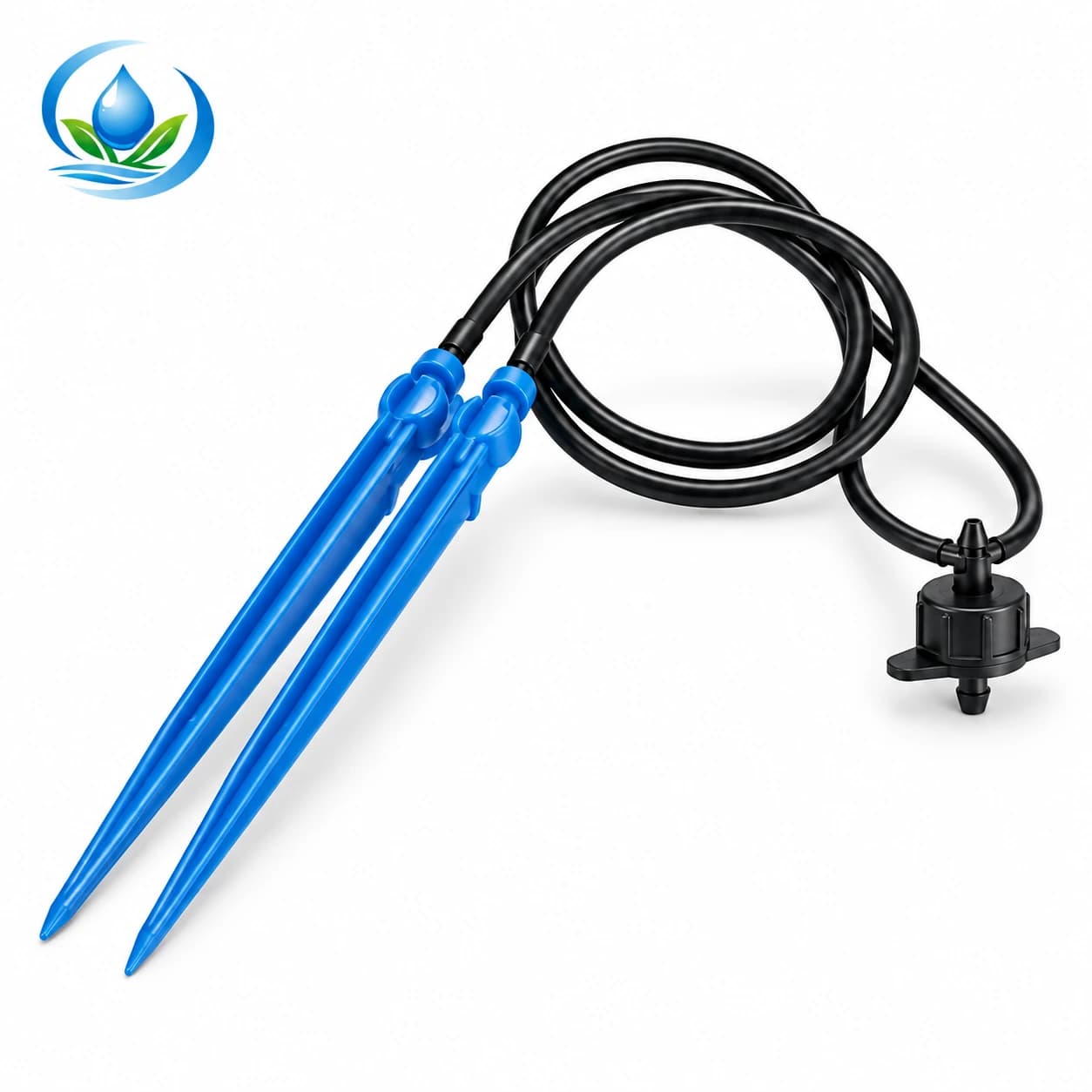
The 2121AD two-branch straight-arrow assembly is described in the catalogue as a two-branch configuration with a 4 L/h dripper. Its discharge entry is 2 × 2 L/h. That means the documented arrangement has two arrow positions with a nominal 2 L/h assigned to each, giving 4 L/h for the assembly. It does not mean that each of its two arrows is rated at 4 L/h.
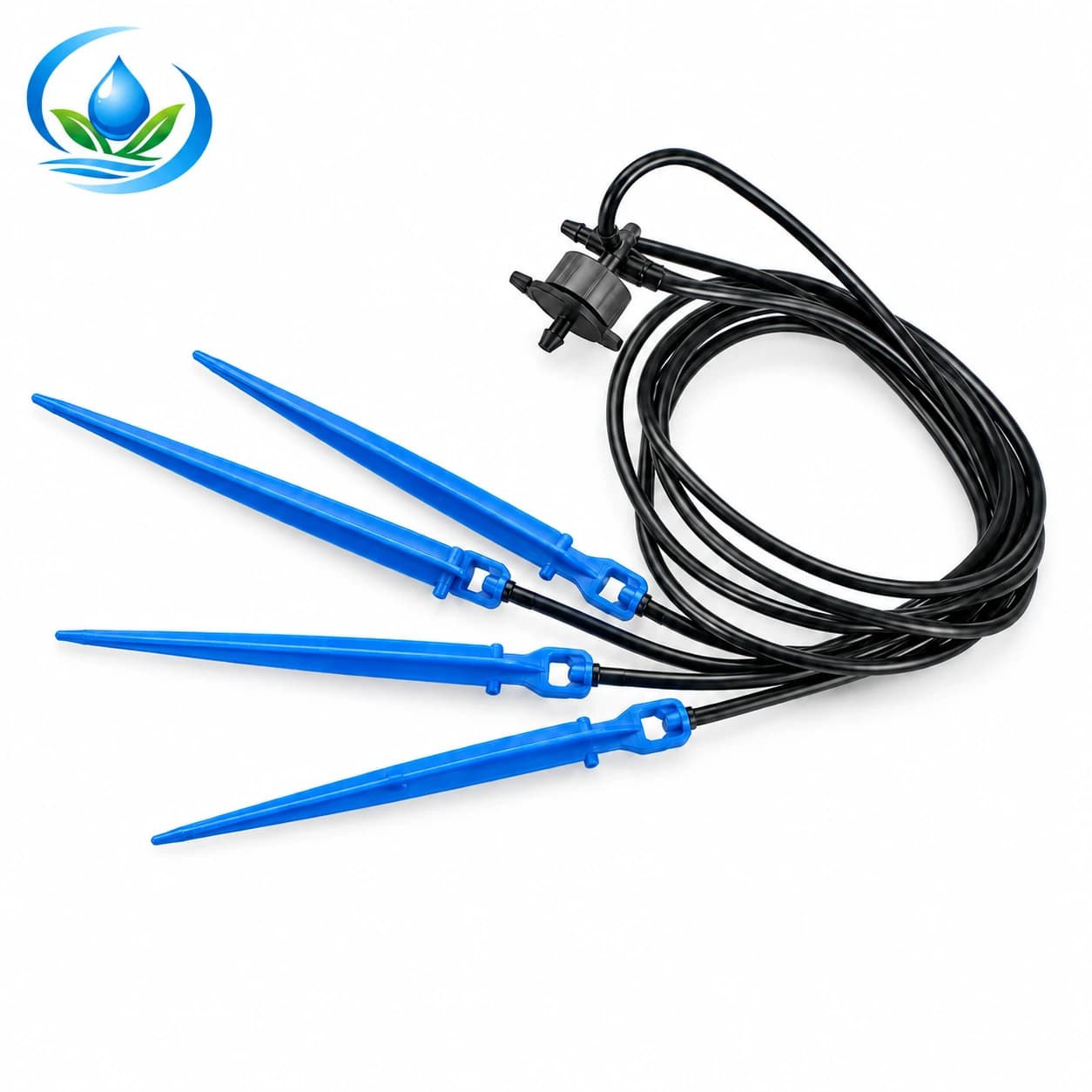
The 2141AD four-branch straight-arrow assembly is listed with an 8 L/h dripper and a discharge entry of 4 × 2 L/h. Here the catalogue assigns the same nominal 2 L/h to each of four arrow positions. The larger total belongs to the complete four-branch arrangement. Replacing two of the documented two-branch assemblies with one four-branch assembly therefore does not, by that change alone, increase the nominal flow available to four watering positions.
| Order detail | 2121AD | 2141AD |
|---|---|---|
| Arrow branches in the listed configuration | Two | Four |
| Discharge notation | 2 × 2 L/h | 4 × 2 L/h |
| Nominal assembly total | 4 L/h | 8 L/h |
| Nominal flow assigned to each arrow | 2 L/h | 2 L/h |
| Tube length | Confirm selected length | Confirm selected length |
The catalogue says the tube length can be customized, but does not give a standard length for these two entries. It also does not establish their pressure-compensation range or an anti-drain function. Ask for the operating conditions and supplied tube configuration of the exact item being ordered. Treat the listed flows as nominal product information, rather than a promise that any supply or improvised arrangement will deliver those figures.
Compare flow per arrow with complete assembly flow
Begin with the number of places where your accepted crop arrangement applies water. A position is an arrow serving a particular part of a container, not necessarily an entire plant. One container might need several application points, while another production arrangement uses one. Container size, substrate and the grower's observations determine that choice. Keep the resulting position count separate from the number of pots, trays or plants on the bench.
For an illustrative group with 24 watering positions, twelve two-branch units provide 24 arrows. Six four-branch units also provide 24 arrows. At the catalogue's nominal values, the first order represents 12 × 4 = 48 L/h, and the second represents 6 × 8 = 48 L/h. The inlet-unit count is halved, but the nominal group demand is unchanged. Neither calculation demonstrates sufficient supply pressure or tells you how long the crop should be watered.
| Quantity | Using 2121AD | Using 2141AD |
|---|---|---|
| Complete assemblies | 12 | 6 |
| Arrow positions | 24 | 24 |
| Nominal total demand | 48 L/h | 48 L/h |
If the crop arrangement instead calls for two arrow positions in each of twelve containers, the same 24-position arithmetic applies. What changes is the placement map: two arrows now lead to one container. Do not describe 24 arrow positions as 24 plants unless that is the actual arrangement. This distinction matters when another worker orders replacements from a list containing only the plant count.
The guide to adding outlet demand helps extend the count to a larger operating group. Include only the assemblies that will be active together, and add their complete verified totals once. Counting an assembly's upstream total and then adding its arrow flows again would count the same water twice.
Choose branch groups that fit the bench
Draw the positions around each proposed assembly inlet. Four nearby positions may form a convenient group for one four-branch unit. An isolated pair may be easier to serve with a two-branch unit. The useful grouping follows the actual bench and connection route. It should not require a tube to cross a trolley aisle or stretch around a container simply to use the fewest inlet units.
Ask for the selected branch lengths before accepting a grouping. A photograph of coiled tubing gives no reliable length measurement. Record the route from the assembly inlet to each watering position, including the required movement and the approach over the container rim. If the supplied length or approved configuration changes, revise the grouping instead of assuming extra tube can be added anywhere without changing delivery.
The arrow-stake and tube-routing guide covers physical placement and movement in more detail. Use that check for the sample endpoint, then return to the assembly count. A four-branch unit that reaches three positions comfortably and strains toward the fourth is not a successful substitute for two properly arranged pairs.
For 26 planned positions, one possible quantity combination is six four-branch units and one two-branch unit: 24 + 2 positions. Another is thirteen two-branch units. Both total 52 L/h on the stated nominal basis. This is a counting example, not approval of either layout. Seven four-branch units would leave two surplus branches; their presence is not permission to improvise caps or assume that closing them leaves the other outputs unchanged.
Keep a complete assembly separate from a loose manifold
A bare manifold offers several paths from one inlet. Its outlet count alone does not define the water metering upstream or at the terminal arrows. If you already own a dripper and want to add a splitter, identify both components and obtain the approved combination. The discharge notation of a complete 2121AD or 2141AD cannot be transferred to a visually similar set assembled from unrelated pieces.
Similarly, an individual arrow sold as a replacement component is not automatically the same purchasing unit as a complete branch assembly. Compare the item description with the confirmed contents: metering device, distributor arrangement, tubing and arrows. Mark which pieces the seller supplies and which remain from your installation. This prevents an apparently inexpensive order from arriving without the part that controls its flow.
Pressure compensation is another separate specification. The emitter selection guide explains the function, but neither the number of branches nor the shape of an arrow proves that a particular assembly provides it. If compensation or drain prevention is required by your existing system, obtain documentation for the exact supplied configuration before accepting the order.
Do not confuse fewer inlet units with fewer irrigation zones
A two-branch or four-branch distributor does not give each connected plant an independent watering schedule. The shared supply and controls still determine when those branches operate. Keep plants with different watering or nutrient requirements in their appropriate controlled groups. Buying a four-branch assembly does not make four unsuitable neighbours into one compatible crop group.
Use the irrigation-zone guide when the purchase changes which crop groups run together. A branch assembly belongs within that control plan. Its inlet count should not be copied into a valve order as though each assembly required a new independently operated zone.
The numerical comparison assumes the intended arrow positions remain active. If pots are regularly sold or removed individually, decide how the chosen equipment handles an inactive position before buying a large quantity. Follow the assembly maker's approved arrangement; folding tubing, removing arrows or plugging unidentified outlets can change the remaining delivery. A useful purchase leaves staff with a documented way to manage ordinary production changes.
Review the layout again when containers are spaced farther apart or a batch moves to another bench. The nursery pot-relocation checks address that change. Retaining the original assembly count may still be possible, but the branch routes and active positions need to match the new arrangement. Keep reserve units separate from the active count used to assess supply demand.
Confirm the sample at its intended operating condition
Before repeating either configuration throughout the crop, compare a complete sample with the confirmed order description. Have it installed by the approved procedure with the intended supply connection, filtration and operating controls. Check each branch rather than accepting a wet patch below the assembly as evidence that every arrow works. Keep the exact model and supplied tube arrangement with the observations.
Where delivery is measured, identify the individual arrow positions and preserve their relevant elevation and routing during collection. Record the interval and operating condition with each result. An acceptable group total can conceal a weak branch. Use the maker's performance information and the crop's requirements to assess results; this article supplies no universal percentage tolerance or pressure setting.
If water delivery is satisfactory but the substrate is not wetted as intended, revisit the position plan with the grower. Changing from two branches to four does not inherently distribute water more widely within each container. The same four arrows could serve four pots or several locations in fewer pots. The benefit depends on where the arrows are placed and whether that arrangement meets the observed crop need.
Place the order in complete, identifiable units
Record the model, number of complete assemblies, number of active arrow positions and selected tube configuration on separate lines. Check whether the displayed sale unit represents one assembly or a specified pack, then convert your required assembly count into that unit. Compare current prices only after contents and quantities match. Confirm availability and delivery for the exact option before ordering associated fittings.
Keep the accepted sample record for repeat purchases. Reordering six four-branch assemblies is clearer than requesting “24 drippers” when that phrase might mean individual arrows, upstream metering devices or complete units. The right choice between 2121AD and 2141AD is the configuration that serves the planned positions with a workable branch layout and a verified operating arrangement. The nominal flow per arrow remains the starting comparison; a larger assembly total is not extra water for every plant.
Before you order
Compare this guide with the specifications for your exact product, selected option, water supply and field conditions. Your equipment requirements take priority over a general example.
Compare irrigation products