Crop Sprinkler Systems: Confirm Frost Protection Suitability Before Buying
Before ordering ordinary crop sprinklers for blossom frost protection, verify exact cold-duty model evidence and simultaneous supply for the protected area.
Published by IrriNex Store
Crop sprinkler systems bought for ordinary irrigation are not automatically suitable for frost protection. A grower considering the same heads for spring blossoms needs two pieces of evidence before ordering: an exact sprinkler model documented for the proposed cold-weather duty, and a site design that can supply water to the whole protected area at once for the required event. A sprinkler that wets soil on a warm afternoon has passed a different test. Make the preseason purchase decision while crop stage, source capacity, coverage and replacement lead time can still be checked calmly. Pair exact cold-weather head evidence with a whole-area source-and-power case; a warm-weather coverage trial at one point does not establish crop protection. Crop frost sprinkler capacity must cover the whole planned protected area with the exact approved cold-duty equipment.
Are ordinary crop sprinklers documented for frost duty?
Identify the crop, the susceptible growth stage, the blocks to be protected and the local frost conditions that the farm expects to face. An orchard with opening flowers, a berry block with exposed blossoms and a vegetable field with tender transplants do not necessarily have the same protection method or coverage need. Ask a qualified local crop or frost adviser to establish the applicable design case. The output should name the protected plant tissue and the field area, not merely say that the farm owns sprinklers.
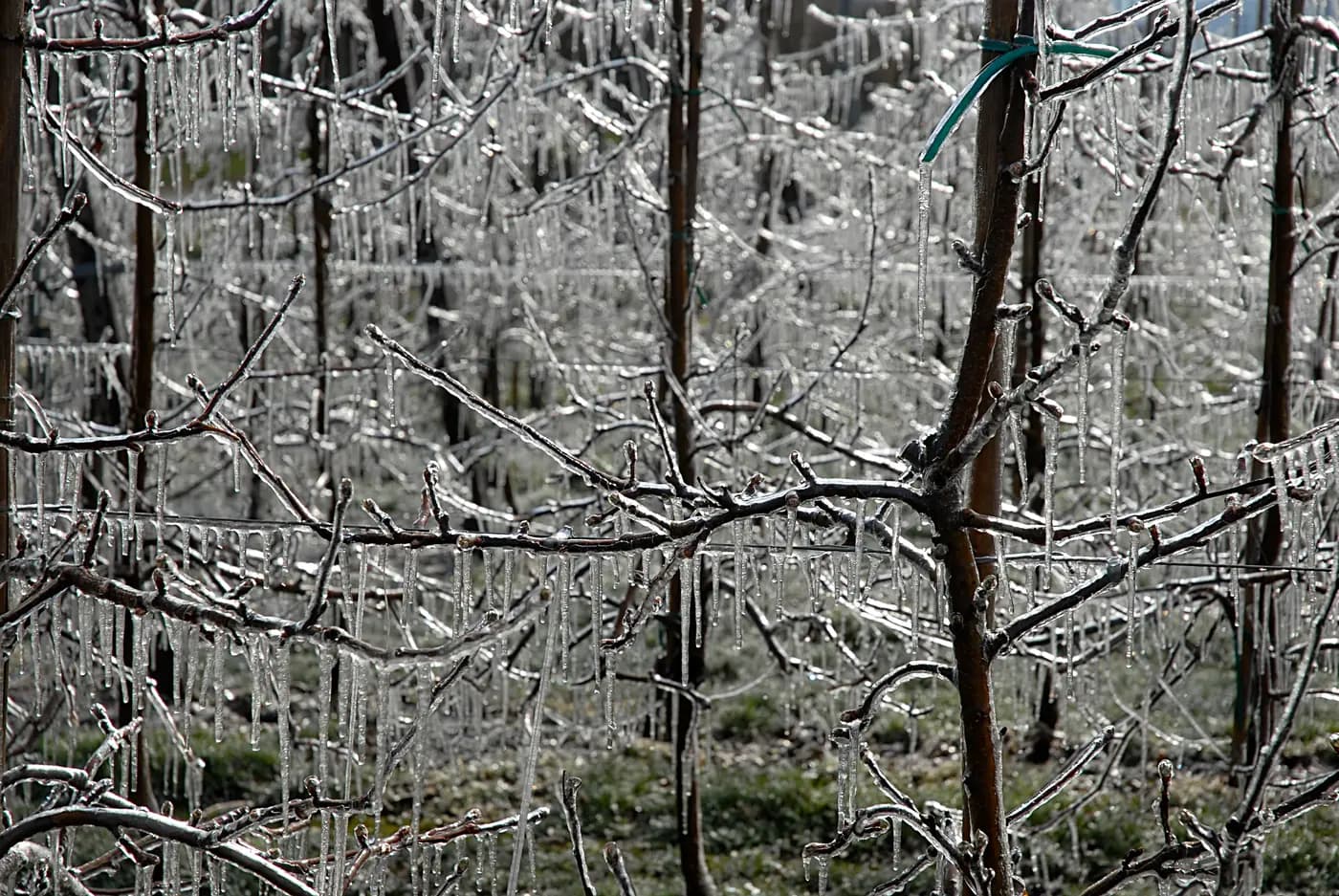
Overhead frost protection relies on heat released as continuously supplied water freezes. Penn State Extension explains that freezing water releases heat and that too little or uneven water can worsen the result. This is why a photograph of ice on a branch cannot certify protection. The underlying process requires an appropriate ongoing water supply during the event; frozen equipment, interrupted flow and missed crop areas defeat that purpose. Crop and local conditions determine the design; the linked berry guidance does not set universal temperatures or application rates for an orchard or another crop.
Keep this duty separate from routine root-zone watering. In a normal irrigation schedule the farm may water one block, shut it off and then water the next. A frost design may need every affected area covered at the same time, subject to its specific approved method. A routine timer program or a healthy looking midday spray pattern does not establish that simultaneous cold-night duty. The running-flow head-count guide helps organize flow arithmetic, but its result is only one input to a frost design that must also address coverage, pressure and reliable operation.
Can water and power serve the whole protected area at once?
Start with a block map showing crop rows, canopy height and shape, slope and low ground, field boundaries, obstructions, existing sprinkler positions and the water source. Shade the plants that the frost plan must serve, including corners and outside rows. An equipment count by acreage alone can hide a cold pocket or a narrow strip behind windbreaks. Mark where the chosen sprinkler method would apply water to protected tissue, and where it might miss. The distance a catalogue says water can travel is not a map of water received by each blossom.
Compare the map with the intended protection method. An overhead pattern, a targeted tree pattern and an under-tree pattern place water in different locations and need different evidence. Do not treat one as a cheap substitute for another because a head happens to spin in either position. In an orchard, branches, support wires, new growth and the access needed for pruning or harvest can intercept spray. The orchard spray-clearance guide helps record those obstacles during ordinary irrigation; the frost plan must additionally show that the vulnerable tissue receives the method's required coverage.
For a block with existing equipment, preserve a drawing of the installed head and nozzle codes and note what runs together now. Photograph one representative head and its connections. Record the source, pipe and valve route that supplies it. Some parts may remain useful for normal irrigation even if no evidence supports using them in frost protection. Mark those roles separately, so a buyer does not order replacement heads on the assumption that unchanged pipes, valves and controls can support a different simultaneous demand.
Establish source and power capacity for the simultaneous case
Document the flow and pressure available at the source under the relevant low-water and other credible operating conditions. Count all protected heads and any other water user that the design permits to operate at the same time. Then calculate the demand using the exact selected head's documented cold-duty discharge, not the lowest number from an ordinary irrigation range. Include pipe, filter, valve and elevation effects when checking pressure at near and distant heads. A pump's maximum head and its maximum flow are separate endpoints, not a proven point that supplies both at once.
A surface supply may fall during a long event; a pond, tank, canal turn or well has to be assessed at the point when the protected area still needs water. Record usable water, source recovery and any duty limits, rather than only the amount visible before startup. The energy source and pump arrangement must be able to sustain the accepted hydraulic case. If the farm has a generator or standby supply, its actual duty, switchover arrangement and responsible operator also belong in the frost plan. A spare machine in a shed is not a verified continuation of water at the crop.
Ordinary irrigation zones may be deliberately small because that is all the source can operate at the selected pressure. Combining those zones for a frost event changes the operating point, pipe losses and pressure reaching each head. Do not assume that a controller setting can create additional water or power. Likewise, switching zones sequentially can leave previously wetted plants without the continuous supply assumed by a different frost method. Have the permitted operating group documented before requesting sprinkler quantities. Keep a source test, a pressure record and the protected-area drawing in one purchasing file.
Ask for exact cold-weather sprinkler evidence
Request the manufacturer's frost-application documentation for the complete candidate model, nozzle and installation arrangement. It should state the conditions under which the head continues to operate reliably in cold, wet and icing conditions, its discharge and distribution at the proposed pressure, and the intended method of covering the crop. The general fact that an impact head turns in summer or a micro head sprays in a greenhouse does not answer this. A performance claim for a different brand, drive mechanism or frost-specific assembly cannot be transferred to an unidentified Store head.
Rotation and pattern matter because water must reach the intended tissue repeatedly and sufficiently evenly. Yet a rapid-looking spray in a short warm trial cannot demonstrate cold-weather reliability, and a listed radius cannot establish the depth or distribution within that circle. Ask the designer what testing, field observations and acceptance criteria will support this exact layout. A mapped catch test can document ordinary water arrival under a named operating arrangement; by itself it does not certify that a head keeps moving, distributing and remaining supplied through a freezing event.
Record the exact connection and support as well. A proposed frost-capable head may require a different riser height, orientation, nozzle or mounting arrangement than the farm's ordinary head. The old outlet could be reusable in one location and unsuitable in another. Confirm pressure rating and the mating interface for every retained part. The sprinkler operating-point guide shows why pressure measured at the running head matters more than a source gauge; its low-pressure purchase examples are not frost qualification.
Read the two Store product pages as ordinary irrigation listings
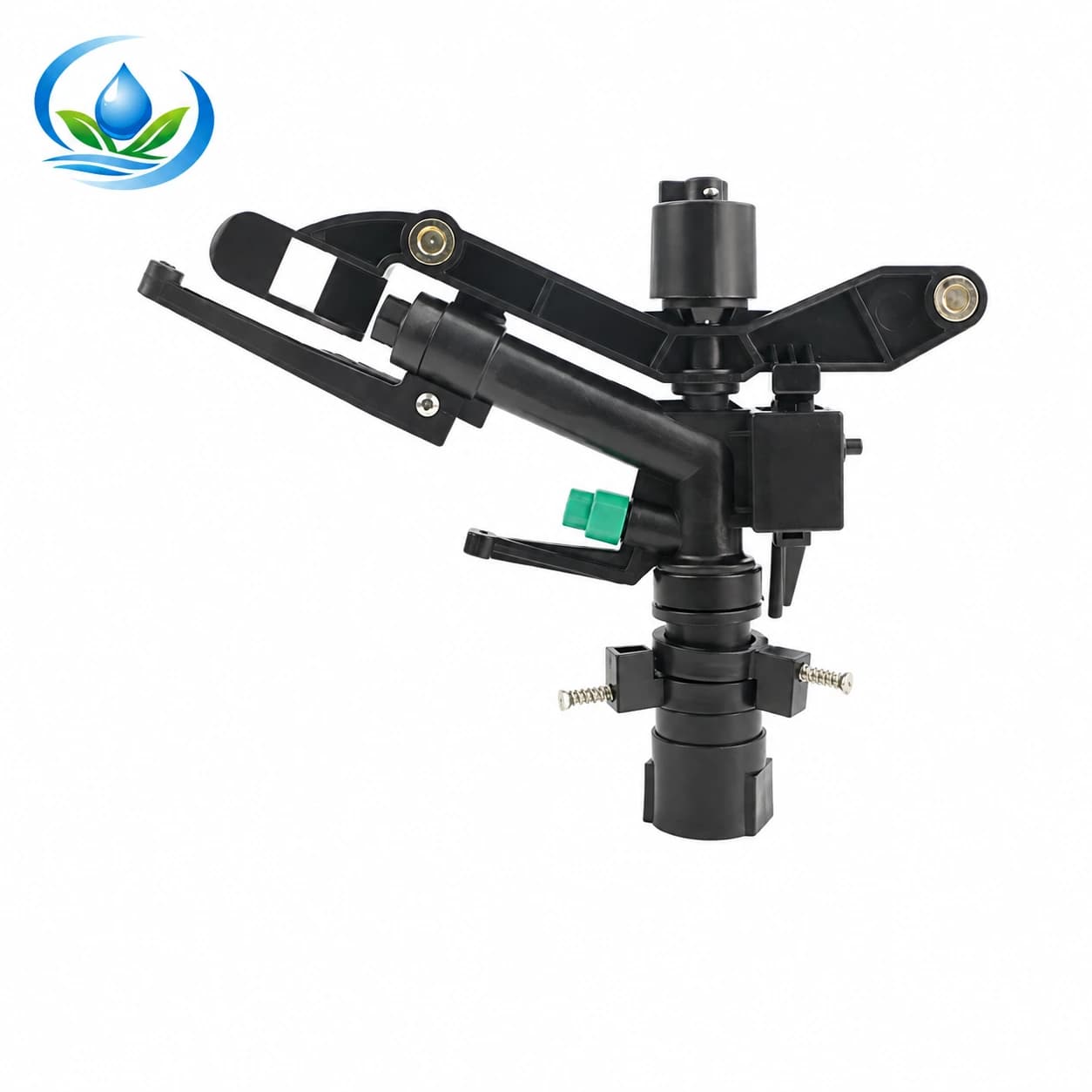
The IrriNex S50 impact sprinkler is a published agricultural irrigation head with a 1-inch female inlet. Its listed working-pressure range is 2.0–5.0 bar; the separately listed flow range is 3.7–5.0 m³/h and radius range is 15–17 m. Those are ordinary product entries, not paired test points for frost operation. They do not show a cold-start test, ice-loaded rotation, approved frost application rate, or the number and spacing of heads required to protect blossoms. Use S50 as an exact code to ask for evidence, not as an already approved frost system.
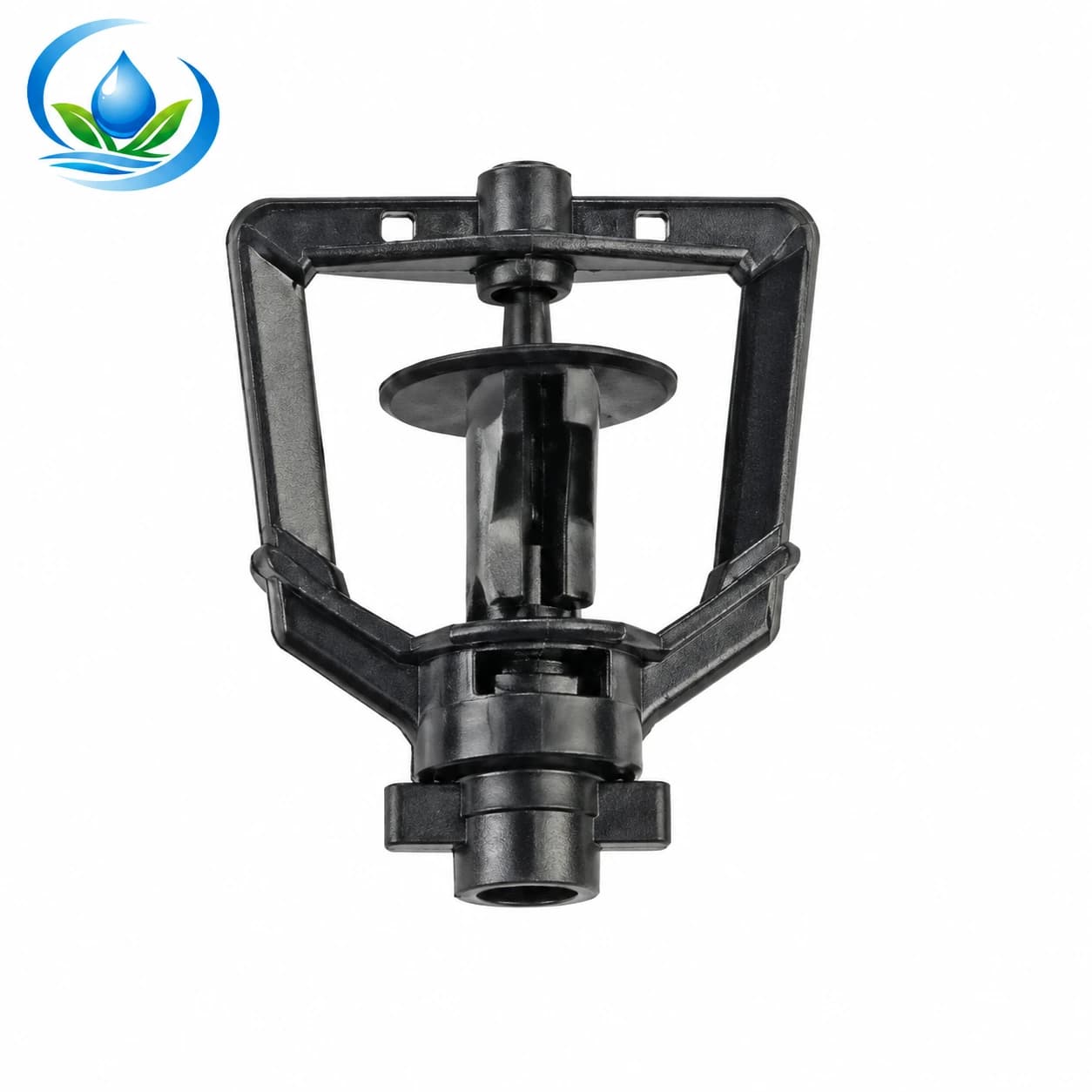
The 251TDC085 standing rotary micro sprinkler is a different scale of irrigation outlet. Its catalogue entry lists a 0.85 mm nozzle, 40 L/h, 2.0 bar and 3 m radius. The catalogue reference is measured with the head 2 m above ground in windless conditions; it is not a cold-weather coverage guarantee. Neither the 251TDC085 entry nor its standing orientation proves frost service, pressure compensation, anti-drain behavior or compatibility with a hanging assembly. The 251T mounting comparison keeps the standing and hanging codes distinct for a normal purchase.
Do not divide S50's listed flow by the micro head's listed flow to choose a cheaper frost layout. The heads wet different areas under different ordinary reference conditions, and neither listing supplies the frost-specific data needed to compare protected crop area or cold reliability. If a supplier proposes one of these exact models for protection, request the model- and nozzle-specific frost evidence and the complete site design before accepting the proposal. If that evidence is unavailable, keep these products in the ordinary-irrigation category and seek an appropriately documented protection option.
Test the purchase case before expanding the order
A preseason inspection can establish what the farm already owns. Read model and nozzle marks, check whether each head is visibly damaged or obstructed, note the installed support and identify source and valve groups. A supervised water-only test under the ordinary approved arrangement can provide baseline flow, pressure, leaks and a spray map. It cannot reproduce a freezing event by simply running the heads for longer on a mild day. Do not wait for an actual frost night to discover that exact-model qualification or source capacity is missing.
For the protection proposal, the designer should provide a scaled layout, the crop and growth stage it addresses, the head/nozzle documentation, the simultaneous demand, pressure at the farthest and most demanding points, source-water duration, power continuity and the means of checking coverage. Mark components that can stay, those needing replacement and those whose status remains unresolved. The soil-ponding guide reminds the buyer that an application can create runoff even when the sprinkler hardware runs; the local frost design must account for the receiving ground as well as the crop tissue.
Budget the whole allowed arrangement, not only heads. A quotation for sprinklers does not automatically include suitable pump duty, protected supply route, filters, valves, controls, instruments, power resilience, mounting parts or the installation work. If the source cannot supply the whole protected area in the required simultaneous case, a larger head order does not close the gap. Consider whether the protected area, method or infrastructure must change with qualified local advice before purchasing a field quantity.
Leave a clear purchase or hold decision
Place each proposed item into one of three practical groups: ordinary irrigation replacement, documented frost-duty component within an accepted design, or unresolved item awaiting exact evidence. Put the complete SKU, nozzle, connection and intended position on every line. For a Store item, check its current price, sale unit, availability and delivery; where the page has no direct purchase option, ask Store support how and when it can be ordered. Availability of a familiar sprinkler is not proof that the required frost model, adapter or full protection system is offered.
The order is ready only when the chosen protection method, crop stage, protected footprint, exact head behavior and simultaneous water-and-power case agree. If one of those is still unknown, retain the ordinary irrigation equipment for its documented use and keep the frost purchase open. A useful result of this review may be a short, specific request for model data or a changed protection approach. That decision made before cold weather is more valuable than a cart of heads selected from summer radius figures.
Common questions about crop sprinklers and frost
Will any sprinkler that creates ice on blossoms protect them?
No. Ice in a photograph shows that water froze, not that enough water continued reaching the vulnerable tissue for the required period. The protection design must consider the crop, exposure, distribution, source continuity and actual head operation. Partial or interrupted wetting can increase injury. Use the relevant local crop guidance and exact equipment data rather than judging from appearance.
Can I run normal irrigation zones one after another during frost?
Do not assume that a sequential irrigation schedule satisfies a frost design. The accepted method determines which plants need continuous simultaneous supply. Calculate the source and power requirement for those allowed groups before relying on the controller program. Changing valve order cannot compensate for an undersized source or a head without cold-service evidence.
Does winterizing the sprinkler system make it frost-ready?
No. Winterization and parts storage protect idle equipment from retained water during freezing weather. Active crop protection is a separate use in which the water supply, coverage and exact head must work during the cold event. A dry pipe on a storage shelf says nothing about blossom protection.
Should I buy the S50 or 251TDC085 for frost now?
Their current listings establish ordinary irrigation identities and separate catalogue figures, not frost qualification. Confirm the exact model and full site design first. If model-specific cold-duty documentation is absent, neither listing supports a responsible frost-protection purchase claim. The farm can still compare them for normal irrigation jobs under their own verified operating conditions.
Before you order
Compare this guide with the specifications for your exact product, selected option, water supply and field conditions. Your equipment requirements take priority over a general example.
Compare irrigation products