Fertigation System: Check the Injector Ratio Before Mixing Stock
Measure clean-water suction and system volume over the same interval, keep the ratio denominator consistent and repeat the test before accepting an injector.
Published by IrriNex Store
A fertigation system should pass a documented clean-water injector check before its setting is used to prepare a fertilizer stock solution. Measure the water drawn through the suction side and the corresponding water volume through the chosen test circuit over the same interval. Identify what your ratio denominator includes, repeat the measurement, and compare the results with instructions for the exact delivered model. A moving mechanism or falling vessel level alone does not establish the intended proportion.
This guide helps a buyer accept a sample or replacement injector, identify a measurement problem, or request the correct service parts. Both the suction vessel and irrigation supply contain clean water during the test. The record describes equipment delivery; it does not prescribe fertilizer concentration, crop nutrition or a chemical mixing recipe.
Identify the unit and its documented test conditions
Photograph the model label, adjustment scale, flow arrow and connections before installation. Keep the order code separate from the manufacturer's model marking. Ask for the matching manual, the meaning of the scale, permitted flow and pressure conditions, installation requirements and any stated accuracy or acceptance procedure. A similar housing or familiar brand shape does not identify interchangeable parts.
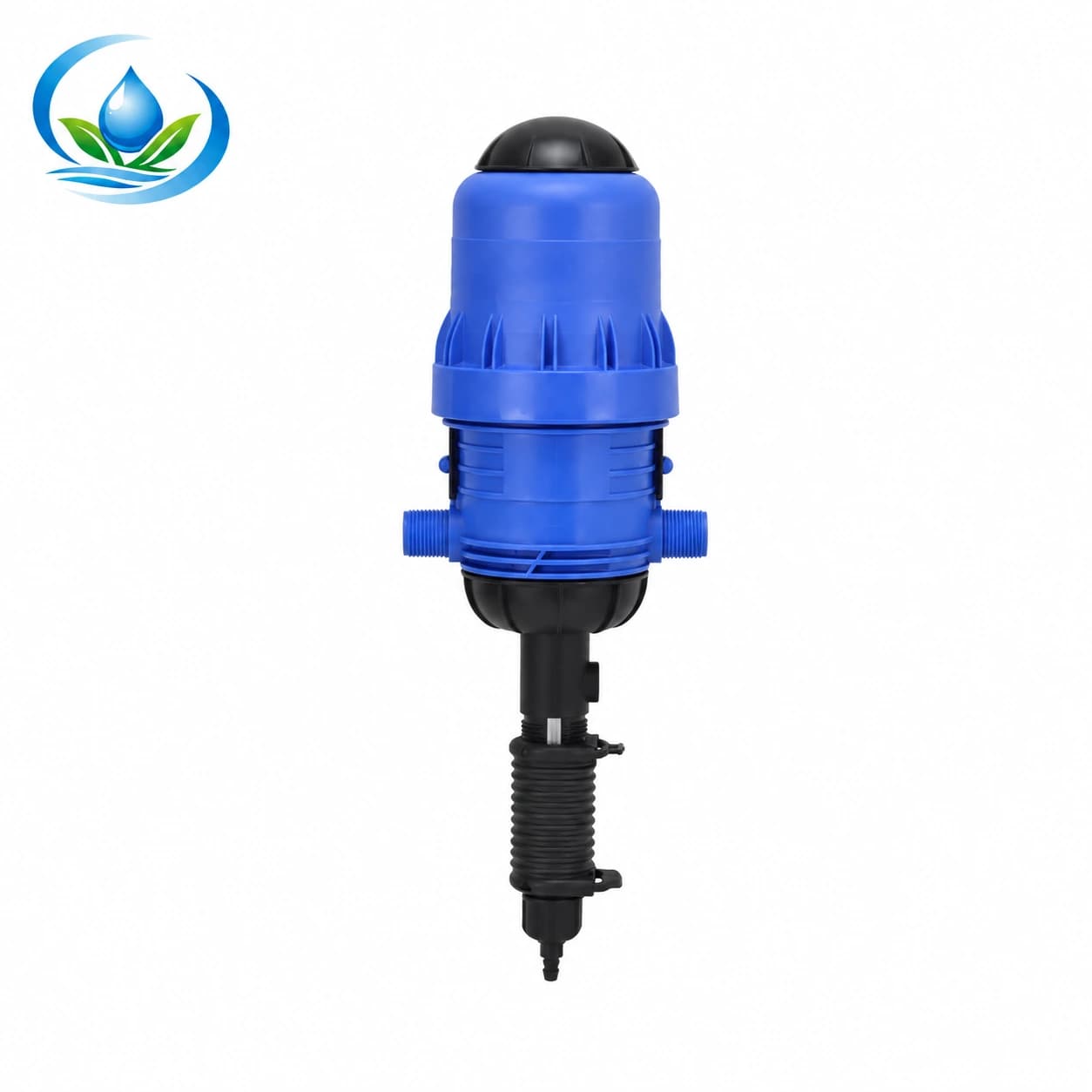
For the water-driven proportional fertilizer injector, request documentation tied to the unit supplied. Do not use a range from a different catalogue code to decide that a test condition is permitted. Confirm the allowed adjustment method before touching the control; some procedures require stopping flow and releasing pressure.
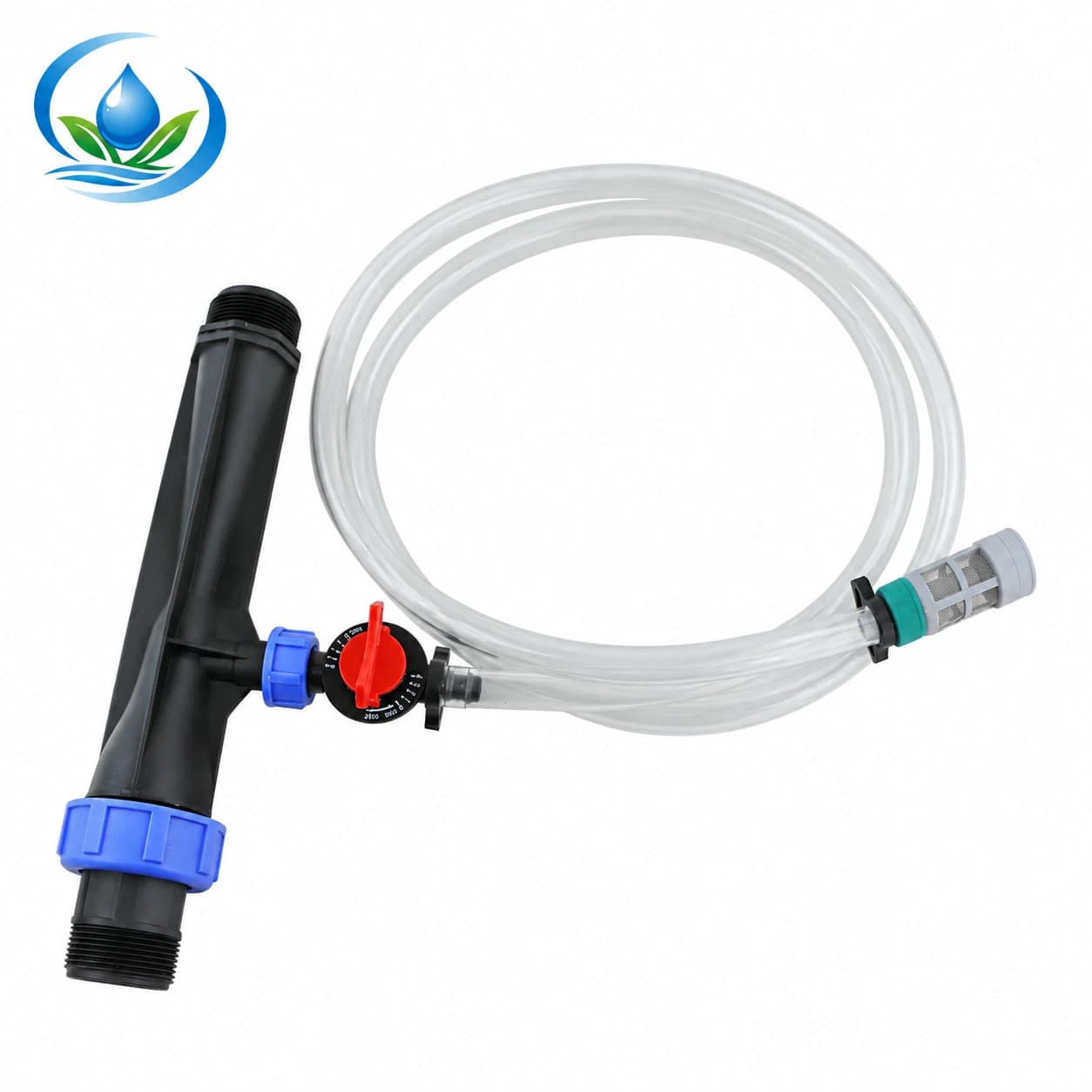
For a Venturi fertilizer injector, record the complete selected size and code. Separate maximum suction, maximum water flow and maximum pressure figures: they are not a single guaranteed operating point. Obtain the relevant performance information for the actual inlet and outlet conditions. A collection test cannot make an unsuitable operating condition acceptable.
Before measuring a newly received unit, use the injector package guide to check its body, suction parts and confirmed set contents against the order. This test then establishes what that identified unit draws under a recorded operating case and whether its measured delivery meets the agreed purchase requirement.
Define the injector measurement boundary before calculating a ratio
On a simple sketch, mark the injector inlet, suction vessel, outlet, any bypass split and return, and the flow-measurement locations. Write what each meter includes. An upstream meter usually measures carrier water before suction water is added; a downstream measurement may include both. A meter on only the injector branch does not describe the entire recombined irrigation flow. A fertigation injector ratio test needs the suction volume and irrigation-flow denominator measured over the same start and finish points.
Use three clearly named volumes. Let S be the clean water withdrawn from the suction vessel during the test. Let W be carrier water entering the complete circuit being assessed, excluding S. Let T be the total discharge from that same circuit. With matching start and finish boundaries, no other inflow or loss, and no change in stored water, T equals W plus S.
Those qualifications matter. A tank filling, an open drain, a leaking connection or water retained in initially empty tubing can break the simple balance. Do not subtract quantities from different circuits or different time windows. The flow measurement and outlet-demand guide helps distinguish a flow rate from a volume accumulated over time.
Write the denominator beside every percentage
A suction fraction of total discharge is 100 × S ÷ T. A suction-to-carrier percentage is 100 × S ÷ W. These are related but different calculations. When a manual describes a ratio as one part suction liquid in a stated number of final parts, its denominator includes the suction liquid. Another convention may compare that liquid with carrier water alone.
Ask which convention the supplied model's scale uses before comparing a calculated number with its setting. Record the definition in words rather than writing only “1%” or “1:100.” University of Maryland Extension illustrates a ratio defined against final solution in its injector calibration guidance. Confirm the convention for your own equipment.
| Illustrative measurement | Calculation | Meaning |
|---|---|---|
| S = 0.40 L; W = 39.60 L; T = 40.00 L | T = W + S | Assumes a complete, balanced measurement boundary |
| Suction fraction of total discharge | 100 × 0.40 ÷ 40.00 = 1.00% | One suction part in 100 final parts |
| Suction compared with carrier water | 100 × 0.40 ÷ 39.60 ≈ 1.0101% | One suction part for 99 carrier parts |
The example uses invented clean-water volumes to explain the arithmetic. It is not an injector setting recommendation or a performance claim. Keep the denominator convention unchanged between trials, even when the numerical difference seems small, so future maintenance records remain comparable.
Prepare measuring equipment without changing the installation
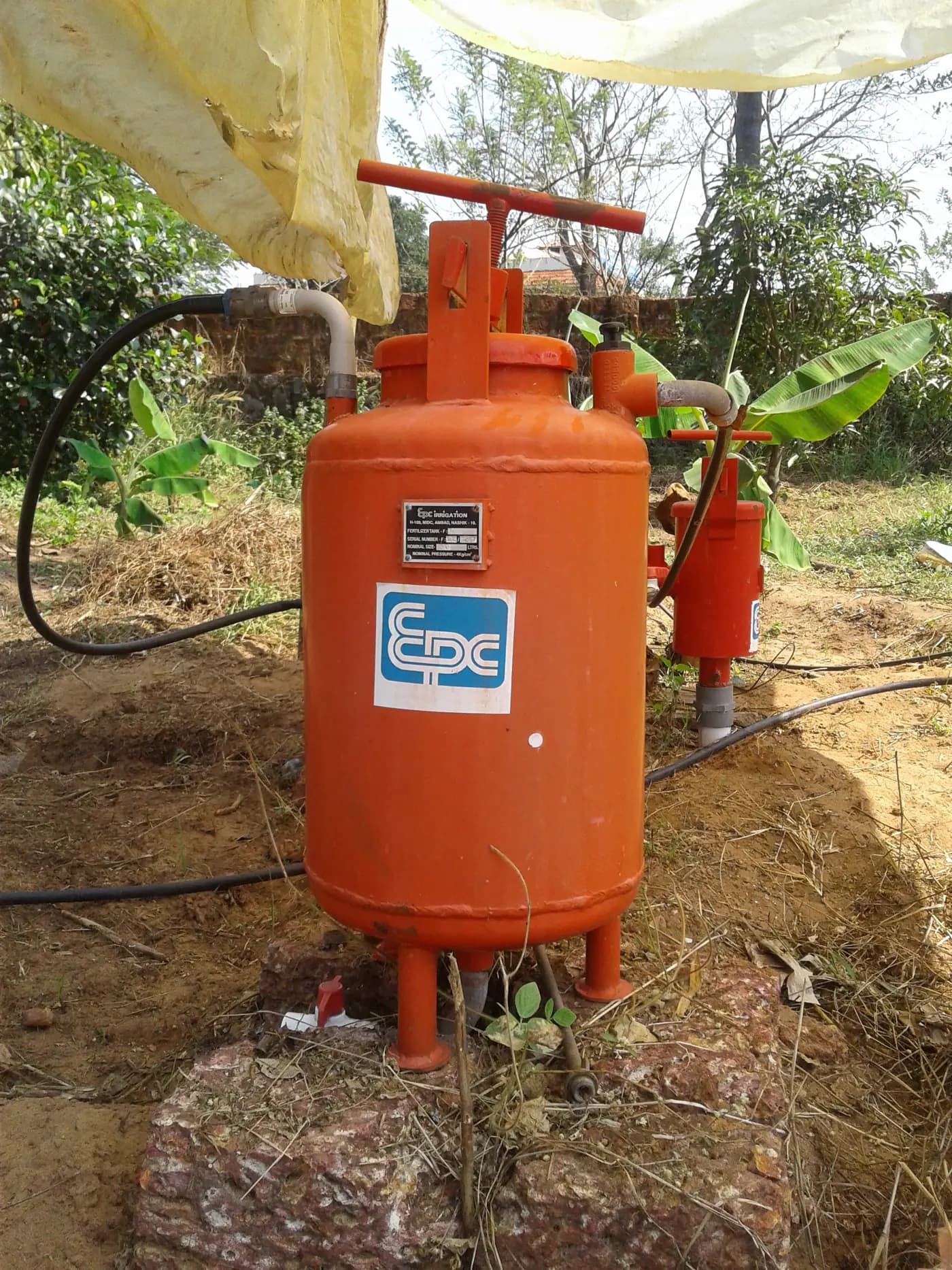
Choose a stable, readable graduated suction vessel with enough clean water for the planned run. Record its graduations and read the same meniscus consistently at eye level. Keep the pickup immersed as the model requires, while preventing the vessel from tipping or the tube from moving during measurement. Do not improvise a reservoir from an unconfirmed pressure-tank product.
Use either an appropriate totalizing meter or a model-approved collection arrangement for the other volume. Complete outlet collection is useful only when it preserves the intended hydraulic condition. Disconnecting a pressurized irrigation network and emptying the injector freely into a bucket can change downstream pressure and the result, especially for a Venturi.
Keep the required filters, valves and source-protection equipment in their operating arrangement. Do not remove a strainer or bypass a protective device to make the test easier. The pressure measurement checklist helps record where readings were taken while water was moving. Include both inlet and outlet readings where the model's test requires them.
Keep priming outside the measured injector interval
Follow the delivered model's instructions to prepare the suction path and remove trapped air. Allow the selected irrigation operating case to settle before taking the starting readings. Water used to fill an empty tube is not automatically water delivered through the injector during the interval you intend to assess.
Keep tube position, immersion depth, vessel elevation and valve positions consistent. Start with enough measurable volume to finish without exposing the pickup. If you must refill or reposition the vessel, do so outside the measurement interval and re-establish the starting conditions. Record the initial reading after that preparation.
Watch for bubbles, leakage, unexpected vessel-level changes or unstable meter readings before beginning. These are reasons to investigate the setup. They do not identify a particular failed seal without further model-specific checks. A short photograph or video of the prepared circuit can make a later support request much clearer.
Capture both volumes within the same start and finish
Record the starting suction-vessel level and the starting totalizer reading, or begin an approved complete collection, at a shared reference time. Where access makes that difficult, use two observers or a recording method that allows the readings to be aligned. Do not use a suction measurement from one run with a convenient meter total from another.
During the interval, maintain the documented operating state. Record elapsed time, active zone, injector setting, pressure observations and any changes. If a zone opens, a valve moves, the pickup admits air or the vessel spills, label the run as interrupted. Its observations may help diagnosis, but the result should not be silently included as a normal trial.
Finish before the suction vessel becomes empty. Establish the ending readings with the same measurement boundary used at the start and follow the approved stopping procedure. Account for any continued suction or collection after the chosen endpoint rather than assigning it to only one side of the ratio. Retain the raw readings before calculating their differences.
Check units and measurement resolution
Convert both volumes to the same unit. For example, 400 mL is 0.40 L; dividing litres by an unconverted millilitre figure introduces a thousandfold error. Write the unit next to every original reading and next to each converted difference. Keep meter multipliers and decimal positions visible on the worksheet.
Make the observed withdrawal large enough to read sensibly with the available graduations, within the model's approved test conditions. If a vessel is marked every 50 mL and the observed drop is only about 50 mL, the reading is coarse. Extending an approved test interval or using a more suitable instrument may improve the evidence; inventing extra decimal places will not.
Elapsed time allows a separate rate calculation: suction volume divided by hours gives L/h. It does not change which volume belongs in the ratio denominator. Keep the rate and the fraction in separate fields. A stable suction rate can still produce a different fraction if the carrier-water flow changes.
Repeat the trial before judging the unit
Repeat the same operating case with fresh starting readings and the same setup. Three trials are a practical example for seeing whether results recur, not a manufacturer-mandated sample size. List every valid run rather than selecting the closest result. Keep interrupted runs identified, together with the reason they were excluded from comparison.
Suppose three hypothetical runs each produce 40.00 L total discharge and draw 0.40, 0.38 and 0.42 L through the suction side. Their total-discharge fractions are 1.00%, 0.95% and 1.05%. The average of those fractions is 1.00%, but it hides the spread. A mean near a target cannot establish repeatability by itself.
Compare the spread and any difference from the documented setting with the exact model's acceptance criteria and the uncertainty of your measurements. This guide supplies no universal tolerance. If the manual gives none, send the results to the supplier for a stated criterion instead of declaring the unit acceptable because the numbers look close.
Keep different operating cases in separate records
A small irrigation group and a larger group may create different flow and pressure conditions. Check only cases confirmed to fall within the supplied unit's operating limits. Use the irrigation-zone planning guide to name the actual combinations. Do not combine their measurements into a single average that conceals a weak case.
For a bypass, distinguish injector-branch behavior from the fraction reaching the combined outlet. A ratio calculated only from branch water is not automatically the ratio in the full irrigation stream. Record the bypass split and measurement positions explicitly. If a suitable full-circuit measurement is unavailable, state that limitation in the test report.
Retest after an authorized adjustment or confirmed repair, using the same recorded method. Avoid raising or lowering a reservoir beyond the instructions simply to achieve a desired number. A result obtained with a different suction lift, outlet restriction or valve state is a different operating case, even if the control marking is unchanged.
Use the record to accept, clarify or service the purchase
Send the supplier the exact model, photographs, circuit sketch, denominator definition, raw start and finish readings, units, duration, pressures and repeated results. Ask whether the unit meets its documented criteria in that case. If a part is required, request a service reference tied to the model and material specification, not a kit selected from visual resemblance.
Confirm the current price, supplied suction components, necessary measurement accessories and delivery terms before ordering a replacement or additional units. Preserve the accepted test sheet with the purchase record. It provides a baseline for a later comparison after cleaning, changing an operating group or replacing a verified component.
A successful water test documents hydraulic uptake under the measured conditions. It does not validate fertilizer mixing, chemical compatibility or nutrient concentration, and another liquid can behave differently. Keep any later preparation and commissioning tied to the exact equipment instructions and the approved crop-input plan. The buying decision is strongest when the measured evidence and its limits travel with the equipment.
Before you order
Compare this guide with the specifications for your exact product, selected option, water supply and field conditions. Your equipment requirements take priority over a general example.
Compare irrigation products