Drip Irrigation Tape: What mil, mm and Roll-Length Labels Mean
Read mil, mm, inch and foot labels as separate wall, diameter, emitter-spacing and roll-length fields before comparing drip tape options.
Published by IrriNex Store
Drip irrigation tape labels can place mil, millimetres, inches and feet beside one another, even though those numbers describe different parts of the roll. A grower comparing an older 8 mil, 5/8-inch, 12-inch-spacing, 1,000-foot carton with a metric product page must first decide which number means wall thickness, nominal diameter, outlet spacing or sale length. Convert a value only after identifying its job and its original unit. Keep the original label beside every conversion so a rounded comparison never becomes an invented exact product match. Keep each original unit beside its converted value; a numerical conversion helps read the label but does not verify the actual tape-to-connector joint. Drip tape wall thickness conversion keeps the original mil or mm label beside its calculated value without establishing connector fit.
This is a purchasing check for a particular labelled roll. It does not set a crop's emitter spacing or promise how many seasons a wall will last. Start by photographing the readable label, carton and selected option. Copy the full description into four separate fields before filling a cart or asking whether an existing fitting can be retained. If one field is absent, mark it unknown. A product picture, a black reel or a shared nominal 16 mm designation cannot fill the gap.
Convert drip tape wall thickness from mil to mm
Wall thickness is the thickness of the plastic tube wall; tape sellers may express it in mil or millimetres. Diameter describes the named size of the line, often while it is inflated or according to a product family's convention. Emitter spacing measures the distance between consecutive built-in outlets. Roll length is the amount of material sold on a reel. Those four dimensions have different units and purposes. None alone supplies outlet discharge, approved working pressure or an allowable uninterrupted lateral length.
Make a small label card with columns for the original wording, the exact unit printed, what is being measured, a converted comparison value and the question still unanswered. A label reading “8 mil” belongs in the wall row, not the diameter row. A label reading “12 in” beside an emitter symbol belongs in the spacing row, not the sale-length row. A “1,000 ft” mark on a box normally describes package length, but verify the seller's wording before treating it as a reel quantity. The tube-family buying guide helps identify whether the material is actually flat tape or round inline pipe.
Also transcribe the manufacturer's name, model, batch or option code when present. Two cartons can share all four visible numbers yet differ in outlet construction, permitted pressure or connector requirements. If the original packaging is lost, do not silently rebuild its specification from a similar-looking online image. Retain a sound sample and the order record, and ask for the exact model documentation. This matters especially when remaining material from different purchases has been wound onto one reel.
Does 5/8-inch tape fit a 16 mm connector?
In a tape wall label, one mil means one thousandth of an inch, not one millimetre. The exact length conversion is 1 mil = 0.001 in = 0.0254 mm. Thus a labelled 6 mil is 0.1524 mm as a mathematical conversion, 8 mil is 0.2032 mm, and 15 mil is 0.381 mm. The NIST conversion table lists the mil-to-millimetre and inch-to-metre factors. These arithmetic results describe the labelled nominal value; they are not measurements of the delivered wall or a tolerance declaration.
Now reverse the comparison for two metric tape options: 0.15 mm ÷ 0.0254 mm/mil ≈ 5.91 mil, while 0.20 mm ÷ 0.0254 mm/mil ≈ 7.87 mil. Those rounded figures help compare scale with a 6 or 8 mil advertisement. They do not change a product labelled 0.15 mm into an exactly 6 mil SKU or 0.20 mm into an exactly 8 mil SKU. The difference between a rounded conversion and a printed specification can matter when a fitting accepts a defined wall range. Obtain that range from the actual fitting instructions.
A thicker nominal wall is one construction difference; it does not supply a universal pressure limit, service life, burial approval or resistance to field damage. Compare the selected maker's stated conditions instead of importing a competitor's season or crop recommendation. If an opened roll feels stiffer, handling and storage may also have affected it. The used-roll check addresses condition and remaining usable lengths; unit conversion does not determine whether recovered tape can return to irrigation.
Do not turn a diameter conversion into fitting approval
For ordinary length conversion, 5/8 in × 25.4 mm/in = 15.875 mm. A metric label of 16 mm is 0.125 mm higher as a nominal numerical comparison. That small difference does not prove the two tapes use the same sizing convention, outside diameter when inflated, internal passage, wall range or acceptable connector. The old part may use a tape-lock geometry unlike a barb intended for round PE tube. Compare the exact mating specifications, not just converted names.
Flat tape poses another trap: its width while empty is not the same thing as the diameter of its circular shape under operating pressure. Do not measure the flat width and enter it as a round outside diameter. If a connection must be selected, record how the tape maker defines nominal size and how the fitting maker defines its receiving range. A fitting photograph may show a ring that appears large enough, but only the exact construction and assembly instructions establish fit. Do not stretch, heat, glue or force a near match to close an unresolved dimensional question.
The retained row-valve fitting guide covers a particular old valve meeting a new tape end. This label worksheet comes earlier: it keeps a “16 mm” or “5/8 in” claim from being mistaken for a verified matched pair. If you are buying both components new, check their exact option records together. If reusing a connection, keep its model and condition in the record as well as the converted tape label. A successful loose hand fit does not establish sealing at the permitted operating condition.
Read emitter spacing as a repeating interval
Spacing tells you how far apart consecutive built-in outlets are along the tape. It is not plant spacing, lateral spacing across the field or the distance from the reel to the first emitter. The label may use inches or centimetres. Twelve inches converts exactly to 30.48 cm; a metric 30 cm option converts to about 11.81 in. They are close enough to compare as sizes but they are not mathematically identical intervals. Keep “12 in” and “30 cm” in their own original-label columns.
Over many outlets, a small difference in interval can change how many emitters a measured crop row contains. End offsets and cut positions also matter, so do not infer an exact outlet count by dividing the sale-roll length by spacing. Measure the intended active row and consult the selected product's outlet pattern. The flow-rate worksheet handles demand once the correct per-emitter discharge and active length are known. This label check does not manufacture a discharge value from spacing.
Spacing may be written as a crop suggestion in a seller's comparison chart. A unit conversion cannot tell whether the chosen interval wets the intended root zone in your soil. Keep soil and crop decisions separate from label arithmetic. Likewise, do not assume that two products with 30 cm labels have the same internal emitter or operating pressure. A whole specification is needed before one roll replaces another in a running block.
Separate package feet from installed metres
For length, one international foot is exactly 0.3048 m, so a 1,000 ft roll contains a labelled 304.8 m, not 1,000 m. A 500 m package is approximately 1,640 ft; 2,000 m is approximately 6,562 ft and 3,000 m approximately 9,843 ft when displayed to whole feet. Show the original units beside these rounded comparison values. A vendor using “1,000” without a unit leaves an order-defining question unanswered; do not resolve it by guessing which unit was meant.
Package length and allowed installed run solve different problems. Several short laterals can be cut from one sale roll, but the roll label does not approve operating all of it as a single line. The accepted lateral length depends on selected emitter discharge, pressure, diameter, friction, elevation and delivery criteria. Count the field's measured cuts and joins separately from the number of whole reels to buy. A metric-to-foot conversion only changes how a length is displayed; it cannot add hydraulic capacity.
For a simple order illustration, suppose a grower needs six independently designed 40 m pieces of one confirmed tape. That is 240 m of intended cut length before tails, losses or a justified reserve. It may fit within a 1,000 ft sale roll on length alone because 304.8 m exceeds 240 m. The example does not approve a 240 m lateral, say that all six pieces will fit without waste, or certify the product choice. Record each actual cut, the sale unit and the selected option before converting the order into a cart quantity.
Compare exact Store options using the same four fields
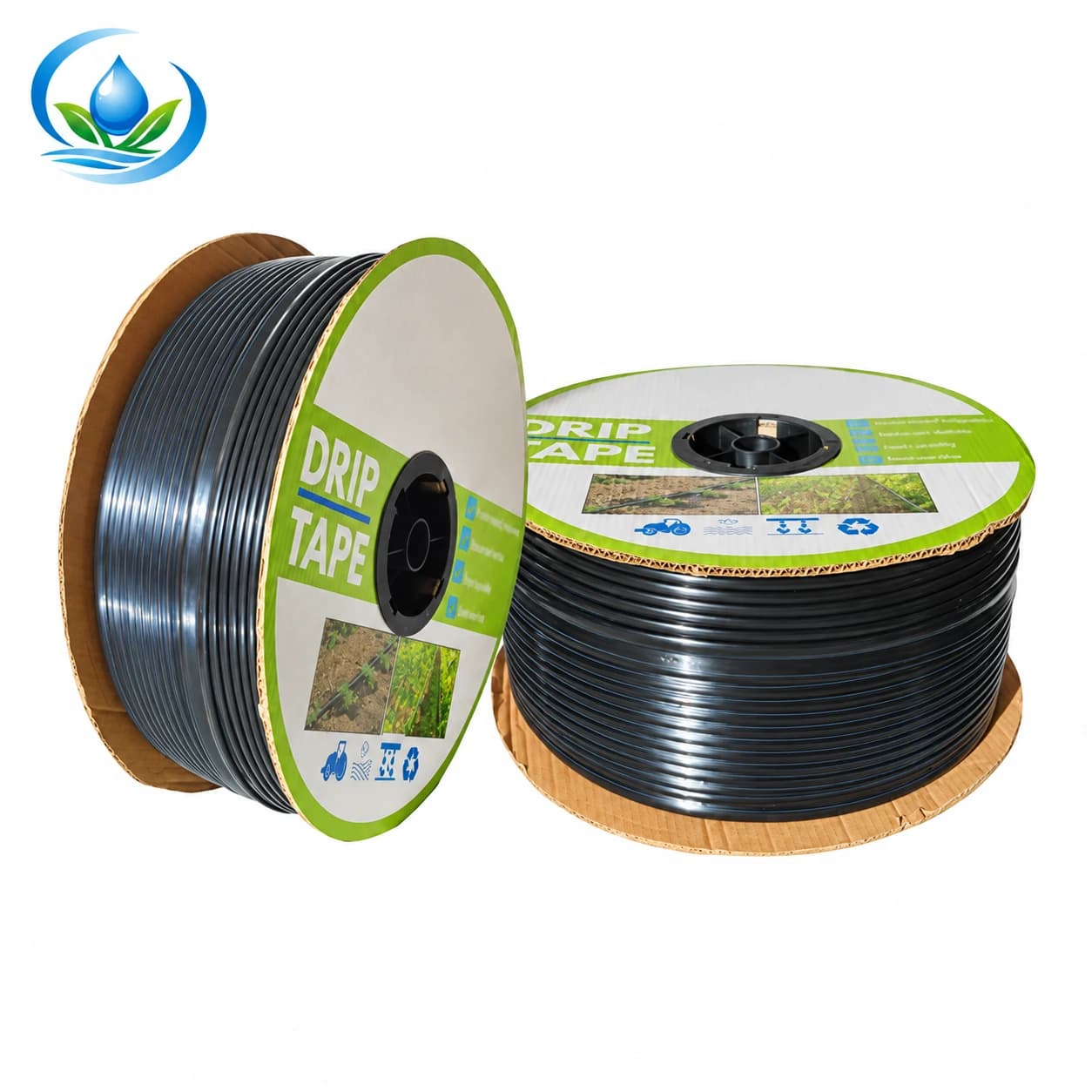
The flat drip tape listing includes option IS-2-4F08BF82DC: nominal 16 mm diameter, 0.15 mm wall, 30 cm outlet spacing and 3,000 m sale roll. Another selected option, IS-2-C526AC2D85, has the same nominal diameter and spacing but a 0.20 mm wall and a 2,000 m roll. Keep the full option code beside each line. The catalogue row does not provide a verified emitter-flow value for either exact flat option, so do not borrow a number from a family range or an inch-labelled competitor.
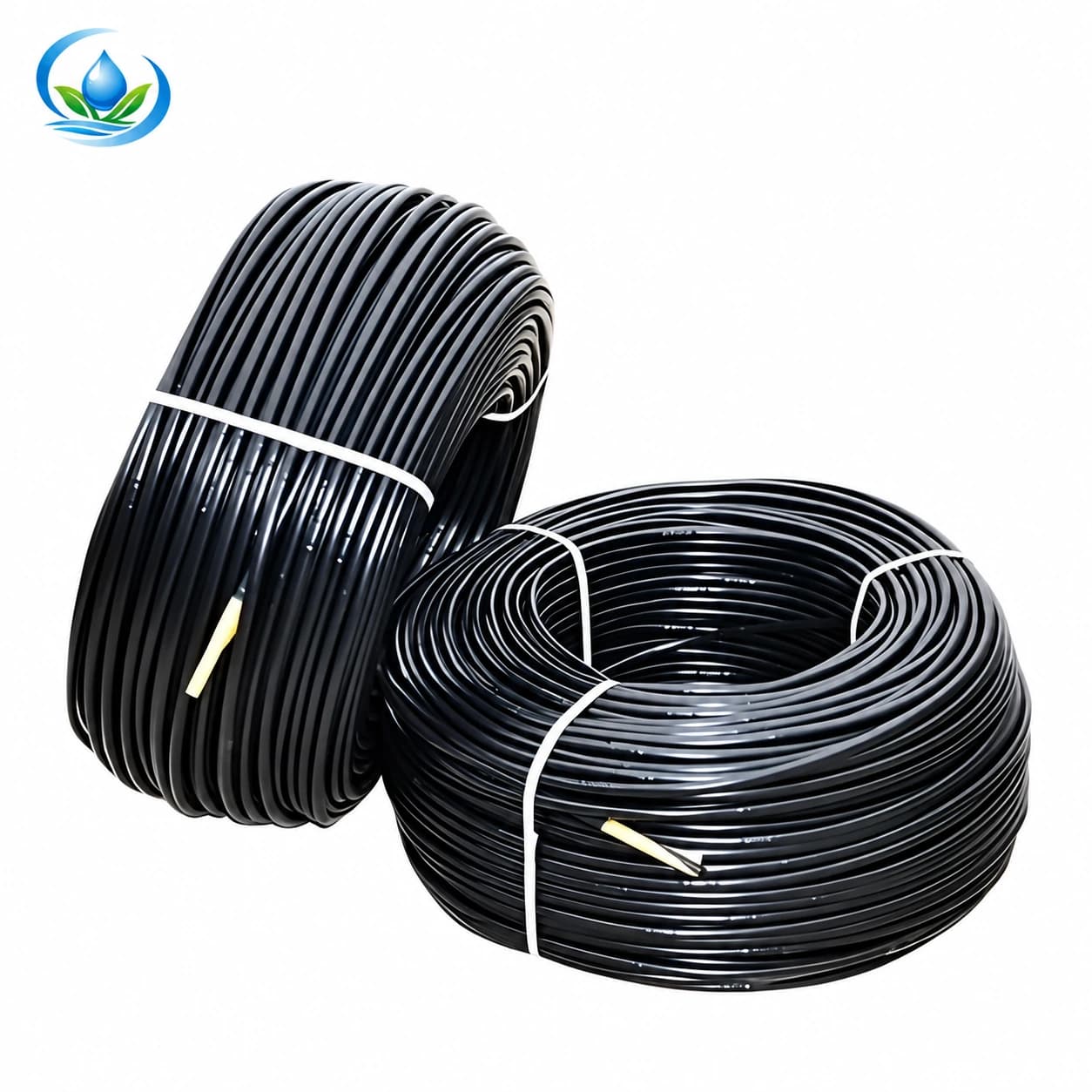
The separate inline drip pipe option IS-3-8CDA6B18CD is a round 16 mm line with a 0.8 mm wall, 30 cm emitter spacing, selected 2 L/h emitter and 500 m roll. It differs from flat tape even though two labels repeat “16 mm” and “30 cm.” Its wall is 0.8 mm, not the legacy 1 mm value from a general description. Tape wall in mil, round-pipe wall in millimetres and a fitting's permitted construction cannot be collapsed into one “16 mm drip line” shopping line.
Write the comparison as original metric labels first, then optional converted reference values: 0.15 mm ≈ 5.91 mil, 0.20 mm ≈ 7.87 mil, 30 cm ≈ 11.81 in. Label the calculated figures “approximately”; keep the original 0.15 and 0.20 mm option identities unchanged. Do not claim a manufacturer tolerance from the number of displayed decimal places. If another seller quotes 6 mil or 8 mil, ask whether the same measurement convention and stated tolerance apply before treating the offers as interchangeable.
Leave flow and pressure questions visible
A flow label may express litres per hour for one emitter, gallons per hour for one emitter, or volume per stated length of tape and time. Copy its numerator, time unit and basis verbatim. “Flow 2” without those details is not comparable with the inline option's 2 L/h emitter choice. A rating per 100 ft already includes the outlets within that length; multiplying it by an outlet count again would double count flow. Where gallons appear, confirm whether the document means US or Imperial gallons before converting.
The flat tape examples above lack a verified per-emitter flow for their exact options. That remains a supplier question before hydraulic sizing. A wall conversion does not provide a pressure rating, and a roll-length conversion does not determine whether the source can run all intended rows. Use the actual model data and operating pressure to compute zone demand in the linked flow guide. Keep any unresolved rating blank instead of filling it with a generic tape recommendation.
Read the selected product's handling, permitted connection and operating instructions alongside its label. The new-roll storage guide helps preserve the original identity before installation, while the row-budget worksheet counts commercial units separately from installed length. Those tasks follow the label audit; neither should start by silently replacing feet with metres or a rounded mil conversion with an exact SKU description.
Finish with a copied-label purchase record
Use one row for each proposed roll: original seller description, model or SKU, wall with its printed unit, named diameter and sizing convention, outlet spacing, outlet discharge basis, roll length, pressure information and the exact fitting to be used. Add a second column for clearly rounded conversions, then mark missing fields. Record whether each value came from the selected product page, original carton or manufacturer instruction. A copied-label sheet can be checked by another person without reconstructing which “16” referred to a diameter and which “8” referred to a wall.
Before ordering, compare the exact selected variant, sale unit, current price, quantity available and delivery details on the product page. Hold an uncertain pairing until the tape and fitting documents confirm their connection range; send the two model identities and the original-unit labels to support for a specific question. If a roll arrives with different units or a different option code, reconcile it against the order before cutting it into rows. The useful result is a transparent comparison in which each conversion is mathematically correct and each remaining compatibility question stays visible.
Before you order
Compare this guide with the specifications for your exact product, selected option, water supply and field conditions. Your equipment requirements take priority over a general example.
Compare irrigation products