Drip Irrigation Emitters: Cleanable Caps Are Not Always Flow Controls
A removable flag cap may provide cleaning access, while an adjustable dripper has a separate operating purpose. Identify the exact model before buying spares.
Published by IrriNex Store

Drip irrigation emitters can have tops that lift, twist or look interchangeable, but those movements do not always control flow. One cap may open a fixed-rate emitter for cleaning; another may be the operator's adjustment control; a third product may rely on a separately coded metering piece. Buying a loose top because it resembles the missing one can change the delivered water or leave an unusable assembly. Identify what the cap does on the exact emitter before ordering a replacement or changing a working row. Keep the body code, cap function and approved spare code together; color or a rotating top cannot identify a suitable replacement. Drip emitter cap replacement starts with the exact body code and the cap's documented function, not its colour or shape.
Imagine a vegetable grower with a tray of unlabelled red tops from a winter service job. Several installed flag-style drippers need cleaning, and a neighbouring nursery row uses adjustable drippers. The temptation is to sort the tops by colour and fit whichever one seats. A better purchase begins with two complete, identified sample emitters and a simple question for each: does moving this part merely allow access for service, does it change the outlet opening in normal operation, or is it a separately specified metering component? The answer determines whether to buy a complete emitter, an approved spare or an adjustable model.
Cleanable emitter cap or adjustable flow control?
Put one removed, correctly labelled example of each installed model beside its original package or order record. Write the complete body code, any code on the cap, the rated variant, the inlet and outlet connection, the permitted operating conditions and the service instruction reference. Photograph the assembled unit and the loose part from both sides. If no code is legible, preserve the entire old unit as a sample instead of naming it from colour alone.
Add a field headed “normal operating control.” For a service cap, the expected position during irrigation is the fully reassembled position specified for that model; opening it is a maintenance action, not a way to choose a halfway flow. For an adjustable dripper, a documented operator control changes the opening during use, but its position still is not a calibrated litres-per-hour reading. For a separate metering insert, the insert's part number and the body it fits are essential; the visible outer cap may only retain or cover that insert.
Keep the questions in that order. First establish whether the part belongs to the complete model. Then establish its function and only then consider a spare. The general emitter buying guide deals with crop demand, nominal discharge, pressure behaviour and zone quantity. This page deals with the narrower identification that prevents a cleanable fixed-flow cap from being purchased as an adjustable control.
Is the loose cap an approved spare for this exact dripper body?
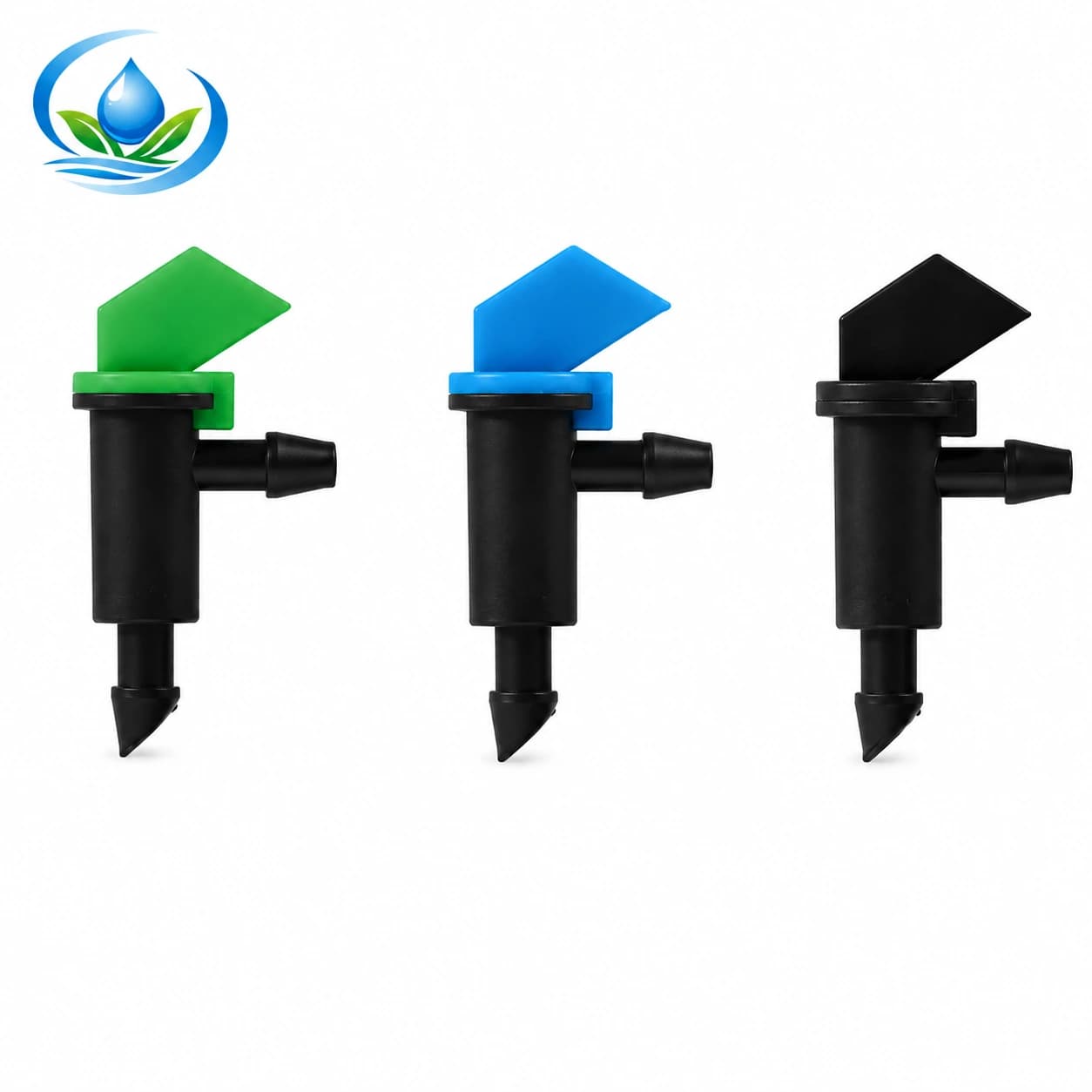
The IrriNex flag dripper has three catalogue codes: FD04 is listed at 4 L/h, FD08 at 8 L/h and FD16 at 16 L/h. Confirm in the exact delivered model’s instructions whether its flag can be removed for service and how it must be reassembled; the current listing identifies rated options without supplying that procedure. These codes identify distinct nominal discharge choices; the flag's removability does not make an FD08 a continuously adjustable 4–16 L/h device. If the irrigation plan needs a different rated output, specify the correct complete variant and review the resulting zone demand.
For a practical order example, suppose an installed row record says FD08 and the grower finds one damaged top. The first task is to verify the body and cap still belong to the FD08 configuration and whether a matching approved top is sold separately. An FD04 or FD16 top from another row is not an established spare merely because its shape appears similar. Even where another manufacturer's flags can be swapped to change flow, that manufacturer's component schedule cannot prove interchangeability for this Store product.
Access for cleaning is useful when a correctly identified outlet contains debris. Follow that exact model's instructions after isolating and relieving pressure on the section. Keep both pieces clean, inspect for damage and reassemble as specified. Do not shave a passage, force an uncertain cap, leave a service top partly seated or run the line open to create a new setting. The question after service is whether the original complete FD variant still performs as required, not whether the loose top can be improvised into another flow code.
If several field emitters have weak output, identify the pattern before disassembling a batch. The uneven-emitter-flow guide separates one restricted outlet from an end-of-line or whole-zone problem. Here the purchase card stays with the particular component: its body, its cap, its rating and its permitted replacement route. A cleanable construction cannot compensate for a blocked filter, wrong operating pressure or a damaged supply tube.
Read each adjustable model's stated range separately
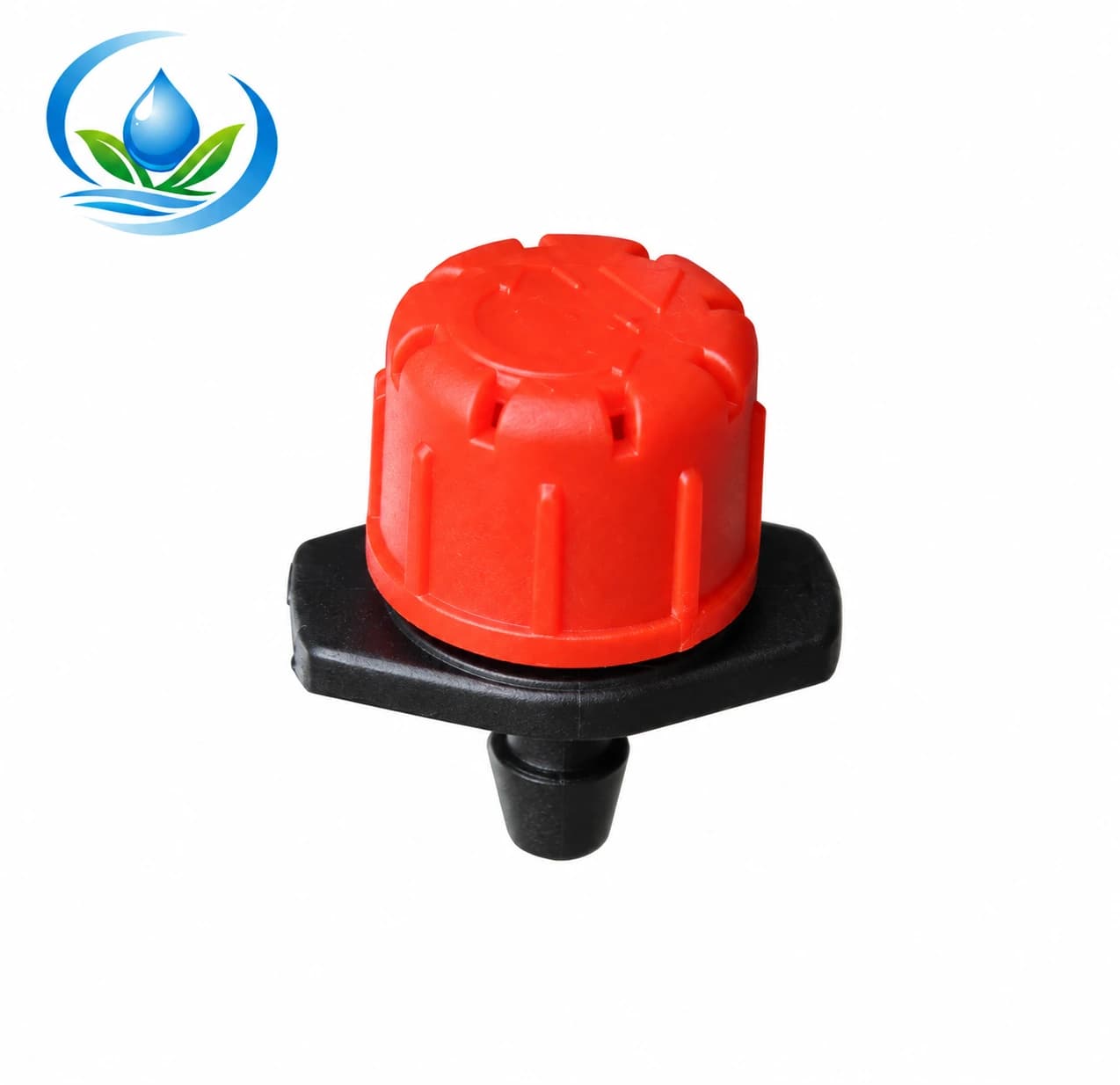
The current IrriNex adjustable dripper page lists AOD0170 in 50, 100, 500 and 1,000 packs, with a catalogue range of 0–70 L/h. The catalogue also records AOD0190 at 4–90 L/h, but AOD0190 is not a selectable option on that current Store page. These ranges belong to separate models; 4–90 L/h does not establish that an installed AOD0190 can be turned completely off at one plant. If replacing AOD0190, confirm an approved current replacement and its connection before ordering AOD0170 packs.
An adjustable control is meant to change an outlet opening within the model's intended use. That is different from opening an FD cap for service where the delivered model's instructions permit it. If an operator needs occasional adjustments between containers, record the current AOD0170 option selected and how its control is meant to be operated. Keep an installed AOD0190 identified as a different model until its replacement is resolved. If the goal is a repeatable fixed output across many identical positions, the FD variants are a different route to evaluate. Neither choice should be made from the shape of a coloured top in a parts bin.
The catalogue ranges do not give a precise flow for each control position, an installed pressure curve or a universal number of turns. A quarter-turn on one unit cannot be written on a box as a verified 20 L/h setting for every other unit. The post-change runtime guide addresses the separate task of checking the delivery and schedule after changing hardware. The present shopping decision is whether the supplied item genuinely has a documented adjustment function at all, and which stated range belongs to it.
Treat an advertised spare insert as model-specific
Some emitter systems have a separately coded internal metering part or replacement cap. If a seller offers one, ask for the exact parent emitter model, flow code, included seal and installation instruction that name the spare. An insert for a different brand or even a different series can fit loosely, restrict the passage or fail to meter as expected. A cap that clicks into place is evidence of mechanical seating, not proof of its operating rating.
For the two IrriNex listings discussed here, no separate cap or insert part number is established in the catalogue evidence used for this comparison. Do not build a shopping list around a hypothetical FD08 replacement flag or an AOD adjustment knob sold alone. Request an identified compatible spare if a separate one is available; otherwise compare the price and availability of the complete selected emitter. Keep any separately supplied part's code next to the complete body code so future repairs do not depend on guesswork.
Imagine an online offer described only as “red 8 L/h replacement cap.” That phrase omits the body model, mating geometry, seal and the conditions under which 8 L/h was rated. A photograph beside your old part may narrow a question, but it cannot close those gaps. Ask support to name the exact matching body and part or choose a complete FD08 whose current listing and delivery can be checked. The cheapest loose cap is poor value if it turns a correctly rated outlet into an unverified mixed assembly.
Keep the water path and fit on the identity card
A compatible cap does not solve an incompatible connection to the crop line. Record whether the installed emitter is inserted directly into a lateral or supplies a small tube to another outlet. Photograph the actual mating points, identify any old adapter and measure the tube's inner and outer dimensions where needed. An apparent 4 mm barb, 4/7 mm tube label and a similarly coloured body do not prove a leak-free combination. The nursery arrow-and-tube guide helps separate the upstream metering emitter from a terminal arrow that merely places the water.
Keep the line location on the card as well. If a flag emitter serves a tree that has been removed, that is a question about the approved outlet arrangement, not a reason to leave its cap loose as a shutoff. The drip-line plug guide distinguishes repairs, end closures and flush access. A cap designed for cleaning cannot be assumed to seal an unused hole or isolate a branch.
For a newly supplied water source or repeated material in service caps, distinguish particles from dissolved water chemistry before buying a filter or a treatment. The water-test guide shows how to read the sample location and results for that separate decision. Neither the current FD and AOD0170 listings nor the separate AOD0190 catalogue entry establishes one universal mesh rating. Obtain the exact emitter's filtration and service instructions rather than transferring a competitor's filter number.
Order complete identities, not a mixed bag of tops
Turn the field count into one line per confirmed configuration. For instance, write “FD08 complete emitter, installed row R3, 18 replacements” rather than “18 red drippers.” Add the number of approved separate service parts only if their exact match is documented. Keep any installed AOD0190 count separate from the current AOD0170 order; their lower limits differ, so one is not an automatic substitute where a plant position must close. Separate installed outlets, replacement stock and trial samples in the quantities.
A short handover can travel with the box: row and position, full emitter code, cap function, spare code if confirmed, inlet and outlet fit, sale unit and any model-specific instructions. The field-crew parts handover guide covers the wider block bundle; the cap-function line keeps the crew from mixing small pieces after packaging is opened. Do not pre-sort unmarked loose caps into flow groups by their colour or by whether they rotate in the hand.
Review the selected product page for its present price, sale unit, available option and delivery route. Where no direct purchase option is shown, ask Store support whether that exact complete variant can be ordered and whether an identified separate part is supplied. Include the photograph of the full old emitter, legible code, intended replacement quantity and any proposed spare number. A useful answer names the parts that fit each other rather than confirming only a broad description such as “flag cap.”
Check one replacement before spreading it across a row
After the chosen parts arrive, compare each label and complete assembly with the purchase card. Use the selected model's service procedure to install a trial unit on an isolated and depressurized section, then restore the normal operating arrangement. Observe the connection and outlet while the planned group runs. The trial asks whether the exact delivered emitter fits, stays assembled and gives the expected output under that row's conditions; it does not treat visible dripping as a measured 4, 8, 16 or adjustable flow.
Keep the old and new units separately labelled until that comparison is complete. If the proposed cap does not belong to the documented body, stop that substitution and obtain the correct part instead of forcing it. If the complete emitter fits but water output remains weak, follow the mapped flow diagnosis rather than ordering more caps. The record should leave the next buyer with a clear distinction: a service top opened for cleaning, an adjustment control used during operation, or a coded insert whose compatibility was specifically documented.
Before you order
Compare this guide with the specifications for your exact product, selected option, water supply and field conditions. Your equipment requirements take priority over a general example.
Compare irrigation products